Judge Kavanaugh …

cbsn-fusion-former-brett-kavanaugh-clerk-katie-wellington-confirmation-hearing-reaction-thumbnail-1650539-640x360Anybody who gets into the fray over Judge Kavanaugh’s confirmation process will immediately be considered either “one of us” or “one of them.” “Us” to some is “those who will stop at nothing to keep this man from becoming a Supreme Court Justice.” “Us” to others is “those who think this man is imminently qualified and should be confirmed.” “Them,” of course, is “anybody who isn’t one of “us.”

Since regardless of whatever else I write at this point, I will be classified by any given reader of this post as either “one of us” or “one of them” and in one of the two camps I just described, I’ll simply express very succinctly my own opinion and then insert verbatim a letter Judge Kavanaugh wrote to Chairman Grassley and Ranking Member Feinstein of the Senate Judiciary Committee about this matter. To any readers who, after reading this post, consider me one of “us,” thanks. To any who, after reading it, consider me one of “them,” thank you for reading it anyway.

How This Looks To Me

You could not find a better example than this whole confirmation process of how polarized our government is — and the way I see it, how polarized our country is. I honestly hope sanity prevails, and this man’s nomination is confirmed. If the accusations about him from 30 years ago are ultimately confirmed to be facts, then there is a process for dealing with that if the facts indicate a need for “dealing with that.” As it sits right now — if for no other reason than the fact that this whole thing arose from something that Senator Feinstein knew about two months ago but chose to go public with only as it was becoming clear that Judge Kavanaugh was about to be confirmed — I’m for having an up or down vote one way or the other, whether he is confirmed or not. Let Senators who vote one way or the other because of their political decision about how their vote may affect them answer later, when the facts are known, for what will ultimately be viewed as either their mistake or their good judgment.

The remainder of this post is Judge Kavanaugh’s letter — nothing else I’ve written. …

Judge Kavanaugh’s Letter

September 24, 2018

Dear Chairman Grassley and Ranking Member Feinstein:

When I testified in front of the Senate three weeks ago, I explained my belief that fair process is foundational to justice and to our democracy.

At that time, I sat before the Senate Judiciary Committee for more than 31 hours and answered questions under oath. I then answered more questions at a confidential session. The following week, I responded to more than 1,200 written questions, more than have been submitted to all previous Supreme Court nominees combined.

Only after that exhaustive process was complete did I learn, through the news media, about a 36-year-old allegation from high school that had been asserted months earlier and withheld from me throughout the hearing process. First it was an anonymous allegation that I categorically and unequivocally denied. Soon after the accuser was identified, I repeated my denial on the record and made clear that I wished to appear before the Committee. I then repeated my denial to Committee investigators—under criminal penalties for false statements. All of the witnesses identified by Dr. Ford as being present at the party she describes are on the record to the Committee saying they have no recollection of any such party happening. I asked to testify before the Committee again under oath as soon as possible, so that both Dr. Ford and I could both be heard. I thank Chairman Grassley for scheduling that hearing for Thursday.

Last night, another false and uncorroborated accusation from 35 years ago was published. Once again, those alleged to have been witnesses to the event deny it ever happened. There is now a frenzy to come up with something—anything—that will block this process and a vote on my confirmation from occurring.

These are smears, pure and simple. And they debase our public discourse. But they are also a threat to any man or woman who wishes to serve our country. Such grotesque and obvious character assassination—if allowed to succeed—will dissuade competent and good people of all political persuasions from service.

As I told the Committee during my hearing, a federal judge must be independent, not swayed by public or political pressure. That is the kind of judge I will always be. I will not be intimidated into withdrawing from this process. The coordinated effort to destroy my good name will not drive me out. The vile threats of violence against my family will not drive me out. The last-minute character assassination will not succeed.

I have devoted my career to serving the public and the cause of justice, and particularly to promoting the equality and dignity of women. Women from every phase of my life have come forward to attest to my character. I am grateful to them. I owe it to them, and to my family, to defend my integrity and my name. I look forward to answering questions from the Senate on Thursday.

Sincerely,
Brett M. Kavanaugh

Thanks for reading this post, and if you regularly follow my Blog, for that, too. Please consider sharing this or other posts with your friends, colleagues and associates.

img_7026 img_3358

Charles M. Jones


I Got ‘Da Powah!

I’m sure my July 22 post What’s More Dangerous Than Fake News? was the reason FaceBook’s stock experienced the worst one-day drop in stock market history just a few days later. Those three days between my post and the historic drop were simply due to the fact that posts usually take exactly that long to peak out on number of readers per day — so by Thursday, enough investors had gotten wind of my infuriation with FaceBook’s censoring of the post of a dear friend of mine to trigger the drop.

I’m sure those of you who know me, quick studies that you are, picked up on the humor in my opening paragraph. Thinking of humor reminds me of the old adage “All work and no play makes Jack [or Charles 😊 ] a dull boy.”  This, in turn, brought to mind that although I inject humorous remarks into my posts now and then, all of them are on what I consider to be serious topics — serious simply because I am passionate in my belief that we are indeed in the midst of a major paradigm shift in this country [and in the world, for that matter,] and I feel almost what you might call a mission to point out the evidence of that shift and enlighten anybody who will listen to me as to what the New Paradigm is shaping up to be.

‘Nuf O’ That — Now For Some More Humor

Now that I have in the preceding paragraph at least injected the obligatory serious note for one of my posts, I’m going to take a break this week and just share some interesting points about FaceBook’s market capitalization plunge [some of which are humorous for me, but not, I’d say, for Mark Zuckerberg.] …

FaceBook lost about $100 billion [that’s a “b”] on Thursday 7/26. Worse, though, is that Mark Zuckerberg’s personal net worth “plummeted” by about $15 billion [yeah, that’s a “b,” too.] And don’t you know, it gets even worse if you can imagine that. … That drop knocked him down two entire notches on Forbes’ list of the richest people on the planet — from 4th to 6th, still behind Amazon CEO Jeff Bezos ($149 billion), Microsoft co-founder Bill Gates ($95 billion), LVMH CEO Bernard Arnault ($84 billion), and now also behind Berkshire Hathaway CEO Warren Buffett ($83 billion) and Amancio Ortega ($72 billion), founder of retailing group Inditex. To add insult to injury, it cost him a top-five position on that list. Poor Mark’s net worth is now a paltry $67 billion [we’re still talking “b’s”, here.] My heart goes out to him. If he’s learned the lesson he needed to learn about value systems and worldview, it’s a shame that this newfound knowledge came at the cost of sending him into poverty.

Now that I’m On A Roll With This Humor …

Heck, I’m going to stay with humor this week and not even try to close this post on a serious note. I love the dry humor of John Kennedy, referring here not to the former President but to the current “Junior” Senator from my home state of Louisiana. I’ll close with some of my favorites from among his quips when responding to questions from the media on issues of the day. …

    • “Facebook is a great company, but it’s no longer a company; it’s a country. That’s how powerful it is. And its behavior lately has kind of been getting into the foothills of creepy.”
    • “I think they’re making a big mistake if they start tacking on extraneous issues to the budget. We have enough trouble doing a budget by itself. We haven’t had one since Moses walked the earth. It’s embarrassing.”
    • “So far there’s been a lot of chopping, but I don’t see any chips flying. And I don’t think that’s going to change.” [referring to the battle du jour over gun control legislation]
    • “I am not. I am petrified of giving the power to confiscate guns and ask questions later to public officials. … If you trust government, you obviously failed history class. The Native Americans gave up their guns, too.” [in response to a question about whether he is “afraid of the NRA”]
    • “We’ve got … some hogs who have all four feet and their snout in the trough. And we’ve got to find out who they are, gentlemen.” [expressing thoughts about Pentagon contractors fleecing taxpayers]
    • “It sounds like she was playing Frisbee in the quad during history class.” [referring to the author of a Washington Post article entitled “It’s time to give Socialism a try”]
    • “As we say in Louisiana, President Trump is a hard dog to keep on the porch. He’s not a porch dog; he’s a running dog. He likes to do things his way.” [speaking of President Trump after the president fired Secretary of State Rex Tillerson]
    • “Our country was founded by geniuses, but it’s being run by idiots. I think most Americans are wondering how some folks up here made it through the birth canal.” [in reference to one of the “budget shutdown” battles]

I’m stopping here not because there aren’t more of these — I could probably have found several times this many with Google’s continued help. I’m just invoking my self-imposed length limit for my blogs.

Well, maybe I unwittingly closed on a serious note after all. Judging from remarks like these, this not-so-Junior-sounding “Junior” Senator’s apparent assessment of the Washington establishment, and his perspective in general, are spot on! This guy’s up there in a class with the likes of Will Rogers and Yogi Berra.

Thanks for reading this post, and if you regularly follow my Blog, for that, too. Please consider sharing this or other posts with your friends, colleagues and associates.

img_7026 img_3358

Charles M. Jones
What’s More Dangerous Than Fake News?

What’s more dangerous than Fake News? The short answer is “Inappropriately Censored Content.” Although I’ll be the first to agree that there’s a lot of content in the media that should be censored, the critical question we need to address is “Who decides what is “inappropriate” or “offensive?” The natural corollary is “On what is that decision based?”

I had planned on a different topic this week, but changed to this topic after reading a blog post by my good friend David Fowler, a former two-term Tennessee Senator who is President of Family Action Council of Tennessee [David’s Profile]. To a non-Tennessean, the post would appear to be about the current Governor’s race here, and it is, but the content is much bigger than Tennessee politics and something I believe everybody in this country needs to understand.

Because of the content and its importance to people like me who share David’s worldview, I was INFURIATED when I read this postscript: “P.S. — Because Facebook has disallowed our attempts to boost the commentaries we’ve posted (not politically correct enough!), in order to reach more people, if you like these thoughts, please consider sharing it on Facebook.“ [this link will take you to this specific post of David’s: The Post Referenced Here].

Who Decides?

My self-imposed length limitations don’t allow capacity here to expound on the actual content of David’s post, but in a nutshell, his basic theme was that the worldview of candidates is probably the best indicator of how effective they will be in the office they seek — and it’s not that difficult to figure out what the worldview of a candidate is. {If you’re a new reader of my posts and want to know more about what I mean by worldview, you can catch up on that at this page at this site: Why I’m Doing What I Do.}

In 1967, Ed Ames recorded a popular song entitled Who Will Answer? The original version in Spanish was written by Luis Eduardo Aute. Ames’ recording was an adapted version in English that contained new lyrics by songwriter Sheila Davis. The chorus raises a good question. …

If the soul is darkened by a fear it cannot name. If the mind is baffled when the rules don’t fit the game. Who will answer? Who will answer? Who will answer?

I use those lyrics here as a segue to pose this question regarding censorship decisions: Who decides? I realize that the views expressed by David Fowler may be “offensive” to someone who does not share his beliefs. But does that justify censoring his posts because he expresses concepts from a perspective rooted in those beliefs? No! I doubt seriously that FaceBook would censor posts by people with more liberal views on factors to be considered in making voting decisions. The company is dominated by liberal thinkers like its founder and CEO, Mark Zuckerberg.

What’s More Dangerous Than Fake News?

As I said earlier, the short answer to the question “What’s more dangerous than Fake News?” is Inappropriately Censored Content. I have written extensively about Fake News, so I won’t get into that here other than just referencing a few examples: News Or NNTN Circa 2017, Fake News Or Just Meaningless News?, Semi-Fake News, and Announcing My New App News4Me.

If content has been censored, somebody has made that decision, and that person has ostensibly made that decision based on one or more criteria for determining the appropriateness of the content. That is why Inappropriately Censored Content is much more dangerous than Fake News. In Fake News, the reader / listener / watcher has the content and can assess for him / herself whether it’s real or fake. If content has been censored, the reader / listener / watcher never even sees or hears it, so he / she has no opportunity to make that assessment. That, in a nutshell, is why Inappropriately Censored Content is the more dangerous of the two — it shifts the decision about “appropriateness” to somebody else.

Thanks for reading this post, and if you regularly follow my Blog, for that, too. Please consider sharing this or other posts with your friends, colleagues and associates.

img_7026 img_3358

Charles M. Jones

Unfortunately, Parties Still Matter

During the two years since I created this website and began posting to this blog, I have been a more frequent tracker of “news” outlets than I was in previous years [these days, I often put the word “news” in quotes because of all the “fake news” I have to sift through to get the news.] I also access more opinion and commentary material — purposely seeking a broad perspective that allows me to understand both sides of issues that are fueling the current highly polarized environment [sometimes, “all sides” would fit better than “both sides.”]

Last weekend, I was intrigued with a column written by a person you might say is [compared with me] on the opposite end of the ideological spectrum. Her name is Saritha Prabhu. Sometimes her weekly column in one of the media sources I track is farther into the weeds than I want to get on some particular issue. In those weeks, I either don’t read it based on the title, or if I begin reading it and quickly see that she’s just one more voice expressing thoughts I’ve already heard a dozen times that week I quit reading or maybe just quickly skim through the rest of it [she’s very astute, in my opinion, and often expresses broader-perspective, above-the-fray concepts, so I wouldn’t want to miss a unique aspect of an in-the-weeds topic she may be focused on that week.]

I thought her 7/8/18 article was excellent — not because I’m a Republican and she’s a Democrat who was airing what she clearly views as “dirty laundry” within her own party, but because she was rising above the trees to see the forest, and expressing very eloquently some serious faults in our current governmental modus operandi that are highly visible in both parties. I firmly believe that if more Conservatives could read articles like hers and not impulsively jump on phrases they could use to put down on Liberals — and if more Liberals could read articles like this one of mine and not impulsively jump on phrases they could use to put down on Conservatives — this country would be much better off.

Just A Few Examples

Before I move on to the “bottom line” of what I’m trying to communicate in this post, let me just share some phrases from her article as examples of why I found it so impressive [try to ignore Democrat / Liberal / Left and Republican / Conservative / Right thinking and read this without any of those biases]. …

“To many of my long-time progressive readers, I’ve suddenly become an elephant in donkey’s clothing. …The 2016 election was an eyeopener for me. … It was the year I recognized that our two political parties have become dinosaurs, ossified beyond recognition. Yes, there’s grassroots energy in the Democratic party, but party leadership is essentially bereft of ideas. … Sixty-three million voters — including millions of African-Americans, Hispanics and Democrats — rejected status quo politics and voted in a strong, rank outsider to shake the establishment from their comfortable perches. Would Trump’s supporters have preferred a decent, moral, well-behaved, well-informed populist? Sure, but in dire times, you take the populist who shows up because beggars can’t be choosers. … I’m no Trump supporter, but I’ve been horrified and repulsed by the political and cultural left’s hatred, demonization and mistreatment toward President Trump, his family, his administration officials and his voters, which is even worse (if that’s possible) than what the right did to President Obama.”

Why Are You A … Republican? … Democrat? … Independent? … Member Of Some Other Party?

The reason that my answer to that question is “Republican” is not that I’m a dyed-in-the-wool Republican who believes every plank in his party’s platform is exactly the “right” plank. My reason is simply that if I want to be able to fully participate in elections and maximize the effectiveness of my vote in all elections, I have to be either a Republican or a Democrat in what is unfortunately still the Current Paradigm [a New Paradigm is taking over at a rapidly-accelerating pace, but decisions today have to be made based on where we are, not where we’re going.] Any other choice limits my ability to vote in primary elections, making me unable to influence which candidates in the general election will be the “least despicable” if that is the choice that is shaping up [which was the case in 2016 — see my 10/16/16 post Mirror, Mirror, On The Wall, … as just one example of many posts I wrote expressing this thought prior to the election; as for more on the Paradigm Shift, you could go to many of my blog posts, but a good starting point would be the A Major Paradigm Shift Well Underway page at this site.]

Given that restraint, if I look at the platform planks of those two parties and start putting checkmarks by the planks that best fit my worldview and ideological / philosophical mindset and Xs by planks with which I literally cannot identify, I end up with more checkmarks by Republican planks than by Democrat planks and more Xs by Democrat planks than Republican planks — ergo, I’m a Republican. However, I could actually paraphrase some of Ms. Prabhu’s remarks, tailored to my party rather than hers, and come up with a similarly scathing indictment against the Republican Party. …

“Our two political parties have become dinosaurs, ossified beyond recognition. Yes, there’s grassroots energy in the Republican party, but party leadership is essentially bereft of ideas [on which they can agree even among themselves]. … I’m [not a supporter of President Trump as a person, but I’m supportive of what he has accomplished and is trying to accomplish — and] I’ve been horrified and repulsed by the political and cultural left’s hatred, demonization and mistreatment toward [him,] his family, his administration officials and his voters, which is [much] worse … than what the right did to President Obama.”

Come, Let Us Reason Together …

As I began wrapping this post up, my 12/13/17 post I’m With Eliza Doolittle came to mind. In it, I referred to Eliza’s [played by Audrey Hepburn] wistful song Wouldn’t It Be Lovely in the 1964 musical My Fair Lady as a way to say how great it would be if our government could actually function as it was designed to function. Alas, though, that would require a departure from the herd mentality exhibited in both parties and a “Come, let us reason together” mindset. What neither party seems to realize is that by continuing on the loggerheads path they are both following, they are accelerating the Paradigm Shift that will ultimately result in their becoming irrelevant.

[Note: If you’d like to read the article by Ms. Prabhu that I quoted in this post, you can access it at this link: The Democratic Party left me — and I’m not alone]

Thanks for reading this post, and if you regularly follow my Blog, for that, too. Please consider sharing this or other posts with your friends, colleagues and associates.

img_7026 Charles M Jones

Charles M. Jones

The Power Of The Media — Part 2

I titled this post as Part 2 of another post just a few weeks ago [The Power Of The Media – Part 1 (renamed “”Part 1” after this post)] because I am feeling more and more every day that the media is a big problem that is at the root of much of the polarized, controversial atmosphere in which we find ourselves today. I referred in that post to several past posts I’ve written about the media here in the United States [e.g., News Or NNTN Circa 2017, Fake News Or Just Meaningless News?, Semi-Fake News, Announcing My New App News4Me]. That Part 1 post was focused more on the power of the media, and it’s on that theme I’ll pick up here.

From A Distance …

One of my favorite songs is From A Distance, written in 1987 by Julie Gold, the most popular rendition of which is Bette Midler’s 1990 recording. Consider these excerpts from the lyrics:

“From a distance, the world looks blue and green, and the snow capped mountains white. From a distance, the ocean meets the stream, and the eagle takes to flight. … From a distance, you look like my friend, even though we are at war. From a distance, I just cannot comprehend what all this fighting is for. From a distance, there is harmony, and it echoes through the land.”

I’m a big science fiction fan — the “classy” kind like Star Trek and Star Wars. The visual image From A Distance creates in my mind is similar to the image of a planet that is formed in the minds the crew of an approaching spaceship — i.e., “from a distance,” the planet is peaceful and tranquil, or maybe it’s undergoing massive seismic disturbances, or perhaps its inhabitants are engaged in a raging global war.

Picking up on that analogy, let’s imagine that we are in a plane flying low enough to make mountains, rivers, fields, cities, houses and buildings visible — and people, too, but not low enough to distinguish individual people and see what they are doing in detail. On any given day, we would no doubt view the United States as peaceful and tranquil — farmers tending their farms, people in cities going to work and coming home, people enjoying vacations, etc. … Even on a day like Saturday June 30, when “hundreds of thousands” of people at 750 different locations across America are marching and rallying in protest of immigration policies, from our vantage point that is only about one tenth of one percent of the population, so it doesn’t affect our overall impression of the country.

But The Media’s Magnifying Glass …

I mentioned in a February 2017 post that 90 percent of U.S. media is controlled by six corporations [re: Fake News Or Just Meaningless News?] — so we can logically assume that they are driven by at least two factors that bring into question their objectivity: 1) their responsibility to their shareholders to maximize profits; and 2) the worldview of their top leadership [i.e., the context within which these leaders make decisions about what does and does not make it into their publications and broadcasts.]

What that means vis-a-vis the subject of this post is that if the media has an agenda that would be bolstered by magnified visibility of what 0.1% of the population is doing on a given day [which in this case I believe they do], it will provide that magnified visibility — by 24/7 coverage instead of just one-of-many-items coverage, and by providing more free air time to politicians with like agendas than to less ideologically-aligned politicians.

I should point out that my reference to “0.1% of the population” is apparently a generous estimate based on less “splashy” news coverage two days later. “Hundreds of thousands” — specifically, somewhere in the 300,000 to 350,000 range — would be “about 0.1% of the population.” In a USA Today article two days later, the phrase used was “tens of thousands.” When you Google “total number of people in immigration protests,” you get lots of hits, but if you click on links to articles 6/30/18 or later by major media outlets you don’t find much in the way of specific post-event estimates. The phrase “hundreds of thousands” usually appears in articles before or on 6/30/18 about the size of crowds expected. So … if the actual number was even half that [150,000 — 175,000], I should have used 0.05% [5 one-hundredths of 1%.]

Another thing to factor into my point here is the fact that any kind of scheduled protest that catches this level of visibility requires a huge logistical effort. Does anyone really think these are all just spontaneous events, just thousands of concerned citizens banding together under no overall direction from organizers and financiers? Read the details within articles and you’ll find that the organizations that provided that direction and financing in the June 30 protests are the same ones involved in all “demonstrations and protests du jour” with one common theme that is congruous with “the Resistance” [politicians, many media outlets, celebrities, etc., who generally oppose anything being done by the current Administration.]

Produces The Image

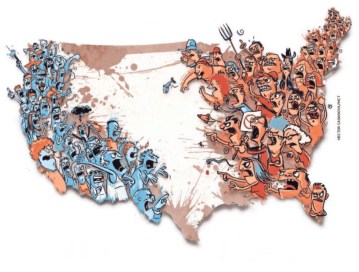
In the spirit of the old adage “One picture is worth a thousand words,” I’ll just point out that the cartoon I chose as the lead graphic for this post summarizes pretty well the image of the United States one might draw if he/she simply used the media — rather than the high-altitude flyover I mentioned above — as the mechanism for forming that image. Had headlines like “One tenth of one percent of the U.S. population took part today in demonstrations against the administration’s zero-tolerance border control policy” simply been one item among many in the media on June 30, the cartoonist’s image probably would have been much different.

What was in the media, though? — Headlines like “Hundreds of thousands all across America took part today in demonstrations against President Trump’s zero-tolerance border control policy, accompanied by 24-hour “on the scene” coverage that reduced almost all other news to brief mention at best, or no coverage at all at worst.

This is about as stark an example of the power of the media as you can find. My takeaway: never assume that what you see emphasized in the media on any given day is an accurate portrayal of how this country would be viewed that day by the crew of a plane flying high enough to see the bigger picture.

Thanks for reading this post, and if you regularly follow my Blog, for that, too. Please consider sharing this or other posts with your friends, colleagues and associates.

img_7026 Charles M Jones

Charles M. Jones

The Red Hen, Sarah, Maxine et al

Anybody who’d suggest that the USA may not be as far from anarchy as most of us think would be labeled as one of “those people” by the mainstream media — “those people” being lunatics, heretics, prophets of doom, unenlightened, … etc. Any sensible person knows that a country as sophisticated as we are could never devolve to the kinds of situations we see in “countries like that” — right? I’d certainly like to believe that.

OK, Maybe I’m One Of “Those People”

Just pause for a moment, back away from the din of day-to-day media coverage of Sarah Huckabee Sanders’ ejection from the Red Hen restaurant in Lexington, Virginia, and think about it in context with several other fairly recent events [I referred to some of these in two of my posts about a year ago and one just a couple of months ago — Enough Already, Are There Any Limits On Anything Any More?] and A Bridge Too Far

    • The rising frequency and severity of mass killings [re: my post Mass Murders Accelerating]
    • The attack on a Congressional baseball practice field that seriously wounded Congressman Steve Scalise
    • Others mentioned in the above-referenced posts — extremely foul and vicious remarks by people like Stephen Colbert, Kathy Lee Griffin [after her “decapitated Trump” Tweet], Madonna Ciccone, Ashley Judd, Michelle Wolf, et al.

The Coup De Grâce

Firmly solidifying her status as the Democrats’ most embarrassingly dense Representative, Maxine Waters — speaking to the apparently minute number of people who care what she thinks — came out with this challenge during all the flareup over Ms. Sanders’ ejection from the restaurant: “If you think we’re rallying now you ain’t seen nothing yet. If you see anybody from that (Trump) Cabinet in a restaurant, in a department store, at a gasoline station, you get out and you create a crowd and you push back on them, and you tell them they’re not welcome anymore, anywhere.”

Think about that. … An elected member of our Legislature actively trying to incite people to “create crowds” and heckle anybody in the Trump administration wherever they see them! Even worse, instead of her entire party soundly rebuking her for those remarks, some key Democrats actually made supportive comments about them and attempted to put a “Well, Trump set this kind of tone; what do you expect?” spin on them.

Surely, this was the coup de grâce, the final blow to sensibility in our government.

How Much Worse Can It Get?

Unfortunately, a lot.  Just today, I read two articles [in “mainstream” media — not far out “rags”] that discussed the very real possibility that this country may actually be headed toward another civil war!  Much of the rationale in those articles was similar to mine in this post.

More likely than civil war, though, is increasing chaos and the unfortunate end of such an environment [read on … .]  An increasing percentage of U.S. citizens has a humanism/naturalism worldview [as opposed to a theistic worldview]. I have written extensively about the difference, enough to make this post far too long if I repeated even a fraction of that text here [this page link on this site will give you the essentials: Why I’m Doing What I Do]. My reason for bringing worldview into the subject at hand is simply that in a society in which there is no absolute standard, there is no standard.

In that kind of environment, each person adopts his/her own set of standards — so on any given day, somebody is going to say or do something that somebody else will say is “wrong.” I’ve also said before that we have too many people in this country with too much time on their hands. Those people, fueled by [and organized and funded by] numerous “organizations with a cause,” are the ones you see in most demonstrations against whoever is the culprit in the wrong du jour.

To extrapolate the current environment of partial chaos in this country to complete chaos — i.e., anarchy — is not as big a stretch as most of us think it is. And if we look at history, what follows chaos? Totalitarianism. Which faction of our government is best poised to swoop in and save us from total chaos? I’ll close with a hint. The poster child of that faction came very close to becoming the Presidential nominee of one of the two major parties in 2016, and another very visible and outspoken face of that faction [who can play the woman card if the party decides that would be advantageous] is at least mentioned as a potential Presidential candidate in 2020.

Personally, I think the Republicans should pray that Maxine Waters [who is not the woman I was referring to in the preceding paragraph] ends up being the Democrats’ 2020 nominee. That would no doubt result in her rising to #1 on the list of worst defeats in history, displacing James Cox, who lost to Warren Harding in 1920 by a margin of 26.17% [I looked it up — I would have guessed George McGovern, Walter Mondale or Barry Goldwater, but their loss margins, though all huge, were a little less: 23.5%, 18.21%, and 22.58%, respectively.😊 ]

Thanks for reading this post, and if you regularly follow my Blog, for that, too. Please consider sharing this or other posts with your friends, colleagues and associates.

img_7026 Charles M Jones

Charles M. Jones

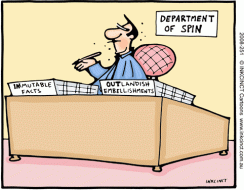
Political Spin 101

As I’ve read, listened to, and watched the “news” coverage this week about two issues, it has become glaringly apparent to me that who best recognizes “spin” opportunities and capitalizes on them is the winner in any particular “news” cycle.

The “Issue”

Let’s take a look at two high-visibility items from the last week or so — new border control enforcement policies and the 568-page Inspector General’s report about the conduct of the FBI and James Comey during an investigation into Hillary Clinton’s emails. As usual, the real issues never get widespread coverage in the media — people on the Left [and media outlets on “their side”] extract or formulate bullet points that support the conclusions they feel should be drawn, and people on the Right [and media outlets on “their side”] extract or formulate bullet points that support the conclusions they feel should be drawn. Regardless of the subject matter, the two sets of bullet points are always diametrical opposites.

Recognizing The Spin Opportunity

What I just described is a classic spin opportunity. They are always present, and each “side” is constantly on the lookout for the Mother Lode — the “issue” that can quickly gain traction and almost instantaneously “go viral.” Two spin opportunities in this past week have clearly been front-runners [those mentioned above], but the one that emerged as the Mother Lode was clearly the new border control enforcement policies.

Before going on, let me say that I think this whole matter was handled poorly, and I’m as much opposed as anybody to doing things that make children feel unsafe or insecure — for any reason. I should also “disclose,” however, that I fall into the camp of people who believe we need much better capabilities not only to do everything possible to eliminate illegal immigration, but also to shore up our processes for admitting legal immigrants.

Capitalizing On The Opportunity [AKA Winning The Spin Game]

Once either party has correctly identified a spin opportunity, the question becomes “How do we capitalize on this opportunity?” Let’s take a look at the winning “issue” — new border control enforcement policies —to see how cleverly this was done in that case.

What are the actual facts? … All the Administration has done recently is begin enforcing existing laws that have been on the books since the 1990s — developed under both Democrat and Republican administrations, many with bipartisan support. You have to do two things to ferret out why things suddenly seem so “different” and “inhumane”: 1) get into the weeds of exactly how those laws are worded; and 2) become personally familiar with how those laws are being [yes, are being, not could be] twisted by people like drug smugglers, people involved in human trafficking, people who make good money getting people into the country illegally, … and potentially, terrorists. Of course, 99.9% of the population will never do either of these things.

To get into a full-blown exposé on these two points is far beyond the scope of this or any of my blog posts. Let me just step one foot into the weeds of the laws. Minors cannot be detained in the same detention facilities in which adults are detained. There is a 20-day limit on the amount of time minors can be kept in custody until their cases can be adjudicated, which is far more time than is needed in almost all cases where adults who have children with them are caught entering the country illegally. There are also provisions for special handling of situations in which the adult involved is asking for asylum [e.g., because of persecution in their home country], and for good reasons adjudication of these situations often requires much more time — often considerably more than 20 days.

Again, going through a full exposé on this is beyond the scope of this blog [these are just two details out of hundreds], but if you just think about these two things, and keep them in mind when you watch / listen to / read “news” stories about this, it’s not hard to figure out how 1) malevolent players could manipulate these two laws and 2) scenes of children being separated from parents by agents who are following the law can show up and “go viral.”

What was the Democrat spin strategy? … The Democrat spin strategy in this situation was a no-brainer. Any dummy could have developed and managed it. Simply get video clips that can be captioned “babies being ripped from the arms of their mothers” and perform routine social media procedures for making any particular thing “go viral.” Capitalize on every opportunity for media interviews to say how shameful it is for this heartless administration to do this to children. Send key Democrats to border counties to make speeches and produce clips for the upcoming campaign. … etc.

What was the Republican spin strategy? … The Republican strategy was to bring visibility to the simple fact that our existing immigration laws are far out of date and need to be overhauled — and the equally-at-fault Democrats who caused this dilemma need to come to the table and work with us to get this fixed.

Who Blinks First?

Which strategy “won” [and why]? … Although probably well-intentioned, and generally more factually correct, the Republican strategy started off on the wrong foot because pictures and video clips like those described above constantly flashing across TV screens achieved Mother Lode status and tended to drown out almost all other “news.” It actually doesn’t matter what the facts are because of what I mentioned earlier: 99.9% of the population will never get into this much detail; they’ll simply go with whatever spin strategy is winning.

It’s possible that the Republican spin strategy [“Let’s fix this together while fixing the bigger immigration problem]” could have turned more positive and overcome the Democrat spin strategy [“Shame on you! Quit breaking up these poor families! Have a heart! This is not American!]” I wasn’t among those betting on that one, though.

I do, however, agree with what I’ve heard at least two “panel experts” say in the last 24 hours — that although “Schumer, Pelosi and Company” appear to have “won” in the short term, it is quite possible that they shot themselves in the foot in doing so. That’s another thing beyond the scope of this blog post, but I’m considering it for a future post. As a “teaser” here, though, I’ll simply say that this whole circus was never about “the children,” “families,” or “American values” like compassion — it was about politicians in BOTH parties focused on the upcoming mid-term elections.

Diversion Tactic

There’s something more fundamental going on in situations like this one. Despite his image problems [which he is not the first president to have], President Trump has done two things very successfully: 1) he’s shaken up the “status quo” and caused people in all parties and all countries to think outside of their boxes; and 2) he has taken bold, decisive steps on practically every front [rather than following in the footsteps of almost all — but not all — of his predecessors: throw out small “test balloons” and then gradually turn up the volume if nothing embarrassing happens.]

If he/she so chooses, one could look at this latest Mother Lode spin opportunity [the immigration “issue]” in the context of timing — i.e., amidst several news items about good things going on in America, and the increasing volume of positive statistics that outline a much improved situation — and conclude that any Mother Lode spin opportunity is always needed to divert the public’s attention from positives to negatives.

Thanks for reading this post, and if you regularly follow my Blog, for that, too. Please consider sharing this or other posts with your friends, colleagues and associates.

img_7026 Charles M Jones

Charles M. Jones

The Power Of The Media – Part 1

IMG_0072.png

In the past several days, it’s been difficult to find media coverage of any topic other than the Trump-Kim summit meeting in Singapore. Even articles and broadcasts not directly reporting on the event itself have often been on peripheral topics about one of the two leaders or one of the two countries. One such article that caught my attention at first did so because its catchy title made it seem like a good human interest perspective: North Koreans flipping over first taste of hamburgers [Link to The Article]. It was indeed that — a good human interest perspective — but some of its content actually gave me some interesting insight into the power of the media.

More Power Than We Realize?

Because I believe it’s a big problem that is at the root of much of the polarized, controversial atmosphere in which we find ourselves today, I’ve written quite extensively about the media here in the United States [e.g., News Or NNTN Circa 2017, Fake News Or Just Meaningless News?, Semi-Fake News, Announcing My New App News4Me]. This post is more focused on the power of the media, with content stemming from a seemingly innocuous and light-hearted article about hamburgers.

There’s a technique I use often when I’m trying to better understand controversy over an issue, and to gain a better understanding of the sources of disagreement. During my career, I used it with clients in my consulting days and in my interactions with people in organizations I worked for and in businesses I ran. The technique is to try and envision a spectrum, with the most extreme defining points imaginable at each end of the spectrum. For most issues, it is extremely unlikely that all people will flock to one extreme end of that spectrum or the other — almost without exception, opinions will distribute more evenly throughout it. That way of visualizing an issue can be very useful in helping people find common ground — which in turn can form a basis for compromise.

For example, the extreme ends of the spectrum on gun control might be “There is no reason for anybody in America to own a gun” on one end and “The First Amendment gives every American the right to own any number and type of guns he/she may desire to own” on the other. Very few if any uber-liberals would completely align with the former “pole” and very few if any uber-conservatives would completely align with the latter.

In applying that concept to my “revelation” as I read the hamburger article, these quotes by the owner of the restaurant were informative:

“The overwhelming majority of North Koreans had absolutely no idea what a hamburger was. … In fact, they didn’t even have a word for the all-American food because the English language is banned in North Korea.”

“(Customers) found it very interesting, different. They had never seen burgers and French fries before, never had cola. Even paper cups with plastic lids were new. It was a totally different experience for them.”

Think about that for a moment. When the information people are allowed to see is completely controlled by a person, a company, a group of companies, or even by their own government, complete detachment from reality can be the result. When this environment prevails through multiple generations — as it has in North Korea — the citizenry becomes so far removed from reality that exposure to it can be a shocking experience.

Back To The Future — 380 B.C.

Actually, Plato described this phenomenon about 2,400 years ago in The Allegory of the Cave in his Republic. …

The Allegory Of The Cave describes an environment in which three prisoners are tied to some rocks, their arms and legs bound and their heads tied so that they cannot look at anything but the stone wall in front of them. They have been there since birth and have never seen anything outside of the cave. Behind them is a fire, and between them is a raised walkway. People outside the cave walk along this walkway carrying things on their heads [animals, plants, wood and stone,] so the prisoners never see anything but the shadows on the wall. In his dialog with Socrates, Plato postulates that since the prisoners had never seen the real objects, they would believe that the shadows of the objects were “real.”

The alarming part I would note here — maybe a caveat we should consider — is that a prisoner who escaped and saw “reality” was received with fear by those he came back to so he could share his “enlightenment.” It was easier for them to rationalize their “reality” than to face the fact that “reality” was outside their “Universe.”

Where Are We?

So, the environment in North Korea would clearly define one end of a spectrum on freedom of the press: “Total governmental control, allowing the citizenry exposure only to government-censored or even government-produced content.” The other end of this spectrum would be something like “No bounds on what anybody wishes to say or write, even if it unjustifiably affects others negatively.” 

Think about these two extremes. In America, we are clearly not at either of the “poles.” If we were closer to [but not at] the North Korea “pole,” most of the media would be scrambling for content to fill their publications and broadcasts because half of what we get now is “he said / she said” analysis — endless panels analyzing the latest remarks some public figure has made, what they imply about the person, what larger issues they raise, whether libel is a possibility, whether the remarks themselves are a basis for prosecution of an implied crime the person making them may have committed, etc. If we were closer to the other “pole,” what we see now would be an even more chaotic sea of noise than it is.

Could It Be? …

It may seem ridiculous to even suggest that America could become such a controlled-media environment. Think about it, though, in context with this post and with some insidious and concerning recent revelations about goings-on in Social Media [inappropriate censoring practices driving agendas of company executives, inadequate ability to screen out outright hacks designed specifically to control what unsuspecting citizens see, etc.]  Spotting North-Korea-style controlled media is easy. Spotting more insidious content control isn’t. Questions worth pondering are “Which type is worse?” and “Does the latter type ultimately lead to the former?”

Thanks for reading this post, and if you regularly follow my Blog, for that, too. Please consider sharing this or other posts with your friends, colleagues and associates.

img_7026 img_3358

Charles M. Jones

An Underreported Factor


In a post shortly after the 2/14/18 mass shooting at Marjory Stoneman Douglas high school near Miami [Post-Killings Bandwagons], I posed a question that an article I read this week prompted me to delve into in more depth. For context, I’ll repeat my opening remarks in that post:

Not surprisingly, the tragic shooting in a Florida high school on February 14 brought out the usual political atmosphere — each party rolling out its bandwagon to rally their faithful around “what to do”, with their respective media adherents being the first to jump on. As usual after tragedies like this, the “do something” options put before us after this one were painted by politicians as binary — i.e., get on our bandwagon or theirs.

The Democrat bandwagon is always tighter gun control laws. The Republican bandwagon is better processes for dealing with mental health issues. Both sides stress why their approach is best, and both sides quote those parts of statistics and research that support their mantra and discredit that of the other side. This goes on until the media outlets sense that coverage of the most recent tragedy is no longer attracting readers / listeners / viewers, coverage fades, and that tragedy just moves into the statistics bank.

In the rest of that post, I posed the question I mentioned above — Why just two bandwagons? — expanding it to ask What potential culprits are there that nobody ever brings up in these flurries of activity after another attack because they already have their canned bandwagon rhetoric ready to pull out and set in motion? I proceeded to elaborate on at least one — the “dark side” of technology, particularly video games. I said then “or at least many of them.” Well, that brings me to the article I read this week — I think I should have said “or certainly most of them.”. …

Shouldn’t We At Least Consider This Potential Culprit?

Get this. … All of the top five video games in the past year have a basic theme of fighting and combat: Activision, Blizzard’s Hearthstone and Overwatch, Tencent’s League of Legends, Epic Games’ Fortnite, and PUBG Corporation’s PlayerUnknown’s Battlegrounds.

Now consider those facts in context with the two cartoons I chose as the images for this post [for added perspective, a review of my post Mass Murders Accelerating would also be worthwhile in emphasizing the point I’m making here.]

So what is that point? Just for more emphasis, here are a few more statistics that — at least for me — help build a case for it [i.e., for the point.] Worldwide gaming industry revenue as of April 2018 was $127.9 billion, $30.4 billion of it in the United States. Access on mobile devices [smartphones] is now more than 50% of total. Almost three-quarters of Americans ages 14-to-21 either played or watched multiplayer online games or competitions in the previous year. Half of adults under 30 have played or watched online games, as have a quarter of adults overall. Strikingly, for many people, watching other people play video games is just as popular as playing games themselves. A 58 percent majority of teens and young adults (ages 14-21) have watched people play video games on websites like Twitch and YouTube, while 59 percent report playing online multiplayer games. Almost half of teen and young adults, 45 percent, both play and watch video games. Among U.S. adults overall, 18 percent play, 16 percent watch and 9 percent do both. 89% of boys and 56% of girls age 14-21 played or watched video games in the past 12 months. Teen and young adult competitive video game players tend to play frequently and for long periods of time. 47% of them play almost every day or every day, rising to 66% who play at least a few times a week. And among competitive gamers under 21 who play almost every day or more, 6 in 10 play for three or more hours on a typical day. [Sources: www.newzoo.com and www.washingtonpost.com]

So the point is, the prevailing bandwagon mentality may be covering up a “sleeping giant” that could be the real culprit. I don’t think my observations prove that this “sleeping giant” is in fact this rapidly-accelerating prevalence of violent games, but I think they do show that it should be among the top contenders for further consideration.

Thanks for reading this post, and if you regularly follow my Blog, for that, too. Please consider sharing this or other posts with your friends, colleagues and associates.

img_7026 img_3358

Charles M. Jones

The Opioid Crisis

shutterstock_745206598_0

This post is about the opioid crisis, and will be a bit different from most of my posts. One of the news feeds that I monitor published an article on this issue that was a real eye opener for me. 

Time Out …

Since what I will express here will be from a perspective that clearly stems from my Worldview, I feel that I should disclose that up front and encourage anyone reading this post to understand that Worldview. The best way to do that is to view the Who I Am page at this web site, perhaps following links within it as necessary to get the full context.

As will also be evident from the Who I Am  page, I must admit that I grew up in an environment in which I was never approached by anybody about drugs, and to my knowledge there was no drug trafficking going on in my hometown at that time. I realize I could have just been naive, not knowing what was “really going on,” but I think I was reasonably “connected” and would have been “in the know” had there been such activity.

I made these introductory comments only to say that I have to admit that I don’t fully understand the “opioid crisis,” or for that matter, the “drug problem.” But something about this particular article caused me to back away, rise above the day-to-day detail in the news, and try to get a better fundamental understanding of this issue.

The Problem

The article I read was Opioid Crisis: Fentanyl deadlier than heroin in the 5/26/18 edition of the [Nashville] Tennessean, which is part of the USA Today network. Here’s the part that caught my attention and prompted me to write this post:

“Death, it turns out, is no deterrent. Asked to explain the severity of the crisis, police and public health officials told the same story in separate interviews: When word gets out that a bad batch of fentanyl has killed a few people, many addicts don’t try to avoid it. They go looking for it. “From what we understand, the addicts want that,” said [a municipal health official who coordinates responses to mass overdoses]. “They want the biggest high they can find. They want to go the brink, and possibly get brought back with Narcan and not tip over that edge. It’s a crazy concept. Two years ago, we thought we were going to come in and say ‘You don’t want this fentanyl stuff. It is deadly, even as small as a grain of sand.’ But that is when they say – ‘Where is it?’”

Stop reading, pause for a moment, and just think about that. There are people who want “the biggest ‘high’ they can find” even if they know that the risk of death in obtaining it is very high. In order to understand that and at least try to put myself in the place of a person with that mindset, I have to try as best as I can to literally take off my “real brain” and “put on the brain” of a person whose background and current situation has put them in that state of mind. That’s not an easy thing to do, but I believe my attempt at it has given me an epiphany of sorts.

The Solution?

Unfortunately, this epiphany has also made me realize that government will never be able to solve this problem regardless of how much money is thrown at it and how many “programs” and “initiatives” are funded with that money. Why? Because the problem is not a result of human activity [drug cartels, the thousands of dealers in their distribution framework, “big Pharma,” or whatever] that laws and regulations can control at least to some degree. It is a problem of the human heart.

There is big money to be made in drugs for exactly the same reason there is big money to be made in smartphones. … or forward-thinking vehicles [more fuel efficiency, better electronics, etc.] … or whatever. That reason is that there is a high demand for it. Among the simplest of basic economic principles is that until supply rises to meet demand, prices [and therefore profits] remain high.

Until we attack this issue at its roots, solutions will continue to elude us. The “tap root” is that as a nation, we have lost too many of the fundamental components of our founding. There are no more absolutes. Everything is relative, so each person has to decide for himself/herself what is true, what is false, what is right, what is wrong, what is good, what is bad. 327 million people trying to do that produces a practically limitless number of “sets of principles and rules.” The result — many people simply cannot handle that complexity.

Some who can’t deal with the complexity affiliate with sects, organizations, political parties, “movements,” etc., if they can find one or more with which they feel they can best identity. Some can’t find such an identity and just want to “escape” and “feel good,” even if they know it’s temporary.

I realize that many current addicts began by taking prescription drugs — prescribed by a doctor — for bonafide health conditions those drugs could treat. One thing led to another, and they ended up finding themselves “hooked” and seeking illicit ways of getting the drugs on a continuing basis.

Although I personally believe that what many addicts are trying to fill is a void inherent in all of us that can be filled only by God, I also realize that assuming that is the answer would still result in “outlier” situations [one of the finest Christian couples I’ve ever known lost a son to drugs in the prime of his life].

So, regardless of how an addict became an addict, getting at the root cause will require gaining a better understanding of why a person would want “the biggest ‘high’ they can find” even if they know that the risk of death in obtaining it is very high.

The Real World

The way our government operates, it is unlikely that this “grass roots” approach will be in the picture. Some more expedient approach will become the most talked about, will gain momentum, and will result in a “program” [and possibly a package of laws and regulations]. It will get funded and proceed into the bureaucratic abyss. Everybody will feel good, there’ll be a flurry of media coverage for a while, and then our leaders will move on to other things. Just as with Social Security, Medicare, Medicaid, the War On Poverty, etc., some elected official or person running for office will observe in a decade or two that after the billions of dollars spent to date, the problem is no better [and maybe worse] than it was “back in 2018,” make it a “campaign issue,” and … well, you get the picture.

Sorry to sound cynical, but this just seems to me to be a problem that will follow this “solution” track. If only the leaders trying to “get something done” on this were readers of my blog, they’d be able to understand the key I’ve found and avoid all of that — so please pass this on to any of them you know.😊

Thanks for reading this post, and if you regularly follow my Blog, for that, too. Please consider sharing this or other posts with your friends, colleagues and associates.

img_7026 Charles M Jones

Charles M. Jones