Blog

Social Media Vis-A-Vis The Paradigm Shift

img_3574I doubt that anybody could present a fact-supported case that social media platforms are not an integral part of the Major Paradigm Shift Underway in America. In fact, I could build a strong case that these platforms are a key enabler of the shift, possibly even a major component of the fuel that is driving it.

Consider this. … The most conservative report I found of the average time spent per day by people who use social media, by platform, is: YouTube, 40 minutes; Facebook, 35 minutes; Snapchat, 25 minutes; Instagram, 15 minutes; and Twitter, 1 minute [Source: www.adweek.com]. It is unclear what degree of mix of these numbers applies to a particular person, and therefore whether they are additive — i.e., whether a particular person uses only one of these platforms, two or three of them, or all of them. The most generous reports seemed unrealistically high to me for averages — several hours in some cases.

To the point that is the subject of this post, I think I would be safely conservative in using somewhere between thirty minutes and an hour as the average time that an average person who uses social media spends on one or more platforms.

How Much Time Per Day Do We Control?

The consensus among medical experts on how many hours of sleep a person needs each night is about eight. Various sources I accessed while writing this post indicate that appropriate minimum amounts of time for other “essentials” are 90 minutes for eating and 30 minutes for personal hygiene. Subtracting these times from 24 hours yields 14 hours as the average amount of time each day a person has available for work and discretionary time.

The current business cycle [late 2007 to now] is the longest since 1947, and is one of the slowest-growth periods since the end of World War II. Although both hours worked and output have grown at below-average rates during this cycle, output has grown notably slower than its historical average. The result is an historically low labor productivity growth rate of 1.1 percent [Source: Bureau of Labor Statistics]. Estimates of “average work week” are all over the map because “clocked hours” is the only way to track this statistic and many millions of salaried employees don’t “clock in and clock out”. The average of various surveys I reviewed is 47 hours per week [since it won’t lead to significantly different conclusions here, I’ll use 49 hours per week (7 hours per day) to keep my numbers round]. Subtracting 7 from the 14 above yields 7 hours as the average amount of time each day a person has available for discretionary time [for retired people, of course, the number stays at 14].

So What Activities Got Displaced By Social Media Activity?

Social Media didn’t exist at the beginning of the current business cycle [late 2007], and the smartphone era was only a few months old. So the question to which we should all want an answer is “What did we give up in order to provide the time we spend on social media?”. The obvious corollary question is “Was it a good trade?”. A followup question I find intriguing is “Is there a trend toward increasing amounts of time being spent on social media [and therefore toward more and more other activities losing our attention]?” — and the obvious corollary to that question  is: “Are those trades good ones or bad ones?”.

I don’t have a research staff to ferret out data that would provide fact-supported answers to questions like these, but I’d speculate that what would probably come out of that kind of research would be very similar to the following:

    • Social media are at least partially responsible for the lowest productivity this country has experienced since World War II — for the simple reason that every minute a person “takes off” at work for interaction with people on social media is at least a minute of unproductive paid time [“at least” because of the Learning Curve Effect — i.e., taking one’s mind off of one activity to focus on another requires some “learning curve” time to get back into the “groove” of the first activity].
    • Whatever activities we have given up to provide the discretionary time we spend on social media were probably activities we would not have given up by choosing to do so — i.e., they waned because social media activity left us with less discretionary time available, and they were the ones that fell off our daily “radars” because we “just didn’t have time for them”.
    • Statistics on use of social media by teens indicate that future generations of adults will use social media more than adults today use it [and that what they do on social media will certainly not contribute to increased national productivity].

If I had to summarize my overall point here in a sentence, I’d say that we should all consciously maintain an awareness of how much time we spend on social media, periodically think about what life activities seem to be feeling more “distant”, and make decisions about the relative values to us of activities that consume our time. Just for perspective, assuming an 85-year lifespan, a 40-year-old person who spends 45 minutes a day on social media will within that year have consumed 0.24% of his/her life’s remaining discretionary hours doing so; a 60-year-old, 0.43%; an 80-year-old, 2.14%; and an 84-year-old, 10.71%. So project yourself to the closest of these ages to yours and think of it this way: “This year, do I want to spend …% of the remaining hours of discretionary time in my life doing this?”. I’d love to be a fly on the wall in the room where an average/typical American asks him/herself that question.

Thanks for reading this post, and if you regularly follow my Blog, for that, too. Please consider sharing this or other posts with your friends, colleagues and associates.

img_7026 img_3358

Charles M. Jones

Old Paradigm Thinking ☞ Old Paradigm Solutions

A major mass transit system proposed for Nashville by the current Mayor is long overdue, but I hate to say [because the Nashville metro area is where I live] that the proposal is an attempt to apply “old paradigm” thinking to “new paradigm” needs. My posts to this Blog and the website I set up to host it have an overall “theme” that is much broader in scope than the design of any particular city’s mass transit system — or for that matter, a national design for population mobility.  However, what I’d like to provide in this post is yet more evidence that there is A Major Paradigm Shift Well Underway in this country, and that evidence of that phenomenon is all around us.

The Problem

Nashville needed a mass transit system like the one currently proposed — which will require fifteen years to complete — at least five years ago, probably ten, maybe even more. Traffic in the area covered by this plan is terrible now, and the population is increasing by about 3,000 people per month. The situation here is a classic example of what happens when a population grows orders of magnitude faster than the infrastructure needed to support it.

Old Paradigm Thinking — Old Paradigm Solution

The Mayor’s proposed system is estimated to cost $5.2 billion and take fifteen years to complete, and as anybody who’s ever followed government-funded projects knows, it will ultimately cost much more and take much longer. It is a combination of 26 miles of new light rail, more robust bus service, and a major tunnel below downtown where the new transit lines would run. The only “innovative thinking” expressed as such in the proposal is that the downtown tunnel will use new boring technology being touted in tunneling projects in other areas [similar to the technology being promoted by Elon Musk’s The Boring Company].

Apparently concerned about [or at least frustrated with] some negative views of her plan being expressed in the media, the Mayor contributed to an article that appeared in the 11/21/17 Tennessean. In it, she refuted what she called “transit myths” showing up in the media about flaws in her plan. Detailing her logic here would make this post too long, but her arguments come across to me as “typical politician-speak”, and the article quotes two respected academicians [who do not live in Tennessee] who disagree with her logic [Senior Fellows at the Cato Institute and the Manhattan Institute].

The main revenue generator for financing the project would be a 0.5% hike to Nashville’s sales tax in July 2018 that would jump to 1% in 2023. Proposed increases to the city’s hotel-motel tax, rental car tax and business and excise tax are simply more “taxes in disguise” because they simply increase the already-too-high costs of those services [businesses don’t pay taxes — people do]. As with the physical and functional design, the financing is simply traditional [old paradigm] formulas into which Nashville-specific parameters have been inserted.

From a design and financing perspective, this proposal would probably track pretty closely with decades-ago proposals in other cities.

How About Some New Paradigm Thinking?

I was encouraged that two people writing letters to the editor in the 11/20/17 Tennessean seemed to agree with what I’m saying here:

Letter 1. “It seems to be addressing tomorrow’s problems with yesterday’s tools. Cooperation with Uber, Lyft and other businesses to address the problem would make sense. How about 24/7 passenger minibuses as a method of carpooling? A hundred of them would take 2,400 cars off the streets of downtown. The city could license them and make money instead of spending it. How about airport-style moving sidewalks from the stadium parking lot to downtown? Focus on moving people around downtown instead of moving cars to and around downtown.” Letter 2. “The most important element in getting Nashvillians to use public transportation is not what we do with the arteries, but with the capillaries. Two elements have appeared on the horizon recently: ride-sharing services (Lyft and Uber) and autonomous vehicles. I submit that the most important factor in keeping Nashville roads free of gridlock and pollution is a system of getting people from their homes to a bus or train line. There is no reason that Metro and other cities cannot operate a software-based system of collecting passengers along residential streets on demand, and transporting them to main lines, and doing the same at the destination end. It may cost more for drivers or autonomous technology, but it will cause the buses and trains to be filled and not operate at a loss as most lines do today.”

I read an article recently about how major players in the hotel industry are rapidly moving toward new designs of rooms that are based on trends in consumer habits [I hope Nashville’s Mayor read that article (or sees this post) and absorbs this concept]. The article indicated that their designers “spend hours debating how best to use space, pay[ing] close attention to the types and sizes of bags that people are traveling with. They also study how guests move around the room, [thinking] ‘How do we make it easy? How do we make it seamless? How do we make it intuitive?’ [They don’t want] guests to spend too much time on figuring out where to place belongings. People want to go out and experience the city. No one wants to spend time unpacking. [Designers want to] minimize clutter and maximize space and promote a clean, minimalist area that is functional and easy to access.”

The lesson here? … People designing one thing [e.g., a mass transit system] can often get innovative ideas by observing not just the “history” and current “goings on” related to that thing, but also the “history” and “goings on” related to some other thing [e.g., a hotel room].

I don’t mean to imply that some, maybe most of the current design [the diagram I chose as the first lead graphic for this post] will need to be a part of Nashville’s transit system. My whole point is that the design doesn’t stem from the right starting point [see Closing Thoughts … below] and does not include sufficient “out of the box” thinking [which the second lead graphic depicts].

Closing Thoughts: For Nashvilleans; For Everybody

As for Nashville, I hope more people will speak out on this and move sentiment toward re-thinking the design, starting where initial research should have started in the first place — with the consumer: i.e., the goal should be determining what overall design will optimize, on average, the ability of a person getting from where he/she is at the moment [not necessarily his/her home] to his/her destination — “optimize”, in this context, meaning striking the best balance between the lowest cost and the shortest time.

As for my readers, I hope this post has been enlightening in terms of recognizing that there is indeed A Major Paradigm Shift Well Underway in this country, and if on any given day we look at “goings on” in almost any area of our lives, the evidence is all around us. The more of us who are aware of the paradigm shift, the more likely the rapidly-emerging New Paradigm will be the best match to our future needs.

Thanks for reading this post, and if you regularly follow my Blog, for that, too. Please consider sharing this or other posts with your friends, colleagues and associates.

img_7026 img_3358

Charles M. Jones

A Lesson From “The Orville”?

MV5BYWU3Y2ZlMjUtMzNlNy00ZTFjLTllNTMtOGQ5N2M1MGI0Y2Y4XkEyXkFqcGdeQXVyNjc5Mjg0NjU@._V1_SY1000_SX1500_AL_There is a new TV series this year — The Orville — that I’ve been watching on what I might call a “trial basis” — “trial” because I’m a long-time fan of the original Star Trek series and one of its offshoots [Next Generation] and movies with those casts of characters, but I’m initially skeptical about The Orville because it has a subtle twist of humor. My assessment at this point — keep on watching, but still on “trial basis”.

If you’re a regular reader and I haven’t lost your interest by now, please bear with me here.  If you’re a new reader, who knows? Maybe the title and opening paragraph are what brought you here.  Please stay with me on this. There actually is something here regarding the Major Paradigm Shift Well Underway in America.

Pure Democracy — A Good Thing Or A Bad Thing?

Although Seth McFarland [creator of the Orville] is no Gene Roddenberry [creator of the original Star Trek concept], a common thread between Star Trek and The Orville is story lines that present sometimes intriguing views of various aspects of life [politics, economics, technology, industry and commerce, religion, etc.]. A recent episode of The Orville depicted a very interesting view of the downside to pure democracy [all decisions are 100% made by 100% of the population].

Most academicians agree that a truly pure democracy is not theoretically possible [the main reason being that it would be extremely impractical because too much of the citizenry’s time would be consumed in administrative minutia, leaving no time for that society to produce anything for its economic sustainability].

As succinctly as possible, I’ll describe that episode before concluding with the lesson we can learn from it. … The Orville [the ship] arrived at a planet and sent an “away team” to the surface to do whatever they were supposed to do. One of the away team members did something in a public square that, if done here in America today, would be considered his First Amendment right. In that society though, it was extremely offensive in the eyes of millions of their citizens because it seemed to denigrate one of their most famous and beloved people. Quite a few people took pictures with their “smartphones”, apparently causing those images to merge into a government-monitored FaceBook-like system. Many of them walked up to him and pressed the red button on a badge-like red/green button thing all citizens wore [the team was there incognito, and therefore looked like anybody else]. Within minutes, the police came and arrested him. … To fast-forward a bit, because this guy quickly got to 4 million “red hits” [meaning that many people disliked what he did], he ended up being “on trial” on planet-wide TV. The show was essentially a “trial”. He was able to defend his behavior, apologize for it, or whatever. But at the end of the show, if the number of “red hits” got to 10 million, he would be “sentenced” to “attitude adjustment” — which, based on the persona of another person who had gone through that process, was kind of a prefrontal lobotomy.

The net story here is that, based on nothing more than the fact that a certain percentage of the population disliked what one person did, that person was accused, tried, convicted and sentenced “by the people”. That’s an alarming picture of what a truly pure democracy could become.

Is Our Republic Heading Toward This Kind of Chaos?

If you ask typical “people on the street” what kind of government we have, many, perhaps most, would say “a democracy”, perhaps thinking what they would call a pure democracy. We are not, and never have been, a pure democracy — we are a Republic, which is a representative democracy. It served us well for over two centuries, but in recent decades it has not worked as well as it has in the past — and in the past decade or so, its problems have been magnified in exponential proportions. I wouldn’t be so quick as to blame this on social media, or on the instantaneous news-around-the-clock environment that exists now, but think about “goings on” these days — e.g.:

Somebody [literally anybody with a smartphone who might post something that “goes viral”, or who otherwise has the ear of somebody with influence] accuses a public figure [movie star, politician, executive of an international corporation, …] of something which, if true, is offensive or even immoral at best and illegal at worst. The process that should follow is arrest [if grounds appear to be sufficient], convening of a Grand Jury to determine if there is sufficient evidence to take the case to trial, [if the result is an indictment] a trial, a verdict, and [if the verdict is guilty] a sentence and a date on which it will begin or be carried out.  … However, depending solely on whether the alleged incident shows up on the “radar screens” of “news” media and social media — and if so, how it is characterized — that person could be “indicted”, brought to “trial”, “convicted”, “sentenced”, and figuratively speaking, “executed” [although not so figuratively if his/her life is, for all practical purposes, ruined because of the negative public image that has been created]. Note. … I am not referring here to any current situation in particular. Even a very cursory analysis would reveal a considerable number of examples over many years of what I’m describing here.

I’m nearing my self-imposed limit for the length of my posts to this Blog, but hopefully, I’ve at least shed some light on something that might be worth consideration: As a society, have we been so hung up on our “right to express ourselves” that we have unwittingly shifted in the direction of a “pure democracy” like the one on the planet in the episode of The Orville? If so, I certainly hope we “wake up” before we end up like the proverbial frog in the pot of slowly-boiling water, unable to jump out when we finally realize what’s going on. As you ponder this question, consider the synopsis of the show on the TV listing [emphasis mine]: “Ed gives Kelly command of a team to find two Union anthropologists who disappeared on a planet similar to the Earth in the 21st century”.

Thanks for reading this post, and if you regularly follow my Blog, for that, too. Please consider sharing this or other posts with your friends, colleagues and associates.

img_7026 img_3358

Charles M. Jones

Mass Murders Accelerating

mass-shooting-baptist-church-sutherland-springs-hero_2

Just last week, I referred to the terrible mass shooting in New York that resulted in the death of 8 people and injury of 12 others.  I of course didn’t know at that time that just five days after the New York killings, an even worse [in terms of number of victims] tragedy in Sutherland Springs, Texas would result in the death of 26 people and injury of 20 others.

These two events, only five days apart, prompted me to wonder if it just appears that the rate and severity of these killings is increasing, or if the rate actually is increasing. I decided to do some analysis, and I regret to report that the rate actually is increasing, and at a rapidly accelerating rate.

One Picture Is Worth A Thousand Words

In a moment, I will direct your attention to the graph below that I created from current news items on the web plus one other source that documented details about these kinds of mass murders since 2006 [See this link to that source: Mass Murders Since 2006]. First, let me say to those of you who fog up whenever somebody refers to a graph, assuming the rest of the article is technical, please read on.  This graph simply shows the trend over time of the number of deaths per month from mass murder events, and its visual impact is alarming.

Mass Murders Track-Graph

The Words Behind The Picture [Nowhere Near A Thousand]

Think about what this graph reveals.  The trend is the average cumulative number of deaths per elapsed month since 2006.  This makes it fluctuate less from month to month, so it visually depicts the long-term trend rather than allowing month-to-month fluctuations to give it a “sawtooth” appearance. The following conclusions are evident:

    1. The trend since 2006 [blue line on the graph] is clearly up, but I suppose we could say not alarmingly.
    2. In late 2015, the trend shows a noticeable upward acceleration.
    3. From that point in 2015, even more alarming is the fact that the upward acceleration is much faster if only 2015 to now is considered [orange line]– and if a moving 24-month average is used [red line], the upward acceleration is even faster.

If this were a graph of the price of a stock you bought in 2006, you’d be elated. If it were a graph of automobile deaths since 2006, there would be an uproar in Washington to do something about this out-of-control situation.

Any undesirable statistic that is changing this rapidly and accelerating rapidly will ultimately gain the attention of enough of our country’s leadership to promulgate action. All the noise in the media at this time about increased control over gun ownership is “standard” for those on one “pole” of the deep political divide in America, and all the “red flag” rebuttals about the Second Amendment are “standard” for those on the other “pole”.

A Silver Lining?

There is a peculiarity about this latest shooting spree that should at least cause leaders at both “poles” to think about solutions rather than just rally around their colleagues at their respective “poles” and start spouting off their standard “bullet points”.

That peculiarity is twofold: 1) specific facts now known about the shooter’s history make it abundantly clear that if existing laws and established procedures had been working as intended, the probability that he could have acquired the weapon he used would have been dramatically lower; and 2) had the civilian who chased the shooter and killed him not had his legally-acquired weapon [and the skills and the courage to use it in this perfectly appropriate situation], the shooter would likely have remained at the church longer and produced much more carnage.

I’d like to believe this incident could at least be the initial foundation of a bridge across the giant chasm between the leaders at their “poles” on opposite “banks” — a foundation that could help them see that with that base in place, building the rest of the bridge may not seem so overwhelming a task.

Nice thought on which to ruminate … but I’m not holding my breath.

Thanks for reading this post, and if you regularly follow my Blog, for that, too. Please consider sharing this or other posts with your friends, colleagues and associates.

img_7026 img_3358

Charles M. Jones

Insideous Success?

93f0d1124b4bb88867290b18a03f1255--manhattan-skyline-nyc-skyline

Coverage in the media of two events within the past week brought an interesting observation to mind, a perspective from which I’ve never viewed what we might call the “Post-9/11 Era”. The two events were not directly connected, and were not even similar in outward appearance, but collectively, they presented this new perspective to me.

One of the events was a “planned but didn’t happen” “White Lives Matter” rally in Murfreesboro, TN [near Nashville], organized by the same groups that staged the recent rally in Charlottesville, VA which turned into a violent clash between protesters and counter-protesters that resulted in the death of one person and injury of several others.  What caught my attention was that the entire city [population over 100,000], for all practical purposes, literally “shut down” — businesses near the site of the planned event boarded up windows, government officials actually told [through the media] residents to “stay home or get out of town” and people with plans to come there were asked to postpone their plans. The organizers of the event ended up cancelling it because less than 100 protesters showed up [fewer than the number of counter-protesters].

The other event was much more visible, and because it resulted in the death of eight people and injury of twelve others, it was obviously much more widely reported — the terrorist attack in New York last weekend.

Regardless of any underlying ideology or theology ostensibly behind both terrorist attacks and large-scale, well-organized and well-financed demonstrations, a more basic driving force seems to be at play — a deep-seated desire on the part of some people to do something publicly visible that gives them a much larger “platform” than they have based on their own achieved level of public visibility. A proven way of doing that is to do things that visibly sow discord, produce chaos, and create an atmosphere of uncertainty and fear.

I personally believe that people who have these deep-seated desires — or who are insecure enough in their personal value systems to be vulnerable to “radicalization” by organizations seeking to fulfill such desires — seem to “need a cause” to justify frustrations in their lives. They may or may not actually share the ideological / theological values of the “cause” they ultimately find, but simply “ended up there” and found an avenue for venting their frustrations [perhaps soaking in some of the ideology or theology along the way and becoming what ends up being reported as “radicalized”].

From 9/11 To Now

Think about what we see every day: comprehensive security systems in airports and many public buildings; beefed up security operations at large gatherings of people [rallies, marathons, sports and entertainment venues, streets with high pedestrian traffic, …], heavy proliferation of video surveillance systems, increased emphasis on immigrant screening, etc. The cumulative effect of all these things could be viewed as a kind of insidious success achieved by people driven by the nefarious goals describe above.

As for the total worldwide cost, I doubt that anyone could accurately calculate it. That would require knowing the cost — not just equipment, but workforce costs — of all the things mentioned above [airport security systems, beefed-up security operations at public events, etc.], I think it would be safe to say that the total would be at least in the tens, probably in the scores, and maybe in the hundreds of billions of dollars. Every one of those dollars increases the average cost of living because they end up being reflected in the costs of goods and services.

On the discord and atmosphere of fear front, on any given day, you don’t have to look past a randomly-selected newspaper or TV “news” channel to see “success”.

From Now To …

A few years after a tragic event, even one as major as 9/11, societies tend to drift back to their pre-event status. The daily routine of most people isn’t appreciably different from what it was before the event. They shop, they go to school, they go to work, they dine out, they dine in, they go to movies, they watch TV, … . For the most memorable events, there are memorial ceremonies or at least moments of remembrance on their “anniversaries”. But by and large, even those most memorable events are thought of by most people as something “in the past”.

It has been sixteen years since 9/11. Assuming about four years as the very earliest age at which most people have clear recollections of their upbringing, there are about 91 million people 20 years old or younger who do not personally remember 9/11. For them, “normal” includes hardly ever an entire year passing without at least one terrorist attack and/or large-scale demonstration protesting something [the latter possibly including at least some violence and maybe even some deaths].

Wrapping It Up

Whether intended or just collateral “success”, I don’t think anybody could argue that many billions of dollars are being spent every year to guard against, quell manifestations of, and recover from, acts of terrorism and protests-turned-violent. So we’d have to chalk that up in the perpetrators’ “successes” column. I’ll close with a question: If the goal of terrorists [including so-called “lone wolfs”] is to sow discord, produce chaos, and create an atmosphere of uncertainty and fear, are they winning or losing?

Thanks for reading this post, and if you regularly follow my Blog, for that, too. Please consider sharing this or other posts with your friends, colleagues and associates.

img_7026 img_3358

Charles M. Jones

No, General Kelly, There Isn’t …

maxresdefault

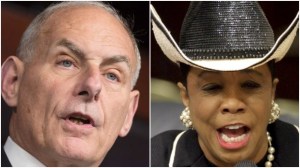
As much as I hate saying it, I’m afraid the answer to an implied question in White House Chief Of Staff General John Kelly’s impassioned statement at a 10/19/17 White House press conference is “No, General Kelly, there isn’t anything sacred in America any more”. In that forum, he openly expressed his impressions of remarks made by U. S. Congresswoman Frederica Wilson [D-FL] about President Trump’s call to the mother of one of the four U. S. soldiers recently killed in Niger. The implied question in General Kelly’s remarks was “Is there anything sacred in America any more?”.

Congresswoman Wilson had characterized one sentence made by the President during that call as insensitive — the sentence was “He knew what he had signed up for”. The liberal media, of course, pounced on that one thing and covered that “story” for days. General Kelly shed light [very eloquently and sincerely in the eyes of many] on what the President meant by that statement, but by then the media train had already left the station.

I made it a point to watch the entire statement, since nowadays all you get from news and commentary on any event of the day is biased interpretations [the “tilt” of bias depending on what media outlet you choose to access]. Then, I made it a point to watch coverage of that “story” on Fox News and CNN, switching between them enough to get a sense of the overall theme of analysis by their “expert panels”. What I saw was exactly what I expected: on Fox News, praise of General Kelly’s “high road” approach, agreement with his overall “tone”, etc.; on CNN, denouncing of his explanation of President Trump’s “He knew what he had signed up for” remark, branding him as a racist for voicing his offense at Congresswoman Frederica Wilson’s comments about the President’s remark, etc.

My conclusions from trying to ferret out these details? …

    • I have been “spot on” in my posts about “Fake News” and the conclusion one could draw from those posts [best described in Fake News Or Just Meaningless News? and News [Or NNTN] Circa 2017].
    • The answer to General Kelly’s implied question “Is there anything sacred in this country any more?”, unfortunately, is “No, General Kelly, there isn’t”. Politicians will use any eye-catching “news” to further their political ambitions [personal ambitions first, party agendas second]. The people who are the subject of the “news” are important to them only to the extent that what they say and/or do can be used as tools to further their agendas.
    • Unlike his predecessor, anything President Trump says will contain some word or phrase or sentence that somebody will find offensive, insensitive, inappropriate, or whatever. Most of the media will pick up on that one thing, report it as a major item of the day, generate multiple “story branches” from it [e.g., the racist angle in this case], and then hash out in panel discussions the whys and wherefores of the expanded “story” for days if not weeks or months.

I’ll close with this quote from one of the above-referenced posts:

Only two things give a person the ability to develop truly well-informed positions on issues like this one: 1) personal choices of “channels” to access [“channels” here being much broader than the TV/YouTube connotation]; and 2) personal filters, based on his/her value system and Worldview, applied to the content flowing through those “channels”. Anyone who limits the first to just one or two channels and/or who essentially delegates the second to just one or two “trusted consolidators” runs a substantial risk of simply disappearing into the huge crowd of what one popular radio personality calls “low information voters”. Anyone who takes whatever time is required [whether he/she thinks he/she has that much time available or not] to control both of these things himself/herself will always be a part of making things better than they are. It’s a hard choice, but the greater the “flow” of people from the latter category to the former, the more rapid our drift toward authoritarianism will be.

Thanks for reading this post, and if you regularly follow my Blog, for that, too. Please consider sharing this or other posts with your friends, colleagues and associates.

img_7026 Charles M Jones

Charles M. Jones

“Megatrends”- Circa 2017

In 1982, John Naisbitt published his classic book Megatrends.  It depicted ten long-term trends that he saw in progress in America. My reference to it here isn’t about the trends themselves but the methodology he used to identify them. What he and his company did was an interesting approach. They tracked major newspapers around the country, logging how many column inches of newsprint was devoted to various subjects over time. Then, analyzing how that coverage by subject area trended over time, they came up with the Megatrends.

The “News” Environment Then …

I was 37 years old when Megatrends was published, so I remember very well at least two of the decades included in Naisbitt’s research. That perspective gave me the general feeling that his predictions were very plausible [as it turned out, well over half of them were at least conceptually on the right track, and two or three of them were “spot on”]. Also, in 1982, CNN was only two years old. CNBC would not be around until 1989 — MSNBC and Fox News, 1996; Huffington Post, 2005; BuzzFeed, 2006.

And Now …

Today, there are numerous 24×7 channels to which a person can tune for “news”, and literally thousands of web sites and blogs providing what could sometimes be classified as “news” because they are sometimes the original sources quoted by the major media outlets in their “news” programming. Compounding this explosion in the number of media outlets is the ability of Social Media [FaceBook, Twitter, etc.] to transform what might otherwise be considered minor content into major worldwide “news” within hours. I’ve put the word “news” in quote marks here because its meaning is much less clear today than it was then [see these Blog posts for more on that: Fake News Or Just Meaningless News? ; News [Or NNTN>] Circa 2017].

Parkinson’s Law Kicks In

This plethora of “news” sources brings to mind Parkinson’s Law: work expands so as to fill the time available for its completion [Cyril Northcote Parkinson, The Economist, 1955]. This principle is often used to describe the growth of the bureaucratic apparatus in an organization, and that is the context within which I mention it here. The myriads of 24×7 media outlets, web sites, and blogs all need content to fill all of their time-slots. I expect there are at least scores of thousands of employees whose jobs are to find content they believe will be more interesting to the public than the content found by their competitors, “package” that content, and produce it for consumption by the public.

This huge army of “journalists” [a term used much too loosely nowadays] churns out orders of magnitude more content than their counterparts did in the decades leading up to Naisbitt’s book, so the task of measuring the percentage of content devoted to a particular subject is orders of magnitude more complex today than it was then.

Naisbitt’s Methodology Today

I can’t help but wonder what a person engaged in Naisbitt-style analysis 35 years from now [same time as from 1982 to now] would conclude were the major megatrends during this decade and the one or two preceding it. My intent here isn’t to try and predict exactly what that conclusion would be [i.e., to produce a specific list of the megatrends themselves], but I believe strongly that it would be consistent with the Major Paradigm Shift Well Underway page of this web site and what I’ve been including in related posts to this Blog. … But as I look at what dominates the “news” these days, it’s interesting to ponder how on earth that person would filter out all the “fake news” and commentary and just track real news.

Thanks for reading this post, and if you regularly follow my Blog, for that, too. Please consider sharing this or other posts with your friends, colleagues and associates.

img_7026 img_3358

Charles M. Jones

Paradigm Shift – Evidence Everywhere

img_3260

I’m not trying to paint myself as a prophet or somebody with a unique ability to observe current “goings on” and “see” with absolute clarity where it’s all leading, but I do believe that I have a very clear understanding of the Major Paradigm Shift Well Underway in this country — and to a considerable extent, underway in the world. I decided to do a kind of “pause” for this post, and do a “let’s see where we are” assessment.

I mentioned in a 7/20/17 post how I believe my background as a CIO gave me some unique insights into assessing things as they are in the context of trends underway in order to shape directions leading to an envisioned future that the trends suggest lies ahead — kind of like Wayne Gretsky’s famous answer to the question “How is it that you’re always right where the action is?”: “I just figure out where the puck’s going to be next, and skate there.”  [This link will take you to that post: Current Paradigm Now Officially Old Paradigm]. With that backdrop, read on …

Let’s Look At Some Specifics

Let’s look at some specific recent/current events that I believe are clear evidence that a major paradigm shift is underway.

    • Roy Moore winning Republican Primary election in Alabama [former Senator Sessions’ seat], despite President Trump’s endorsement and campaign speeches for his opponent. In a way, this is very similar to the ouster of Eric Cantor, a powerful Republican on the rise, in 2014.
    • Social Media’s influence. ..
      • The Trump-Corker “Twitter War” [10/8/17ff]. Think about it. The staid, calm/collected Corker, got sucked into Trump’s modus operandi.
      • Trump’s 10/7/17 Tweet about North Korea: “Being nice to Rocket Man hasn’t worked in 25 years, why would it work now? Clinton failed, Bush failed, and Obama failed. I won’t fail”. Excoriating comments in the media notwithstanding, this is as good an example as one could find of an American President clearly communicating that “things are different now”.
      • Twitter announcing 10/8/17 that it was pulling Marsha Blackburn’s campaign ad because it contained one sentence it said “had been deemed an inflammatory statement that is likely to evoke a strong negative reaction”. Twitter said the language “violates Twitter’s policy for advertisements. … If this is omitted from the video it will be permitted to serve”. [Twitter blocked the video as an online ad, leaving Blackburn only to be able to post it within her account.] On 10/10/17, Twitter reversed its decision and re-enabled the online ad capability. This is very alarming — not the “content” of this particular news item, but the underlying implications of content censorship by media moguls. [See the page Civi Caveo  at this site for more on alarming trends].

These are just top-of-mind examples. My self-imposed length limitation on my posts doesn’t permit inclusion of others.

The Old [And Still Current “Dead Man Walking”] Paradigm

In the context of America’s [and it would not be much of a leap to say the world’s] governmental systems, the Old [And Still Current “Dead Man Walking”] Paradigm has very recognizable characteristics:

    • The minority party uses “rules” [e.g., the filibuster] to block vote and thwart all majority-party-initiated agenda initiatives — even those with which they may agree in principle.
    • Majority leaders control who committee chairs are and what gets to floors for debate and vote.
    • The archaic seniority system — rewards longevity in office, not performance.
    • K Street [the lobbying system].
    • “Commission a study” as the typical “action” for dealing with an issue.

Again, these are just top-of-mind examples. My self-imposed length limitation on my posts doesn’t permit inclusion of others.

The New [Rapidly Becoming Current] Paradigm

In an admittedly very cursory web search looking for more general signs that would confirm that a paradigm shift is occurring, this was one of the most interesting [status comments are mine; source of original: http://www.tnellen.com/ted/tc/paradigm.html]:

    • The established paradigm begins to be less effective. [✔️Check!]
    • The affected community senses the situation, begins to lose trust in old rules. [✔️Check!]
    • Turbulence grows as trust wanes. [✔️Check!]
    • Creators or identifiers of new paradigms step forward. [✔️Check!]
    • Turbulence increases as paradigm conflicts become apparent. [✔️Check!]
    • Affected community is extremely upset and demands clear solutions. [✔️Check!]
    • One of the suggested new paradigms demonstrates ability to solve a small set of significant problems that the old paradigm couldn’t. [✔️Check!]
    • Some of the affected community accepts the new paradigm as an act of faith. [~A Few]
    • With stronger support and funding, the new paradigm gains momentum. [🤔 On The Verge]
    • Turbulence begins to wane as the new paradigm starts to solve problems and the community sees a new way to deal with the world [🙏 Jury’s Still Out]

The new “rules” — the specific attributes of the New Paradigm — are still unfolding. I’ll probably write considerably more on that front in many of my future posts, but for starters I think the following are at least potentially in the mix [don’t write me off as a heretic just yet 😊]:

    • Movement to a more formalized three-party version of what is now essentially a four-party power structure. The current four “parties” are 1) the far left wing of the Democrat party [Sanders/Warren et al], 2) the “establishment” Democrats [Schumer/Pelosi et al], 3) the “establishment” Republicans [McConnell/Ryan et al], and 4) the far right wing of the Republican Party [Cotton/Jordan et al].
    • A continued sharp change in the nature of International “diplomacy” — Out with “set up commissions to study issues and make recommendations” and “talk and negotiate for 25 years with no results”, and in with “tough negotiations backed by demonstrable strength that is available when needed”.

Thanks for reading this post, and if you regularly follow my Blog, for that, too. Please consider sharing this or other posts with your friends, colleagues and associates.

img_7026 Charles M Jones

Charles M. Jones

The Real America [Again]

Las Vegas Massacre

In watching media coverage of the terrible tragedy in Las Vegas last weekend, I was reminded of the same clear theme I wrote about in my August 30 post following coverage of Hurricane Harvey’s devastation in Texas: how people reacted in the midst of the tragedy is The Real America. So I decided to use the same title for this post, simply adding “[Again]” at the end — but in this “Page Two”, as Paul Harvey used to say in his News and Comment radio broadcasts, I’ve added another element.

My plan prior to the Las Vegas massacre was to use this week’s post to express some thoughts on what I consider to be another tragedy, albeit thankfully a more benign one not directly affecting people’s lives — NFL players kneeling during the playing of our National Anthem. With certainly no intention of equating massive loss of life to prima donnas being prima donnas, I call that disrespectful behavior a tragedy because it is yet another chip in the foundation of this great country.

Law Enforcement At Its Best

I should first say something about law enforcement’s swift containment actions that I am convinced saved at least scores and probably hundreds or maybe even a thousand or more lives. Stephen Paddock was clearly planning to kill as many people as he could, and he had armed himself accordingly. The list of guns in his hotel room, several of them modified to enable fully automatic operation, is mind-boggling.  Had law enforcement been less effective at zeroing in on his location, getting to it, and breaking in, he would have had much more time to continue spraying the crowd with more bullets, no doubt increasing several-fold both the death and injury counts.

Real People Being Real People

Video clips and interviews with eye witnesses have simply shown ordinary people helping ordinary people — on the scene, by helping others to safety, trying to manage their wounds until paramedics could get to them; and afterwards, by giving blood, bringing food, water and other supplies, etc. In a media briefing Monday night, one official said that the Convention Center was getting so many supplies donations that they may become unable to handle the “volume”, and that there was actually a waiting list for blood donations, with appointments being booked for Thursday and Friday.  A man from Tennessee shielded his wife from the shower of bullets, losing his own life in the process. … These are just a few examples of people being The Real America.

Prima Donnas Being Prima Donnas

It’s a shame that it takes a tragedy like this to consume media coverage and overshadow reports of the activities of “celebrities” [a much over-used descriptor these days], like the huge focus we’ve seen lately on NFL players kneeling during the playing of our National Anthem. This selfish and disrespectful behavior is a tragedy of a different kind because it is one of many attacks these days on this country’s foundational roots.

Generally, people have a right to express their frustrations with whatever wrongs they perceive. However, in exercising that right, they don’t have a right to openly disrespect our country or symbols that represent it [anthem, flag …], or to destroy the right others have to enjoy a sports [or other] event they came [or tuned in] to see by using them as a captive audience against their will. Excuse me, but I was an Eagle Scout and also earned Scouting’s God and Country Award, and I grew up in a small town in which something like this at a high school football game would have resulted in expulsion of those involved [and everybody I knew would have thought that was a fair penalty]. Now, many decades later, that value system is still in me, and I’m one of those people whose spines tingle as they listen to our National Anthem with hand over heart in salute to our flag.

One Tennessee Titan involved in “anthem kneeling” is apparently clueless as to the source of funds that pay his [probably exorbitant] salary — he said “And the fans that don’t want to come to the game? I mean, OK. bye. I mean, if you feel that … we’re disrespecting you, don’t come to the game. You don’t have to. No one’s telling you to come to the game. It’s your freedom of choice to do that”. I’d love to have been a fly on the wall in the room where I expect the team owners probably helped him “see the light”.

We Need More Focus On Real Americans And Less On “Celebrities”

During the 2016 presidential campaign, some “celebrities” said they were going to move if Trump won the election — e.g., Barbara Streisand, Whoopi Goldberg, Al Sharpton, Samuel L. Jackson, … upwards of 20 if I recall correctly. As best I can tell, none of them have fulfilled that promise so far.

What I’d say to them, and to these NFL prima donnas, is a corollary to one of my favorite Scriptures, Joshua 24:15: “Choose … this day whom you will serve. … But as for me and my house, we will serve the Lord”.  My corollary is a similar choice: “Choose this day whether you do or don’t love your country and appreciate the sacrifices others have made to give you the freedoms you enjoy. If you do, address any concerns you have with it in a way that allows you to exercise your right to express your concerns while also respecting the rights of others; if you don’t, find another country you like better and move there”.

Thanks for reading this post, and if you regularly follow my Blog, for that, too. Please consider sharing this or other posts with your friends, colleagues and associates.

img_7026 img_3358

Charles M. Jones

 

Earth To Senator McCain …

I’m sorry if I offended anybody with the title of this post, but Senator McCain needs to wake up. Hero-level military record and distinguished past service in the Senate notwithstanding, he is rapidly becoming an albatross around the neck of the Republican Party. In fact, the rationale he outlined in his September 22 statement on why he will be a “No” vote on the Graham/Cassidy bill has made him the Republican Old Paradigm “poster child” of the Major Paradigm Shift Well Underway in this country [Senator McConnell is First Runner-up]. The clear winner of the Democrat version of that designation [now that Harry Reid is no longer eligible] is Nancy Pelosi, with Chuck Schumer as First Runner-up.

Time Out …

Let me say before going on that the Graham/Cassidy bill is not the best alternative for dealing with the choice the ACA has put in our path: 1) its imminent collapse when we finally realize we simply can’t afford it in its current form; 2) its becoming the “straw that broke the camel’s back” as it rapidly accelerates our movement toward financial insolvency; 3) its repeal; or 4) its repeal, with something we can afford established in its place. The current procrastination can only continue until #1 rises to the level of “Clear and Present Danger”, at which time we’ll be in a panic to do something because #1 will have by then become our “choice”. If #2 hasn’t simultaneously become reality by then, there may still be some hope that something can still be done to at least stem the tide. I don’t think anybody in our elected leadership actually wants us to choose #3 [unfortunately, their disdain for it stems more from their individual political assessments of it than from a desire to do what’s best for America]. That leaves #4 as the only choice that makes any sense.

So the reason I’m taking the approach I chose for this post is not that I think the Graham/Cassidy bill is the best solution to the ACA dilemma. It’s because I’m convinced that 1) it’s the best option so far that has risen to near-passage status [a major part of my rationale for that assessment being that it separates the Medicaid aspects of the ACA (only about 10% of its text) from the parts (the other 90%) that make it the disaster it is], 2) it’s too late to start from scratch with anything that can pass with 51 votes, and 3) anything that can gain the support of eight Democrats will probably lose the support of at least that many Republicans, so our choices will be back down to #1 and #2.

Statement Announcing “No” Vote — What Did He Actually Say?

I don’t mean in any way to disparage Senator McCain as a person. He is a fine man, and he has served his country in many positive ways during his remarkable life.  However, in his statement explaining his position, he said three things that clearly give him a prominent seat on the Old Paradigm bus that is rapidly approaching the cliff that will precipitate its final descent into the Valley Of Oblivion:

    • “Healthcare reform legislation ought to be the product of regular order in the Senate. Committees of jurisdiction should mark up legislation with input from all committee members, and send their bill to the floor for debate and amendment. That is the only way we might achieve bipartisan consensus on lasting reform. … We should not be content to pass health care legislation on a party-line basis, as Democrats did when they rammed Obamacare through Congress in 2009.”
    • “Senators Alexander and Murray have been negotiating in good faith to fix some of the problems with Obamacare.”
    • Nor could I support it without knowing how much it will cost, how it will effect insurance premiums, and how many people will be helped or hurt by it. Without a full CBO score, which won’t be available by the end of the month, we won’t have reliable answers to any of those questions.”

Earth To Senator McCain …

In the New Paradigm that is rapidly developing [obviously outside your field of vision], your wistful reference to “regular order” makes about as much sense as a General today wishing wars would go back to battles in which ranks of soldiers line up and shoot at each other. “Regular order” has been dead for at least nine years, and it was on life support for a considerable amount of time even farther back than that. Vilifying and obstructing the majority party on every front clearly has not worked for either party during that time period, and “bipartisan efforts” today only surface when something HAS to be done and the majority party can’t ram its agenda through [and even in those situations, those efforts are not truly bipartisan because both parties have too many deep-seated ideologically- and campaign-donor-based positions from which they will not budge].

Senators Alexander and Murray have not been “negotiating in good faith to fix some of the problems with Obamacare”. They have simply been trying to find a palatable way to throw more money into a failing program [e.g., by capitulating on the issue of “Cost Sharing Reimbursements” (CSRs) that prop up insurance companies]. Their plan wouldn’t “fix” anything. It would simply postpone some of the more visible symptoms of the underlying problem — which is a program that cannot survive in its current form.

Even if a “full CBO score” had been available before you announced your opposition, you still would not have known “how much it will cost, how it will effect insurance premiums, and how many people will be helped or hurt by it”. Democrats didn’t know that when [in your words describing that process] “they rammed Obamacare through Congress in 2009” because the CBO score was based much more heavily on assumptions than on facts. The CBO scores of recent failed proposals have the same flaw, as would the score of the Graham/Cassidy bill if it were available [only a very preliminary — and therefore even more meaningless — version was released on 9/25]. Hardly anybody of any political persuasion can produce a fact-based argument that the CBO projection of the 2009 partisan bill that became the ACA in 2010 projected the financial disaster we have today.

Why Single Out Senator McCain?

As to why I singled out Senator McCain and didn’t mention others who may end up being the deciding “No” vote which when added to McCain’s and Paul’s will scuttle the bill [e.g., Murkowski, Collins (who said 9/25 that she’s a “No”, but that could just mean the Maine-centric sweeteners the leadership has offered aren’t yet sweet enough for her), perhaps others], that was a conscious omission for a very good reason [my making the phrase end up in bold type is a clue] — but I’m already over my self-imposed length limit here. I’ll probably get to that in an upcoming post entitled Last Chance On The ACA? Or Not?.

Thanks for reading this post, and if you regularly follow my Blog, for that, too. Please consider sharing this or other posts with your friends, colleagues and associates.

img_7026 img_3358

Charles M. Jones