The Real America


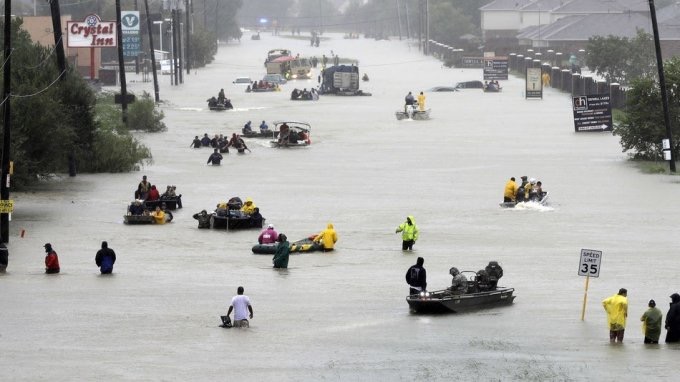
A few days ago, Hurricane Harvey slammed into the Texas Gulf Coast less than 30 miles from a town [Victoria] where my wife and I lived for two years just after our graduation from LSU in 1967. Harvey’s Category 4 winds certainly wreaked the havoc that would be expected of a hurricane of that magnitude, but the rainfall and rising water damage over the four to five days since landfall has made it the worst rainfall disaster in Continental U. S. history. In 1970, I was transferred by DuPont to that company’s plant near LaPlace, Louisiana — which is about the same distance from New Orleans that Victoria is from Harvey’s landfall point. Interestingly, it was twelve years ago this week that New Orleans was devastated by Hurricane Katrina.

Encouragement From Tragedy

I grew up in a small town about an hour’s drive North of New Orleans, so I understand hurricanes. I have close relatives who lived South of New Orleans, much nearer to the Gulf Coast, and some of them experienced considerable property loss from past hurricanes like Betsy and Camille. I certainly would not want my remarks here to minimize in any way the heartache people in Texas are experiencing at this time, but there is something very encouraging that I’ve noticed as I’ve watched news coverage of this hurricane.

The Real America

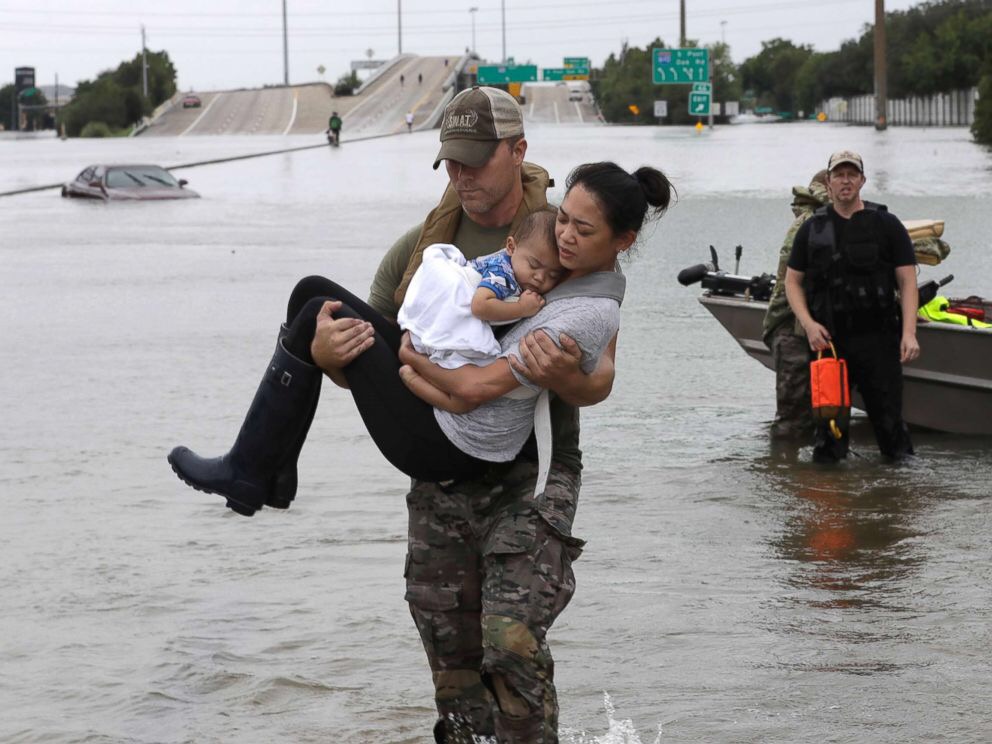
There is no encouragement, of course, in the numerous stories of loss. Those stories are absolutely heartbreaking. The encouragement is in seeing the real America — people from all over this great country pulling together to help those affected by this tragedy.

It is so refreshing to have multiple days in a row of this kind of positive news coverage, shoving all the hatred and vitriol among small factions in our midst to the back burner. The liberal media is having to search very hard to find negative stories in an attempt to hide the reality of what is going on: 1) the very prompt, efficient and well-coordinated manner in which the impact of this tragedy is being managed by governmental agencies at all levels [local, state and federal]; 2) charitable organizations pouring in with volunteers and financial resources [and very effectively coordinating their efforts with governmental resources]; 3) our President and First Lady personally visiting the state [and by staying away from the hardest-hit areas in order to avoid burdening their governments with security requirements that would dilute their effectiveness in disaster management], doing so in a way that showed compassion and support while avoiding the logistical issues associated with a Presidential visit; and 4) the lack of looting, complaining about poor government support, etc.

There are, of course, the never-fail-to-find-a-way-to-criticize-Trump die-hards in the media who are meeting head-on the challenge to find negative stories — “The President doesn’t show compassion during Texas visit”; the First Lady wore spike heels when leaving the White House for the trip”, etc. I’m sure some tenacious reporter will learn from an “anonymous source close to the White House” the shocking news that the heels were given to Mrs. Trump by a Russian official during the campaign collusion going on last year. Thankfully, these media outlets are the ones with small and dwindling readership/listenership/viewership — so what most people are being exposed to during this respite is the real America.

What Now?

I’d love to believe this will continue after Harvey is no longer a top daily headline — i.e., that there will have been at least one beneficial impact of Harvey 2017 [a wake-up call to the media, resulting in more sensible news coverage]. I won’t hold my breath on that, but it’s a nice thought.

Thanks!
Charles M. Jones

Someday, I Envision …


I visited the Alexander Graham Bell museum in Sydney, Nova Scotia this week. I was amazed at how many innovative things other than the telephone he was involved in — not only technology associated with the transmission of voice [and images], but sound recording, aviation, hydrofoiling, etc. I found this quotation particularly intriguing: “I believe it will be possible in a very few years for a person to take his dinner in New York at 7 or 8 o’clock in the evening and eat his breakfast in Ireland or England the following morning” Alexander Graham Bell [1896].Well, I couldn’t resist. That got me to thinking how one with such foresight today might complete a sentence starting with “I believe it will be possible in a very few years …”. Whether I am a person with foresight is for others to decide in the future, but I thought I’d take a stab at making a prediction. Don’t forget that you heard it first right here in this blog post [before I became famous 😊]. …

I believe it will be possible in a very few years …

So here’s my prediction … “I believe it will be possible in a very few years for a U. S. citizen to have sensible choices when they go to the polls, to see the officials they elect conduct governmental affairs in a fiscally responsible and morally sound manner, and within the bounds dictated by civil interaction that is focused on producing results through consensus, do what they promised in their election campaigns they would do if elected”. …

I think initial movement in this direction is already underway.  It began at least as far back as the early days of what is now called the Freedom Caucus, and the 2016 presidential election was a major inflection point. The specific path that will ultimately get us there may not seem clear right now, but I honestly believe the direction has already been established.

Write It Down …

It’ll be interesting to see if the museum that will no doubt be constructed about yours truly, that great blogger from the early 21st century, has this prediction posted within its walls. Even more interesting will be how it is characterized — like Bell’s intuitive prediction I’ve quoted here, or like Thomas Watson’s [IBM founder’s] 1943 prediction “I think there is a world market for maybe five computers”, or Ken Olsen’s [Digital Equipment Corporation founder’s] 1977 remark “Why would anybody ever need a computer in their home?”

So write it down, and tell your grandchildren to be on the lookout for this quote [if they can find the museum 😊].


Charles M. Jones

E Pluribus … ?

1502561827084The media’s reporting of the terrible tragedy this past weekend in Charlottesville, Virginia, has been most interesting.

First, let me say that while I firmly believe in the First Amendment right of all Americans “peaceably to assemble, and to petition the Government for a redress of grievances” [which includes the right to engage in peaceful demonstrations], I believe just as firmly that there is no place in America for open displays of hate, and certainly none for violent demonstrations.

That said, the media coverage of the Charlottesville situation is as good an example as one could find of the extremely heavy bias against our President, and the apparent dogged determination by many factions [Democrats, the mainstream media, the so-called “Deep State”, etc.] to seize on every opportunity to discredit him and to thwart his every move — no doubt with the ultimate goal of getting him out of office in 2020 at the latest [sooner if possible].

Double Standard

During President Obama’s tenure, he was criticized, mainly by Republicans, for being extremely hesitant to utter the phrase Radical Islamic Terrorism, but the mainstream media generally characterized that tendency as being “above board”, “not making hasty judgments”, “sensitive to millions of non-violent Muslims”, etc. But President Trump’s omission in his initial statement about this incident of phrases like White Supremacists and Neo-Nazis has been practically the only thing you can read, hear or see in the media for the last three or four days.

At 5:29pm on Monday 8/14/17, President Trump tweeted “Made additional remarks on Charlottesville and realize once again that the #Fake News Media will never be satisfied…truly bad people!” I’m sure the majority of the media — which is grossly weighted toward liberal views on issues — will take this as “just another swipe at the media by the president”.  However, I went back and looked at what the President actually said during the weekend [before all the facts were known] about the tragedy in Charlottesville, Virginia, and then looked at how it was immediately characterized in the media.  I couldn’t help but notice how Establishment politicians [not just Democrats — Republicans, too], and of course the mainstream media, were focused entirely on whether or not the President’s remarks were appropriate [by their definition] — the basic issues, and the fact that one person, Heather Heyer, was killed and 19 were injured, actually faded by comparison.

Interestingly, Heyer’s mother, Susan Bro, issued a statement through the media thanking Trump for “those words of comfort, and for denouncing those who promote violence and hatred”. The media seemed to overlook that little tidbit — the first I heard of it was in President Trump’s August 15 news conference [which I should add, was called to announce and discuss his Infrastructure initiative, but in which the only questions asked were about this issue].

At Least There’s Some Evidence That Some People “Get It”

In this morning’s [Nashville] Tennessean, I was actually encouraged by how a much broader perspective on all of this seemed to come out in multiple articles [that “theme” was not intended, I’m sure, either by that publication’s editors or those of their affiliate USA Today network, all of which are generally extremely liberal]. The “theme” to which I’m referring is that what we should be focused on is the extremely divisive “atmosphere” in our country. This whole thing blew completely out of proportion because bitterness between two “factions” heated up to a point that escalated into violence. That has happened so many times in recent years that it almost seems like “the new normal” [Black Lives Matter (“pigs in a blanket, fry ‘em like bacon!”), violent student demonstrations against some person scheduled to speak on their campus, etc.]. I’ll close with some quotes from today’s Tennessean articles that indicate that some people really do “get it”:

    • A Freedom Rider and participant in the sit-ins that desegregated Nashville lunch counters in the 1960s said he saw the “same dynamics” in Charlottesville that he saw at the height of the Jim Crow South. He did not blame Trump for the violence. Trump “didn’t create the Klu Klux Klan, he didn’t create the Confederacy,” he said. “That hate starts way, way, way back.” [quotes from two local civil rights leaders, to whom the deadly chaos over the weekend wasn’t a surprise].
    • Various statements by both Republican and Democrat candidates for Governor were almost unanimous in both condemning the violence and denouncing “hatred, bigotry and prejudice”, but an underlying “theme” in all their statements was the need for being less “militant” [my term, not theirs] in our attitudes toward people who don’t share our opinions on issues.
    • Various statements by both Republicans and Democrats on the National level were also almost unanimous in both condemning the violence and denouncing “hatred, bigotry and prejudice”. The underlying “theme” in those statements, however, was more along the lines of “tolerance” and “unity” — a good theme, but clearly worded toward their various voter constituencies.

The best of all was by a local [Black, I might add] Pastor of a very large [predominantly Black, I might also add] megachurch: “This crisis cannot and should not be viewed as an isolated event. It must be taken at face value for what it is. Our wonderful country with all its hopes and dreams is shifting from the United States to the Divided States of America. Our national identity of e pluribus unum — out of many, one — is at risk. … Our response to this threat cannot be to duck our heads and pray it will pass us by. Instead, we must be hopeful — and prepare ourselves to be our best selves.”

I long for an environment in this country in which we can all begin to see this bigger picture, rise above quibbling over what terms people [including the President] use to describe a situation, listen to what they are actually saying, and not “filter” what they say through the “lens” of our personal view of the speaker.

Unfortunately, the media is not our friend in any attempt to rise to this ideal. The reality is that headlines prevail in a “news” outlet’s ability to keep itself in business [read: “its ability to sell ads”]. Another unfortunate reality is that of all a person reads, hears and sees on a given day: after 3 seconds, 40% of it is forgotten; after 60 minutes, 50% is forgotten; after 24 hours, 70% is forgotten; and after 7 days, 90% is forgotten [my composite taken from various sources I consider credible].

Well, we can always hope!

img_7026 Charles M Jones

Charles M. Jones

It’s Time For A “Gang Of 16”

Gang of ... in Legislature

We need a Gang of 16 in the Senate and a Gang of 24 in the House! In 2013, the term Gang of 8 became the monicker used to describe a coalition of eight Senators — 4 Republicans and 4 Democrats — who agreed to work together toward a bipartisan Immigration Reform bill. The Senate passed the resulting bill, the Border Security, Economic Opportunity, and Immigration Modernization Act of 2013, by a vote of 68-32 [a veto-proof majority], with 14 Republicans joining all Democrats. Unfortunately, the House [under Speaker John Boehner] did not act on the bill, and it expired at the end of the 113th Congress.

Although that specific effort ended in nothing productive, I think the time is right to reconsider that concept from a much broader perspective. Let’s look at the concept. … Eight people out of a hundred decided that trying to work together across party lines on a mutually recognized worthwhile goal was better than each party always circling its wagons and opposing the other. The result was a veto-proof piece of legislation passed by the Senate.

Had a comparable coalition been formed in the House, it would be logical to assume that some bill could have been passed in the House — if not with a veto-proof majority, at least a House-passed bill that go to Conference Committee along with the Senate-passed bill [which is how our law-making process is supposed to work, but which unfortunately has become a much-too-rare activity].

So the end result would have been that fewer than 10% of the members of the Legislature would have been the catalyst for action that produced a tangible result — a joint bill that both parties had always agreed would be a good one to have going to the President.

How Would The “Gang Of …” Concept play Out Today?

The numbers today would suggest that a Gang of 16 [8 Democrats and 8 Republicans] would be needed in the Senate and a Gang of 24 [12 Democrats and 12 Republicans] would be needed in the House — that’s only 16% of Senators and less than 6% of Representatives [less than 8% of the entire Legislature]. Given the “don’t take the blinders off — just press the party line” mindset so prevalent in our Legislature these days, maybe there aren’t enough sensible people there to work with, but in the hope that there are and that the “Gang Of …” concept can work even in this polarized environment, here’s how it could play out. …

Both the Senate Gang of 16 and the House Gang of 24 commit to each other that if they can craft compromise bills that they would all have voted to pass had they come to their respective floors absent their efforts, they will all vote to pass them in their respective chambers [i.e., no yielding to pressure from their party leadership, and no backing off for self-serving individual political “grandstanding”!].  The Senate Gang of 16 would be providing 8 Democrat votes, which if all other Republicans rally around the work of these eight colleagues of theirs [and yes, around the fact that it’s a bipartisan result], would result in the 60 votes needed to prevent a filibuster [and therefore in a Senate-passed version of the bill]. The House Gang of 24 would be providing 12 Democrat votes, which with some combination of 12 or more additional Democrats and/or 35 or fewer Republican defectors, would result in a House-passed version of the bill. Generally, depending on the President’s party affiliation and whether the joint bill passed with veto-proof majorities, that bill might still fail to become law — but in the current political mix, it most likely would become law. In any event, at least all the steps of the process would have been followed, and any failure to become law would have come about in the manner provided by the Constitution [rather than in a manner conjured up by politicians (Senate and House rules)]. That in itself would be a huge improvement over the current totally dysfunctional state.

The weak link in this chain remains Republicans because even one hold-out would kill the Senate version of the bill. Surely, however, the obviously-increased pressure against “bucking the party” would keep Senators who might otherwise be hold-outs from actually following through with that inclination [the public’s ire against them would certainly be greater than it has been so far].

So Are There Even 40 Bipartisans Among 535?

In closing, I’m reminded of the account in Genesis 18:20-33 where Abraham is “bargaining” with God to see if there is a way to keep Him from destroying Sodom and Gomorrah. Abraham says, “What if there are 50 righteous people in the city? Will You really sweep it away instead of sparing the place for the sake of the 50 righteous people who are in it?” God says “Yes”, so Abraham presses on.  “What if there are 45?”, then 40, etc., until he gets down to 10 [obviously, based on the outcome, there weren’t even 10]. Adapting that concept to the point of this Blog post, my question to all 535 Legislators is “Are there even 8 Democrats and 8 Republicans in the Senate, and 12 Democrats and 12 Republicans in the House, who will be bipartisan enough to step out and do this?

Thanks!

img_7026 Charles M Jones

Charles M. Jones


More ACA — or The SHAFT Act?

img_1036

This just in … After failing to pass anything remotely related to repealing and replacing the ACA [as they promised Americans who voted for many of them they would], Republicans have punted on the Healthcare front for the time being — ostensibly to move on to other priorities like tax reform.  So on the Healthcare front, here’s what will happen between now and the 2018 elections. …

If the ACA [Obamacare] is simply allowed to continue collapsing

The ACA will collapse [soon if so-called CSRs (Cost Sharing Reductions, which are loss-offset payments from the government to insurance companies) are throttled back — a distinct possibility with Republicans holding the purse strings]. Think of CSRs as the Healthcare equivalent of government subsidies for rail [Amtrak] and mail [United States Postal Service, or USPS] services. These ostensibly “independent” agencies will never be allowed to fail, so whatever losses they incur will always be covered by the government [i.e., by taxpayers]. In the case of the ACA, this essentially means that insurance companies contracting with the ACA exchanges have credit cards with no credit limit and no interest [from the perspective of those companies] on cumulative “purchases” [subsidies].

The ACA is not sustainable without the CSRs, so the CSR funding issue is simply a brake pedal — each congressional action to continue CSR funding presses on the pedal and slows the collapse [the amount of continued funding is analogous to the amount of pressure applied to the brake pedal]. If CSR funding is discontinued completely, the collapse would accelerate rapidly.

We already know that under any collapse scenario, Republicans will say “We told you so!” and Democrats will say “Republicans killed it by cutting funding”, so I won’t bother to pursue that train of thought. Here’s what will happen when the ACA collapses. …

    • At least as many Americans will lose their healthcare coverage as would have been the case had a realistic and affordable/sustainable repeal/replace law been passed [that would ultimately have happened anyway, which is why all the rhetoric about how many fewer people would have had coverage under the now-failed repeal/replace laws was meaningless — i.e., ten-year projections of coverage under the proposed laws was being compared with ten-year projections of coverage under an ACA that won’t last that long].
    • For the time being, though, a feeling of false euphoria will prevail, and politicians who feel that they have “saved” the ACA will be able to bask in their success for a little while.  And, the minority of Americans who are benefitting from the ACA will continue to benefit, and the majority of Americans who are suffering because of the ACA will continue to suffer.
    • There will be political fights over CSR funding [and other parts of the ACA], but when push comes to shove, the government will continue to pay “whatever it costs” to keep it afloat for as long as possible [it is impossible to accurately predict what that cost will be]. I anticipate that timeframe to be about two years if Republicans continue their legislative majorities in 2018, or three years if Democrats gain legislative majorities in 2018. If Democrats gain legislative majorities in 2018 and win the White House in 2020, this funding will last the lesser of 1) seven years or 2) the number of years left until our unbridled entitlement programs [now including this one] bring us to the brink of financial collapse [at which time all bets will be off for all government programs, entitlement or otherwise].

If some kind of political compromise is reached to prop up the ACA

Although Mitch McConnell says “It’s time to move on”, a significant number of Republican Senators are saying that it’s not over yet, expressing at least moderate optimism that something can still get passed, through the Conference Committee process, and signed by the President. If these Senators are correct, I still say that whatever finally gets to President Trump under the current poker-game strategy — if it’s even remotely akin to the ridiculous “‘Skinny’ Repeal/Replace“ bill that [thankfully] failed by one vote last week — will ultimately fail just as the ACA has failed [and for the same reasons]. For more depth into my rationale on this, see The AHCA – My Prediction.

We already know that whatever bill gets passed will be heralded as wonderful by Republicans and lambasted as devastating and mean-spirited by Democrats, so I won’t bother to pursue that train of thought. And of course, it will in fact ease some of the short- to intermediate-term problems with the ACA [that’s what politicians do best — develop short-sighted fixes to long-term problems, essentially kicking the can down the road and making the problem appear to be fixed].

So, I’ll just outline what should be communicated in announcing the final solution to the “Repeal/Replace the ACA” dilemma [this, of course, isn’t how it will be communicated]. … This act is called the Simple Healthcare Access For Today act, or the SHAFT act. The minority of citizens who avail themselves of the benefits it provides might say they [and of course, if they are receiving subsidies, the majority of citizens who are footing the bill] are “getting the SHAFT” from the government. Here are the key features of this great new program. …

    • The goodies that are most popular among you have been retained [children can remain on parents’ policies until age 26, a person cannot be refused coverage because of preexisting conditions, etc.].
    • The mandates that theoretically would be required to make all the goodies you like affordable have been repealed [the employer mandate; the individual mandate; taxes on people who don’t get any coverage; subsidies, both to insurance companies and to citizens who cannot afford mandated coverage; etc].
    • The government will pay “whatever it costs” to keep this program afloat for as long as possible [it is impossible to accurately predict what that cost will be]. We anticipate that timeframe to be about two years if Republicans continue their legislative majorities in 2018, or three years if Democrats gain legislative majorities in 2018. If Democrats gain legislative majorities in 2018 and win the White House in 2020, this funding will last the lesser of 1) seven years or 2) the number of years left until our unbridled entitlement programs [now including this one] bring us to the brink of financial collapse [at which time all bets will be off for all government programs, entitlement or otherwise].

If Republicans [including Trump] wake up and actually realize what must be done

Since I’d put the probability of this scenario actually unfolding at almost nil, I won’t take the time to elaborate on it here. I want to be optimistic and hope for the best, though, so I’ll expand on it if/when it seems more probable.

So pick your poison …

The first and second of these scenarios will have the same result in the long term, so pick your poison in choosing between a salvaged ACA and a new law repealing and replacing it. The probability of the third scenario actually unfolding is almost nil, but please join me in hoping it will be the one that unfolds!

Thanks!

img_7026 Charles M Jones

Charles M. Jones

To Our Leaders, A Blog Post In Verse

I suggested in a previous post that our leaders should just refuse to answer any more media questions about anything but the agenda — what’s going on to deliver what the people actually care about and want. I honestly believe that would be a very smart move, so in this post, I’m expanding on the concept with a little poem. First, my previous mention:

Just Ignore It? [from my 2/24/17 post “Fake News”? (Or Is It Just Meaningless “News”?)]

Here’s an idea.  … I believe much of this kind of “news” would die away quickly [because there would be no “controversy” to drive headlines] if all Administration officials decided to just refuse to participate in interviews where trivial questions are being focused on, responding with “We’ve decided to quit wasting time on media-conjured ‘issues’ … I’d be happy to discuss progress, plans, policy, etc., if you’d like to get into those kinds of questions. Otherwise, I need this time for more productive work”.

So here’s the poem, which I’m sure puts me in the class depicted in the above pictures …

If I Were You …

If the President’s advisors included me
Or if a member of his Cabinet I could be
To help drive his agenda I’d do what I could
For to me it is clear — that would be good

If I were the leader of the party in power
In Senate or House, with moods so sour
I’d rise above all the partisan bickering
And get things done — first listening, then dickering

If I were the President with all his frustrations
This final Tweet to the media I’d post:
“No more responding to your constant accusations …
I’m moving on to what America needs most

The promises I made will be what I mention

When I speak at some location
And that is where I’ve turned my attention:
To making great again this Nation

The President’s tactics won’t fit the swamp mold
So establishment resistance won’t go away
And media jokes will still be told
But results matter most at the end of the day

If next year’s elections from our view can fade
We can focus on the foundation our agenda has laid
Like taxes lowered and jobs created
And the people we serve will be elated

Then when next year’s elections do draw near
The best voter decisions will be quite clear
Sixty Senators and a strong House majority
Leadership that can act with the people’s authority

So …

So interviews on accusations we refuse to grant
And if the media tries to give interviews that slant,
We’ll just say “We no longer fool with that kind of chatter;
Do you have any questions about things that matter?

Thanks!

img_7026 Charles M Jones

Charles M. Jones


Current Paradigm Now Officially Old Paradigm

A sportscaster once asked former NHL superstar Wayne Gretzky how it was that he always seemed to be right where the action was in Hockey games [nicknamed The Great One, Gretzky has been called the greatest hockey player ever by many sportswriters, players, and the league itself]. His answer was “I just figure out where the puck’s going to be next, and skate there”. I’ve often reflected on that dialog, because in that simple exchange, Gretzky revealed what it takes to be a successful CIO. I’d have to leave the decision as to whether or not I was a successful CIO to people with whom I interacted during my years in that capacity: employees, executive team counterparts in other areas of corporate responsibility, vendor principals, associates in national and state organizations on whose Boards I served [and in some cases chaired], etc. I guess I can at least assume I wasn’t a total failure, because I made a very good living in that role for several decades.

As a member of an organization’s senior executive team, a successful CIO has to visualize where the organization is headed from a business perspective, what IT environment would best support the organization’s success in that future business climate, and gain support [and funding] in the current business climate for projects that would move in the direction of that IT environment. Sounds simple, but it’s much easier said than done — particularly in situations where not only containing but actually reducing costs is a key need in the current business climate.

So how does all that relate to my posts to this Blog?

As I look at how things have unfolded since I started this web site and blog almost a year ago [about two months before the 2016 presidential election], it’s not difficult for me to assess where we are now vis-a-vis where we would be had Hillary Clinton been elected President — better off by orders of magnitude: for many reasons in my opinion, but even if there were no other reasons, because a) we have a Supreme Court that has about the same liberal/conservative balance it had prior to the death in 2016 of Justice Scalia [with Clinton in the White House, it would be much more liberal-leaning now because she would have filled a conservative vacancy with a liberal, rather than the conservative/conservative replacement I believe Justice Gorsuch’s appointment will turn out to be], and b) we have a practical and pragmatic thinker in the White House instead of a standard, business-as-usual, don’t-rock-the-boat politician.

However, the inability of Republicans to clearly articulate and move forward with an agenda, coupled with the Democrats’ unrelenting battle against President Trump [“the Russians are coming”, or whatever] and the largely liberal media’s wholehearted support of that battle, has produced a new level of gridlock in Washington. This week’s apparent [at this writing, at least] final collapse of the Repeal/Replace the ACA component of the Trump administration agenda is absolute confirmation of my assertion since the get-go on this site and in my blog posts that the Current Paradigm is dead. The only remaining variable in the Paradigm Shift Underway is what the attributes of the New Paradigm will be. By the way, I suppose it’s obvious by now, but perhaps I should point out that my choice of images to include in this post stemmed from my strong feeling that I am correct in this assessment of our current political system.

In future posts, I will, from that overall perspective, offer my views on 1) what New Paradigm attributes I see developing and what additional attributes I think are most likely to develop, and 2) how development of these attributes relates to the here and now [e.g., what is likely to happen on the Trump administration agenda front, how all this might play out in the 2018, 2020, 2022 and 2024 elections, etc.].

So Here’s The Deal …

So here’s the deal. … I’ve decided to rise above all the details with which the media is currently consumed and do what nobody in the media seems to be doing — look at all this “noise” [where the action is and what is going on now], figure out possible scenarios that may develop from here [figure out where the puck’s going to be next], describe potential environments current and anticipated directions may create [skate there], and outline what our lives would be like in those environments [be ready to play the game “where the action will be”]. Only what I’m sure will be masses of historians who will one day look back on my writings and critique them will be able to document whether I was Gretzky-class in my assessments and predictions. 😊

Thanks!

img_7026 Charles M Jones

Charles M. Jones

Advice To America’s Leaders

Strom Thurmond – Filibuster Record Holder

Since I’m sure my blog posts have caught the attention of our national leaders and made them aware of my vast knowledge of the issues we face as a nation, I’ve decided to go ahead now and share the advice I know they must be hungering for so desperately, to wit …

Senate Majority Leader Mitch McConnell

Official PortraitGet rid of the filibuster already! You’ll catch a lot of flack initially, but the blistering speed with which you will be able to get great things done will ultimately be what you, Speaker Ryan, others in party leadership, and President Trump and his administration will be remembered for decades from now. A decade from now, nobody is going to remember whether you were faithful to a politician-promulgated rule that has long since outlived its usefulness. All people will remember is what got done, and nobody will care if it was with 51 votes in the Senate or 60. The people have given Republicans everything they need to produce what they were elected to do — so do it! [See Out With The Filibuster! for more depth into my rationale here, and why the argument that eliminating the filibuster is something Republicans might regret in the future isn’t valid in this century].

Speaker of the House Paul Ryan

114_rp_wi_1_ryan_paulEncourage Senator McConnell to get rid of the filibuster in the Senate, and then work with him and President Trump to clarify and solidify a more specific agenda — and get on with it! In terms of personal knowledge of the issues we face, particularly financial ruin if we don’t get ourselves onto a more stable fiscal path, I believe you are one of the sharpest knives in the Legislative drawer. Your ability to lead effectively, however, is yet to be determined. You could take great strides in demonstrating your leadership ability by leveraging Senator McConnell’s political “savvy”, and listening more receptively to ideas of other “sharp knives in the drawer” [in both the House and the Senate — e.g., Senators Paul and Cruz, and Congressmen Meadows and Jordan just as a few examples]

Senate Minority Leader Chuck Schumers000148

Come to grips with the simple fact that the ACA [Obamacare] in its current form is failing, and is literally collapsing at an accelerating pace. When that happens, the same number of people [or even more] that you keep saying will lose their coverage under the Republican replacement plan will do so anyway. If you’re as concerned about “the people” as you say you are, getting a workable healthcare system in place would be your goal, and working with Republicans — even with the President that you despise so much — would make a lot of sense. Democrats carefully [and wisely] avoided touting the ACA in the 2016 campaign because it was an albatross and Republicans were campaigning successfully on repeal and replace. They won and you lost. Get over it, and start focusing on what’s best for America instead of trying so hard to avoid “repeal” terminology!  And then, who knows? That could broaden your horizons of thought on other issues that our leadership needs to address — immigration, true tax reform, long-term fiscal stability, etc.

House Minority Leader Nancy Pelosi114_rp_ca_12_pelosi_nancy

Ditto the above advice to Senator Schumer, plus this. … Step down as Minority Leader! In your early years in that role you did quite well, but even some of your own party members see that it’s time for new leadership and are reluctant to express openly any evidence of their support for you going forward. Your apparent determination to double down and prove your detractors wrong is kind of like a Confederate soldier’s descendant saying “Save your Confederate money, boys; the South shall rise again!”. It’s time to do what is best for your party. Step down as Minority Leader — heck, just resign from the House and go enjoy the California beaches. And, if the lush rest-of-life retirement stipend and Rolls-Royce-level health insurance your championing of the “middle class” has earned you are not sufficient to support whatever lifestyle you want, you can take tiny little dips into your top 0.1% [as Bernie Sanders would say] $200 million net worth to fill in the gaps! [Yes, I did the math: even if you earned as little as 4% on your investments and lived to be 100, you could spend about a million dollars per month and still leave each of your five children $20 million — leaving each of them still in Bernie’s “top 0.1%”]

And Of Course, President Trumpdonald-trump2.jpg

Don’t quit tweeting— just be smarter about your tweets and quit shooting yourself in the foot with them. The concept of a President of the United States using Social Media [Twitter and FaceBook, particularly] to communicate directly with the American people is a good thing, and could be thought of as a modern-day, technology-facilitated version of FDR’s “fireside chats”. Using that medium does accomplish what I believe is your goal in using it — to communicate your thoughts on various issues directly to our citizenry, unfiltered by the speculations, embellishments and interpretations of so-called “journalists”. A modicum of “filtering” and editing, though, by advisors you trust implicitly, would serve the double purpose of achieving that goal and avoiding embarrassing missteps.

Well, there you have it. Follow this advice and everything will work out just fine. This advice has been provided as a public service, with no expectation of remuneration. My reward will be the satisfaction of seeing my country get off the current path toward fiscal insolvency and moral decline and onto a path that is fiscally sustainable and [hopefully] morally more consistent with the worldview of our founders.

Thanks.

img_7026 Charles M Jones

Charles M. Jones

Independence Day Thoughts – July 4, 2017

4th_of_july_2On this day when we celebrate the 241st anniversary of the adoption of our Declaration of Independence, I am experiencing two sets of emotions that are producing a degree of tension in me that I find troubling.

What I believe is the main source of this tension was expressed very well in an interesting opinion article in this morning’s [Nashville] Tennessean. The author was Tom Purcell, a Pittsburgh Tribune-Review humor columnist who is nationally syndicated, and the title was Bring Back Common Sense For July 4. I will close this post with a short paragraph composed of excerpts from that article — because its basic theme, in my opinion, “hits the nail on the head” as to what we need most in this country on this Independence Day.

The Declaration’s Place In Our History

[Don’t forget that you saw it here — what may be the most concise history ever written of the formal founding of our nation!] Our nation was actually still “in labor” when the Declaration Independence was adopted. Interestingly [and perhaps surprisingly to the millions of people in America who don’t know and probably don’t care], it was not “born” until the Constitution was officially ratified as our governing law just two weeks shy of twelve years after the Declaration of Independence was adopted. During that twelve years, ten Amendments were added to the original document — Amendments that were necessary to get the required number of states to ratify the Constitution as our governing law. Those ten Amendments came to be known as the Bill of Rights, and they constitute 37% of all Amendments to the Constitution since it [with those Amendments] was ratified on June 20, 1789. The “baby” was “born” at that point, but it took another 7-1/2 months for it to become a fully operational government [all three branches “up and running”] on February 2, 1790.

Why is this important, and what does it have to do with the conflicting emotions I’m experiencing 227 years later? …

The Emotions?

Thankfulness

I am thankful that through the providence of God I was born in the United States of America. I have been to 49 of our 50 states [for some reason, my paths have never been through Idaho], and to every continent on this planet except Antarctica and Australia, and despite all that’s wrong with our country at this point in its history, I am certain that there is no other country on earth where I would prefer to be a citizen.

Concern

My overall concern cannot be summarized in a sentence or short paragraph. It was why I set up this web site and began posting to its Blog section. A visit to the Home page [Home Page], and to pages within the menu selections there, is the best advice I can give to anyone wishing to explore or re-explore my overall concern.  However, the one thing that concerns me most on this particular day of remembrance of our founding is the general “atmosphere” that prevails today — in the regular processes by which our government operates, in media coverage of those processes and of our elected and appointed leaders, and in how various ‘factions” of our citizenry express their opinions on issues and their views of other “factions” adhering to different opinions.

The Tension

The tension these conflicting emotions have generated in me is not just nostalgia, not just wishing we were like we were “back in the day …”. I know as well as anybody that you can’t expect circumstances to remain constant over 241 years of gargantuan changes in practically every facet of life — my career spanned over 40 of those years, and the bulk of my work life was in an occupation that was one of the most, if not the most, influential drivers of those changes [information and communication technology]. The tension stems from the atmosphere itself. The level of distrust — within our leadership, between our citizens and our leadership, and among the many “factions” within our citizenry — is worse than at any time in my personal memory. And perhaps even worse, the amount of disrespect, hatred and vitriol that is evident in how people are expressing themselves is astonishing. So the tension is the realization that this cannot continue as “the new normal”. Something’s got to give.

On this particular occurrence of this particular holiday, we would be wise to realize that the whole reason the “birthing” process that formalized our founding took over a decade was that people had strong feelings on certain issues that were very important to them — and no doubt they expressed those feelings in some heated arguments. In the end, though, they came to consensus, and our nation was born. I expect that they came to consensus because they were a bit more civil in their dealings with one another, and that they spent more time trying to reach that consensus than they did trying to demonized each other. Call me an optimist, but I’d like to think that we still have the capacity to get back to that point.

In Closing …

I’d like to close this post with the following short paragraph composed of excerpts from the article I mentioned in my opening remarks. …

“In the course of human events it is necessary, now and again, to renew our commitment to the principles and practices that made our country great in the first place.  Our country has always held to what the Declaration of Independence says about certain ‘Truths’: they are ‘self-evident, that all [people] are created equal, that they are endowed by their Creator with certain unalienable Rights, that among these are Life, Liberty, and the pursuit of Happiness’.  Regrettably, we forget these simple truths sometimes.  To renew our passion for the free and equal pursuit of life, liberty and happiness, we need a new declaration that promotes civility, open conversation and common sense.  When someone disagrees with a political position we hold, it does not make that individual a monster or something subhuman. It does nobody any good to demonize or ridicule this person — not in a country founded on freedom of speech. To renew our gratitude for the incredible freedoms we enjoy — freedoms that do not exist in many other parts of the world — is it not better to engage your political opponents in civil conversation and debate rather than to prevent them from speaking at all? Groupthink and political correctness are killing debate in our country.  … How did we arrive at a state of affairs in this country in which a person who criticizes [another’s position on an issue] is smeared as someone who hates [certain segments of our population]? … In a country as free and robust as ours, we certainly can work out our differences and find common ground. To do so, we must restore civility in our public debate, dial down the violent rhetoric and listen to others who think differently than we do.  As other parts of the world work to emulate America’s devotion to free thought and speech — as others across the globe work to embrace the ‘unalienable Rights’ to ‘Life, Liberty, and the pursuit of Happiness’ — can we please get back to leading the way? [It’s the Fourth of July]. I can think of no better time to embrace a new declaration that promotes civility, open conversation and common sense.”

Happy Independence Day!

Thanks.

img_7026 Charles M Jones

Charles M. Jones

John Lydgate’s Wisdom Vis-A-Vis The AHCA

Most people probably have no idea who John Lydgate was, but most people probably have heard one of his famous quotes: “You can please some of the people all of the time, and you can please all of the people some of the time, but you can’t please all of the people all of the time” [Lydgate was a monk and poet in Bury, England (just North of Manchester) in the late 1300s and early 1400s].

I titled this post John Lydgate’s Wisdom Vis-A-Vis The AHCA because the above-mentioned quote of his is exactly why any law the GOP may be able to squeeze through under the Reconciliation procedure [required because there will be zero support from the 48 Democrats in the Senate] will ultimately fail just as the ACA [which was passed under Reconciliation with zero support from Republicans] is failing now. Whatever form it takes, there will be some “groups” of people who will not be pleased with it — people benefitting from expanded entitlements [Medicaid], people with pre-existing conditions who perceive [whether accurately or not] that their coverage is “less” than it “would have been” under the ACA, etc. The heavily-biased media will only need one case in each of these “groups” to plaster on every newspaper and TV screen images of doom “brought about by this terrible, mean-spirited law”, as practically all Democrats are calling it. Few if any media outlets will ever mention that comparing any new law — even one passed with bipartisan support — to “how things would have been under the ACA” is a meaningless exercise because the ACA in its current form is collapsing at a rapidly-accelerating pace, and it will continue to do so until all legislators in both parties are forced to work together to do something to fix the resulting disaster.

Mainly [but not solely] for this reason, I honestly believe that, from a long-term perspective, the best thing the GOP could do now is to simply back away and let the ACA finish collapsing. Let the Senate squabble a little more, and then schedule an Oval Office Message to the American People on Healthcare in which President Trump, with Senate Majority Leader Mitch McConnell and House Speaker Paul Ryan standing on either side of him [looking concerned, but frequently nodding approvingly], delivers a speech something like the following:

donald-trump-oval-office.jpg“My fellow Americans … As you know, a major promise I made to you throughout my campaign was to repeal and replace the Affordable Care Act — also known as “Obamacare” — which has been rapidly failing for the past several years and is now collapsing at an accelerating pace. Many of you also elected your current Senators and Representatives in large part because they made that same promise. I want to begin what I will say tonight with a simple truth: under the current procedural rules that govern the process by which proposed legislation makes its way through the Senate and the House and ultimately to my desk for signing into law, we cannot fulfill this promise at this time. That leaves us with no other choice but to move on to other important initiatives like tax reform, immigration reform, and developing a sustainable fiscal plan that will deal once for all with our mushrooming debt.

Removing Healthcare from our short- to intermediate-term focus will, unfortunately, allow the ACA, which was passed with no Republican support in 2009 and is still championed today by Democrats as a good plan, to continue in its downward spiral toward complete collapse. That will directly and adversely impact many of you who will continue to lose coverage and be left with few if any truly affordable options for replacing it.

The current two-party dominance in America, together with the extreme polarization that has developed for several decades along both ideological and fiscal lines, have resulted in the deadlock that we see now. The truth is that the filibuster, well-intentioned as it may originally have been, has become a mechanism that enables the minority party to block any legislative proposals it wants to block if they can achieve a monolithic, party-line mentality within their own party.  Democrats have clearly chosen this path for the foreseeable future. I fully realize that Republicans were accused of the same mentality when they were in the minority not many years ago, but at least they weren’t completely monolithic in their thinking and would sometimes supply “defectors” to join with Democrats and get at least some things done. In fact, the whole reason we were unable to pass the current proposal in the Senate is that just a few Republican Senators were unwilling to move from their positions of opposition [which in turn were understandable based on the feelings of their particular constituencies].

In retrospect, all of this may actually be for the better when we look at the situation from a long-term perspective. All Democrats refuse to discuss any bill that is characterized as repealing the ACA, and some Republicans refuse to discuss any bill that isn’t characterized as repealing the ACA — even though they all know that the ACA cannot survive without considerable modification that would be very close to “repeal and replace”.

When the ACA collapses beyond a certain point — a point that is difficult to accurately describe or predict, but which is much nearer than anybody in our leadership would hope — bipartisan development of a solution will become not only desired but necessary because the situation will be the very crisis we have been sounding alarms about for the entire eight years since the ACA became law. At that time, I can assure you that I will have no higher priority than to turn that crisis into an environment in which as many of you as possible will have the best healthcare possible within reasonable fiscal bounds. There isn’t a doubt in my mind that Senators and Representatives in both parties will be eager to work with me toward that end — Republicans because they will finally be able to achieve more of what their constituents elected them to do, and Democrats because they will then still own a system that has actually collapsed [i.e., they will no longer be able to argue that the ACA is not fundamentally flawed, and that trying to patch it with improvements is a better option than learning from its failure and developing a better plan that is not encumbered by elements retained from a failed system].

It is important to me that you know what a huge disappointment this is for me. I wanted very much to deliver on this promise very early in my administration. But it is what it is, and we have too many other priorities that have been waiting too long. As of tomorrow, we are moving on to those priorities.

I want to thank you for making me your President, and for providing what theoretically should have been a Legislative environment in which I could have moved forward quickly with the agenda I laid out in broad terms during my campaign — that environment being majorities in both the Senate and the House of Representatives. I look forward to getting back to Healthcare at an accelerated pace as soon as failure of the ACA reaches the point I’ve mentioned tonight that will make that possible.

Thank you for listening to this message that is directly from my heart. May God bless you, and may God bless the United States of America.”

It will be most interesting to see whether the Senate brings a bill to the floor [knowing it may not pass], and if so whether or not it passes.  In that situation, it will be even more interesting to see if a Senate-House compromise bill can be passed and sent to the President for signing. And in that situation, it will be even far more interesting to see if the President considers vetoing it [unheard of as it may sound, I honestly believe that is a possibility — see some of my earlier posts, and the related pages at this site].  Fasten your seat belts for the ride — it might be bumpy!

img_7026 Charles M Jones

Charles M. Jones