The RINO-DINO Spending Bill

dino-democrat-in-name-only-rino-republican-in-name-only-21824163

This week, we have clearly seen that the label “Tax and Spend” no longer belongs just to Democrats. The way I see it, the phrase should become “Tax and Spend Politicians”, because as I pointed out in a previous blog, they’re all made out of ticky tacky and they all look just the same. I’ll call the massive $1.3 trillion spending bill the RINO-DINO “bi-partisan” spending bill [not to be confused with budget bill, which we haven’t seen for many years].

RINO, of course, is the long-used acronym for Republican In Name Only. You don’t see DINO in the media, I assume because neither Democrats nor their liberal media allies like the potential connotation of “DINOsaur.” The truth is that there is very little if any difference between the two from the perspective of how they think about specific pieces of legislation.

Let’s couple that fact with two other pieces of the legislative process these days: 1) how the two dominant political parties actually operate on a day-to-day basis; and 2) the declining influence of ideological positions.

On the first of these pieces, both parties operate under a seniority system that rewards long-standing membership in the two chambers of the legislature. That, by definition, means the Current Paradigm [which I’ve said in previous posts to this blog is already dead but still hanging on by its claws] is still hanging on. More junior legislators — who were elected to “drain the swamp” and get our government back to some level of sensibility — simply don’t yet have the muscle to change the status quo. Comments from those legislators, and even from some RINOs, indicate that this spending bill was “bi-partisan” only because both RINOs and DINOs in the leadership of both parties developed it in a vacuum and had the power to pressure them into holding their noses and voting for it.

On the second piece, ideological positions seem to matter less and less anymore, and all discussions about priorities end up being about money — how much money do we need to put into this great new initiative [or how much more money do we need to put into this existing initiative]?

Why Am I Keeping The Term “Tax” in “Tax And Spend?”

So since we just passed one of the biggest if not the biggest tax cut packages in our history, why am I keeping the term “Tax” in “Tax And Spend?” You don’t have to be an accountant or a mathematician to figure that one out. I’ve written about this almost ad nauseam in my blogs, and the fact that we are on an unsustainable fiscal path was one of the original pages of this web site [and although I haven’t updated the numbers, what I said on that page is just as valid today as it was a year and a half ago].

In the long term, Government cannot spend more unless it does one or some combination of three things: 1) spend less in some programs to offset the increased spending necessary to initiate new programs or grow existing ones; 2) increase taxes; or 3) grow the economy [increase GDP] rapidly enough to generate revenue sufficient to offset the increased spending [many, but not all, economists say #3 has never worked — i.e.. it is not possible to “expand our way to prosperity” on a sustainable basis].

So if we continue to increase the level of deficit spending and essentially ignore the national debt, a day of reckoning is out there — and the longer we continue on this path, the closer and more painful that day of reckoning will be [see my recent post The Mother Of All Balloon Notes]. Ergo, “Tax” stays in “Tax and Spend”.

Stay Tuned

Despite all the criticism of President Trump’s tax cut initiative, there are some good elements to it, particularly if they are viewed in context with cutbacks in business-choking regulations piled on in recent years. However, I’m inclined to agree at least to some extent with the economists who say that Government can’t “expand its way to prosperity”. I honestly hope that at least some of the success we experienced under President Reagan’s administration from actions of his that were similar in many ways to President Trump’s. If we do, the day of reckoning could be farther out, but it won’t go away.  It will come.

Thanks for reading this post, and if you regularly follow my Blog, for that, too. Please consider sharing this or other posts with your friends, colleagues and associates.

img_7026 img_3358

Charles M. Jones

Post-Killings Bandwagons

IMG_3645Not surprisingly, the tragic shooting in a Florida high school on February 14 brought out the usual political atmosphere — each party rolling out its bandwagon to rally their faithful around “what to do”, with their respective media adherents being the first to jump on. As usual after tragedies like this, the “do something” options put before us after this one were painted by politicians as binary — i.e., get on our bandwagon or theirs.

The Democrat bandwagon is always tighter gun control laws. The Republican bandwagon is better processes for dealing with mental health issues. Both sides stress why their approach is best, and both sides quote those parts of statistics and research that support their mantra and discredit that of the other side. This goes on until the media outlets sense that coverage of the most recent tragedy is no longer attracting readers / listeners / viewers, coverage fades, and that tragedy just moves into the statistics bank.

I am encouraged that this latest event seems to show some evidence of being “the straw that broke the camels back,” but I expect the end result will be passage of relatively minimal legislation if any. And because of the “bandwagon effect” and the factors that drive how Legislators make decisions, whatever is passed now or in the future will be a less than optimal solution.

Why Just Two Bandwagons?

It alarms me that nobody seems to be broadening their view to include other potential root causes of this problem in our culture today.

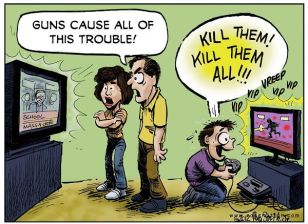
At least one such potential cause I’ve thought of often over the past few years as the frequency of these attacks has increased dramatically [see Mass Murders Accelerating] is depicted quite well in the cartoon I picked as the lead graphic for this post. This cartoon appeared recently in one of the news feeds I follow. It shows a Mom and Dad watching a news report on TV while their son is right behind them playing a violent video game. The caption over the parents reads “Guns cause all this trouble.” The caption over the son reads “Kill them! Kill them all!”

A Prime Candidate?

So what potential culprits are there that nobody ever brings up in these flurries of activity after another attack because they already have their canned bandwagon rhetoric ready to pull out and set in motion? At least one depicted in the cartoon I’ve mentioned here should be a prime candidate — the “dark side” of technology.

Although technology has many upsides that make our lives easier and better, there are many caveats we should be keeping in mind more than we have been so far. One is video games, or at least many of them.

I have never played a video game, so I’m sure there are many experts out there who could present some very good arguments to what I’m saying here. My perception of video games comes from indirect exposure — TV ads attempting to entice new buyers, observation of others [particularly children] playing them, etc. The vast majority seem to involve “battles”, often in military settings but also in what appear to me to be “street fighting” situations. The bottom line is that regardless of whether or not I have a distorted view of the percentage of video games that include violent situations like that depicted in the cartoon, millions of kids have access to them and many of those become what could arguably be described as “addicted” to them — consumed with competing, “winning” battles, etc.

If you pair what I described in the preceding paragraph with the unquestionably more lax parental oversight that prevails these days, it’s not much of a stretch to envision at least tens of thousands of children in their early teens who have been influenced by these games throughout their formative adolescent years. Now, in their high school years and beyond, they may still be playing the games, but even if not the influence on their thought processes is there.

Continuing this train of thought and just doing the statistical math, if even ten percent of these young people in their teens and twenties have led disappointing lives … and if even ten percent of those blame “somebody else” for their problems and foster burning desires to “get even” or “make a statement” about their frustrations … well, you get the point: which is that at any point in time you may chose nowadays, this backdrop could easily have created at least a few potential perpetrators out there ready to be the instigator of another Sandy Hook Elementary School or Marjory Stoneman Douglas High School or Pulse Nightclub or … attack.

A key part of the role that violence-ridden video games might play in forming this mindset in a person is a general desensitization to killing. In a game, “it’s just a game,” and when you turn it off there are no bloody bodies around. Expanding on that concept, not a day goes by that evidence of total disregard for human life in the world today is everywhere — Bashar al-Assad literally killing his own dissident citizens with poison gas, Christians being killed just because they are Christians in some parts of the world, Kim Jong Un literally starving his own people so he can funnel practically all of his regime’s financial resources into his nuclear weapons program [the end result of which could trigger instantaneous death to millions of people], etc.

I’m not trying to build a case that violence in video games is the real culprit behind the mass killing problem. My point is that I’m surprised that there’s never even any mention of it and probably several other potential culprits by politicians in the flurry of media coverage after each event. The reason, of course, is that their interest is in media coverage, not in actually trying to fully diagnose the problem and find the best overall approach to solving it — and their bandwagons are so well refined that jumping on them is simply the path of least resistance. That’s a whole different issue, so I’ll just stop here and write about that another day.

Thanks for reading this post, and if you regularly follow my Blog, for that, too. Please consider sharing this or other posts with your friends, colleagues and associates.

img_7026 Charles M Jones

Charles M. Jones

The Mother Of All Balloon Notes

balloon-payment-5a95bd177462c

It’s interesting to me that this article didn’t even make it to headline status in the 3/5/18 edition of USA Today … Report: Spending, tax cuts soaring to records; Debt is reaching levels not seen since World War II. It was in the Business section, and not even on the front page of that section. A better title for the article might have been The Mother Of All Balloon Notes.

Let’s Make A Deal

Using the title of a well-known TV game show, I have a proposal for a hypothetical person [I’ll call him Sam] making $197,000 a year who has a wish list of things he is convinced he needs to buy right now. Unfortunately, the things on his list add up to $200,000. With no savings at the moment and current regular living expenses eating up his entire salary and already causing him to spend a considerable amount of time managing cash flow, he is extremely frustrated.

Fortuitously, at a cocktail party he attended to get visibility among influential people in circles related to his profession, he met a guy [I’ll call him George] who made him a deal that seemed too good to be true. Here’s the essence of it:

    • Sam gets a $200,000 loan, with the full principal to be deposited in his bank account immediately. No security is required. George says the fact that Sam has a good job and earns almost the same amount annually that he is borrowing now is sufficient security.
    • For the next nine years, Sam will pay only interest each month, at a variable rate of 2.3% that is tied proportionately to the Federal Funds Rate [which is currently only 1.5%]. That means his first monthly interest payment will only amount to about $383.
    • In the tenth year, Sam will pay interest at the then-current rate as usual, plus the entire principal of $200,000.

Sam knew that coming up with an extra $383 each month would add further complications to his already-annoying cash flow management problems, but he was confidently expecting a raise fairly soon that would make up that amount with cash to spare. He realized the variable interest rate could increase his monthly payment over the next ten years, but reasoned that future raises would probably more than offset any such increases. He was also very confident in his ability to succeed in his profession, and expected promotions over the next ten years that would enable him to accumulate money to pay the principal — banking as a fallback on his confidence that absent sufficient cash to pay the principal in full at that time, his good payment record and substantially higher income would enable him to successfully negotiate a new loan for the shortfall. And of course, during all this time, he would have been enjoying the things he needs now rather than ten years from now.

Sam didn’t know that in some states, these “balloon notes” are illegal, and many states require notices of the coming “balloon payment” to begin at least several months, maybe more, before the due date. Anyway, he signed on the dotted line and began spending his $200,000.

Back To The Article I Referenced …

I’m sure you’ve figured it out already, but Sam is Uncle Sam, aka the United States. I’m sorry, but I couldn’t come up with an American-sounding name for Sam’s creditor that would draw a parallel that easily recognizable — somehow Jinping just didn’t flow off the tongue as well as George. To relate Sam’s loan to the article I referenced at the beginning of this post, just multiply the numbers by a hundred thousand — i.e., add eight zeros. Sam’s “salary” [Gross Domestic Product] becomes $19.7 trillion , with a “t” — $19,700,000,000,000. The $200,000 loan becomes $20 trillion — $20,000,000,000,000.

Most people don’t realize this, but $20 trillion is nowhere near the total future financial obligations of this countryit doesn’t include state and local debt, so-called “agency debt” [debt issued by federal agencies such as FHLB and GNMA and government-sponsored enterprises such as Fannie Mae and Freddie Mac.] … or the biggies: unfunded liabilities of entitlement programs like Social Security and Medicare. If that isn’t enough grease on this fire, a probably even bigger amount than entitlement programs not included in this debt figure is the unfunded liability of future pension obligations of federal employees, elected officials, etc. For several decades now, corporations and many not-for-profit organizations have had to compute and “book” this latter amount in order to be compliant with Generally Accepted Accounting Principles [GAAP that external auditors use], but GAAP does not apply to governmental entities.

The Moral To This Story

In closing, I’ll just get back to my relatively simple story about Sam. I was unsuccessful in an admittedly hasty attempt to look up correct source attribution for the old adage “If it seems too good to be true, it probably is.” So, I’ll just leave it at “an old adage.” Hopefully, the wisdom of the adage will prove to be questionable and Sam’s view of the wisdom of his loan will prove to be correct. 😊

Thanks for reading this post, and if you regularly follow my Blog, for that, too. Please consider sharing this or other posts with your friends, colleagues and associates.

img_7026Charles M Jones

Charles M. Jones

Maybe Khrushchev Was Right

Soviet Premier Nikita Krushchev

Nikita Khrushchev was the leader of the Soviet Union during my junior high and high school years. Technically, his title was First Secretary of the Communist Party of the Soviet Union — at that time, the equivalent of Vladimir Putin in today’s Russia. I remember vividly his general demeanor, and more specifically his propensity to express in public forums his firm belief that Communism was superior to Capitalism. Consider these quotes [emphasis mine]:

    • I once said, “We will bury you,” and I got into trouble with it. Of course we will not bury you with a shovel. Your own working class will bury you.
    • The United States will eventually fly the Communist red flag. … The American people will hoist it themselves.
    • We do not have to invade the United States, we will destroy you from within.
    • You Americans are so gullible. No, you won’t accept Communism outright, but we’ll keep feeding you small doses of Socialism until you’ll finally wake up and find you already have Communism. We won’t have to fight you. We’ll so weaken your economy until you’ll fall like overripe fruit into our hands.
    • The press is our chief ideological weapon.

Fast forward to today. The Russians are clearly meddling in our elections and many other facets of our society, but not in the ways Democrats were hoping would offer a more palatable explanation of Hillary Clinton’s loss in the 2016 election [i.e., more palatable than the simpler explanation that she was an unimpressive candidate with no clear message who was surrounded by people running a campaign very poorly]. It is clear they have come around to realizing that the “collusion dog won’t hunt,” so they’re focusing on obstruction or whatever else will keep some kind of anti-Trump narrative alive and capturing a decent share of each day’s media coverage. To me, the main value so far in the Moeller investigation is that it is now more publicly known that Russia and other countries are actively involved in cyber warfare — and although it doesn’t get anywhere near the media coverage, so are we.

Back To Khrushchev’s Predictions

Let’s look at some current “goings on” and relate what we see to Khrushchev’s statements. It’s a known fact that many anti this / anti that / for this / for that rallies and demonstrations are fueled by intentional campaigns with one and only one goal — to sow seeds of discontent, create animosity between “factions”, etc. … With Twitter hashtags, Social Media “bots”, etc., even the recent Florida school shooting was used as a springboard for this kind of activity, capitalizing on what the perpetrators knew would be controversy over gun control. Consider this article about a week after the incident [CNBC Article 2/22/18]:

The headline itself is quite revealing. … Florida shooting shows how hard it will be for Facebook to fight its fake news problem. It’s followed by these sub-headings: “What people see on Facebook about the tragedy depends on what they search for, who their friends are and what they’ve viewed before”; and “When everyone’s news is their own personalized version, it can be impossible to find any ‘truth.’”

What you see on Facebook about the tragedy depends on what you search for. Different searches done by CNBC Thursday morning for “Florida high school shooting,” “Florida school shooting” and “Florida shooting,” for example, turned up three distinct sets of videos at the top of the resulting Facebook pages. The sources of the videos ranged from national networks such as NBC, CBS and Fox to local news channels, individual video bloggers and foreign sources like China’s Xinhua news agency. From there the content fragments still further into at least five different types of content: videos, public posts, articles, posts from groups, and another section called “what people are saying.” That last category surfaced some posts from [the writer’s] Facebook friends, suggesting that content was also chosen for [him] based on [his] network. Among the posts were some still claiming that students speaking out against the shootings were paid actors, and others refuting that cynical conspiracy theory. Similarly, there were competing posts on another issue: Some said one shooting survivor claimed that CNN handed him a scripted question to read at its Wednesday town hall broadcast, while another, from CNN, said that charge was untrue.

Even as I was writing this post off and on over the past day or two, I ran across this article …

Report: Russian group hacked Germany’s government network. A Russian-backed hacker group known for many high-level cyber attacks infiltrated the German government’s secure computer networks, the Deutsche Presse-Agentur [DPA, the German Press Agency] reported Wednesday. DPA cited unidentified sources saying the group APT28 hacked into Germany’s Foreign and Defense Ministries and stole data. The attack was noticed in December and may have lasted a year, DPA reported.

The message there, of course, is that Russia is doing what they do everywhere — not just in America.

The truth is that any entity — a person, a company, a government … — can generate this kind of activity if it has two things: 1) the technical knowhow, particularly the ability to make an item appear as though it came from an entity [person, company, or government] within the United States; and 2) possibly, but not necessarily in all cases, the financial resources needed to do #1.

Technology Gap

For most of my lifetime, technology has been advancing at a pace far faster than the ability of government to adapt to it — and more worrisome, to effectively utilize it. Deployment of technology has been very decentralized at multiple levels of government — so coordinated thinking about potential needs like national databases to support gun control has been minimal at best, non-existent at worst. Also, no disrespect toward many dedicated and highly capable government employees in this country intended, government generally does not attract and retain the best and brightest of the workforce — for a number of reasons to be sure, but the easiest to relate to is that the best and brightest can make much more money and be more free to “be all they can be” in the private sector.

Until we can narrow this gap and become less polarized politically, I’m afraid we will continue to lag behind several major powers who appear to be light years ahead of us in this critical area — Russia and China for sure, and probably other counties as well. Unfortunately, the former is more doable than the latter, but even more unfortunately, the former is also dependent to some extent than the latter.

Thanks for reading this post, and if you regularly follow my Blog, for that, too. Please consider sharing this or other posts with your friends, colleagues and associates.

img_7026 img_3358

Charles M. Jones

The VERY Reverend Billy Graham

Whatever world or national issue I was considering as subject matter for this week’s blog post is mere trivia in comparison with the news this morning that Reverend Billy Graham has died. I consider myself fortunate that most of my adult life paralleled Reverend Graham’s ministry from its early years to indisputable recognition as far and away the most dominant Christian leader of the twentieth century — a recognition that carried well into this century.

The best-known part of his ministry was the Crusades he led for six decades. I was only nine years old when he led a 12-week Crusade in London in 1954.  His 16-week revival event in New York in 1957 drew tens of thousands to Madison Square Garden. His last Crusade in June 2005 in Queens, New York, drew a total of 230,000 people. I watched his televised Crusades throughout my adult life, and attended one in Baton Rouge, Louisiana in 1970.

“America’s Pastor”, “Protestant Pope”

Reverend Graham’s influence, historians say, was monumental. Some called him “America’s pastor.” Others referred to him as the “Protestant pope.” He is reported to have led more than 3 million people to commit their lives to Christ, and his preaching was heard in 185 of the world’s 195 countries. “No more than one or two popes, perhaps one or two other people, could come close to what he achieved,” said William Martin, a former historian at Rice University and the author of A Prophet with Honor: The Billy Graham Story.

The image of a televised Billy Graham Crusade is probably an indelible part of the recollections of millions of people my age and younger, and two other members of the four-man leadership team that made those Crusades what they were — Cliff Barrows and George Beverly Shae — would be a part of that image. The other member of the team, behind the scenes but no less important, was Grady Wilson, who was essentially [whether so titled or not] the “Chief Operating Officer” — the man who managed the massive operational and logistical side that is so necessary in a ministry of that magnitude.

For a man of his stature, Reverend Graham was a humble man who would always point people heaping accolades on him to Jesus Christ as the One toward Whom any recognition should be focused. Some accounts of the unveiling of a 9-foot bronze statue of him in Nashville indicate that he was uneasy about that event. In 2016, after sale of LifeWay Christian Resources’ property where it stood, the statue was moved to LifeWay’s Ridgecrest Baptist Conference Center near Asheville, NC, just a few miles from the home where Reverend Graham lived most of his life. “It will welcome nearly 70,000 men and women who come to Ridgecrest every year for spiritual training and retreat,” said Thomas Rainer, LifeWay president and CEO at that time.

Well Done, Thou Good And Faithful Servant

When asked what he’d like people to say about him when he died, Reverend Graham said, “I want to hear one person say something nice about me and that’s the Lord, when I face him. I want him to say to me, ‘Well done, thou good and faithful servant’” [see Matthew 25:21].

My feeble attempt in this post to pay tribute to a man who was one of the most positive influences on my life will be just a small drop in a very large bucket of writings about him today. But to him, nothing in that large bucket can compare to the one thing I am certain he heard this morning: “Well done, thou good and faithful servant.”

img_7026 img_3358

Charles M. Jones

Semi-Fake News

I found something Tennessee’s extremely popular Governor Bill Haslam said in a recent interview quite interesting — and eye-opening in some ways. Probably because he is term-limited and not running for re-election this year, several profile-type pieces about him have appeared in the media lately. Before using his remark to bring out what was eye-opening about it for me, let me just share the remark itself with you [emphasis mine]:

“Gov. Bill Haslam said on … that 2018 is ‘really important political year’ but that he worries how the business challenges facing the news media will impact coverage of the race to succeed him.  [Expanding on] what irks him about their business’s current state of affairs, he said, ‘This is going to be a really important political year. This is a real governor’s race. We have a [U. S.] Senate race that’s really important, not just for the state but the country, and a number of congressional seats in play. My fear is that all of these won’t be covered in the detail they traditionally have.’ “Furthermore, Haslam said when he asks most people where they get their news, many name dubious sources without editors.

What caught my attention when I read that was his apparent perception that “traditional media” is what it used to be “back in the day …” — subject to considerably more “editing” by real “journalists” than is actually the case today. And interestingly, although “traditional media” are a long way from being totally dead, the percentage of people [particularly those in the 18-36 age range] who get most if not all of their “news” [and of course, “fake news”] from internet-based sources and social media is increasing by leaps and bounds.

“Fake News” Is Real, But What About “Semi-Fake News”?

The term “fake news” has become commonplace these days, particularly outside the “mainstream” media [which folks in the “non-mainstream” media describe as the purveyors of fake news]. I’ve written about this before [e.g., see Fake News or Just Meaningless News? and News [Or NNTN?] Circa 2017], but the eye-opener in Governor Haslam’s remark made me realize that there is also quite a bit of what I’ll call semi-fake news out there. My point here is that both fake news and semi-fake news are causing problems that are getting worse by the day.  Other than tampering with our election machinery itself [vote gathering and counting processes] — of which there is absolutely no evidence — those problems are much worse than any meddling by Russians [or anybody else] into our election campaigns. Before developing that point, let me first define the two terms:

Fake News. Segments reported in the media that are clearly false. These segments often show up as lead stories on TV and major front-page headlines in papers, quoting “undisclosed sources.” Retractions [if any] come days if not weeks later, as brief mentions on TV just before going to commercials, and short paragraphs on page 14E of newspapers. Just one of thousands of examples: “ABC News suspended a star reporter, Brian Ross, after an inaccurate report that Donald Trump had instructed Michael Flynn, the former national security adviser, to contact Russian officials during the presidential race.” [The report fueled theories about coordination between the Trump campaign and a foreign power, and stocks dropped after the news. In fact, Mr. Trump’s instruction to Mr. Flynn came after he was president-elect.]

Semi-Fake News. Flashy attention-grabbing headlines designed to attract readers/listeners/viewers rather than just accurately and factually communicate the underlying story.  A classic example of semi-fake news is what was arguably the dominant item in media coverage during the week of February 5-9 — the long-predicted “correction” in financial markets. I’ll get into why I call most of that coverage semi-fake news in the next section. …

A Recent Classic Example Of Semi-Fake News

An appropriate headline for a story the night of 2/5/18 about the “correction” in financial markets would have been something like “Dow drops 4.6%, possibly signaling long-anticipated correction in financial markets” [I should mention here that the percentage drop that day was nowhere near the largest ever (22.6% on 10/19/87) — in fact, it ranked as only 25th largest since 1960]. Yet look at this sampling of headlines:

  • CNN … ”A stock market lesson for Trump — the hard way.”
  • USA Today … ”Trump Has Often Taken Credit For The Stock Market’s Climb. Will He Own The Drops Too?”
  • USA Today … “Politicians Who Crow About Stock Market Gains Face Hazard When Market Drops.”
  • New York Times … “Has Trumphoria Finally Hit A Wall?”

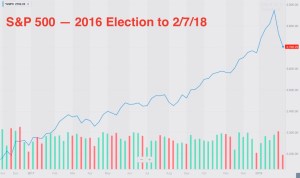
Interesting backdrop on this one … Paul Krugman, this article’s author, doesn’t exactly blame Trump for the market drop, but suggests gullible market investors are guilty of falling for Trump’s childish idea that the economy can grow 3% a year, not the 1.5% pace that he believes is the speed limit. And people forget that not only were prognosticators predicting that the stock market would plunge if Trump were elected president, but they seemed at times to actually be hoping for it to happen. Krugman’s famous comment along that line, published the day after Trump’s election, is instructive: “It really does now look like President Donald J. Trump, and markets are plunging. When might we expect them to recover? … If the question is when markets will recover, a first-pass answer is never.” [For the record, since those words were published, the S&P 500 Index has risen 26%. And that’s after the recent big market drop.] On election night, Nov. 8, 2016, as Investor’s Business Daily wrote a week and a half later, “fear consumed traders. At one point futures on the Dow Jones industrials index plunged 800 points.” Democrats were everywhere in the media, gloating. [Oops. “By Friday, the index finished the week up 959 points, more than 5%,” IBD wrote back then, making the case for a Trump bull market that later became reality.]

There are two takeaways from calling these attention-grabbing headlines what they are — semi-fake news. First, they are misleading at best, and insidiously furthering an anti-Trump narrative at worst [the former because they unnecessarily overdramatized the actual story; the latter because the more liberal (which is most) media outlets were gleefully reporting this in an anti-Trump context]. Second, it’s not just fake news we need to be on the lookout for — semi-fake news can be just as bad from the perspective of having adverse affects on our already disappointing political climate.

A Very Short Math Refresher …

Here’s a very short math refresher for anybody not getting my point about coverage of this “correction” being semi-fake news. If the Dow Jones Industrial Average [DJIA] is at 2,246.74 [its value on 10/16/87, the Friday before the largest percentage drop in history — 22.6% on Monday 10/19/87] and “drops” by 1,175.21 points, that’s a drop of 52.3 percent — and if the 2/5/18 “drop” had been 52 percent, the entire world would probably be in a state of financial chaos right now. But if the DJIA equals 25,520.96 [its value on Friday 2/2/18] and “drops” by 1,175.21 points [as it did on Monday 2/5/18], that’s a “drop” of only 4.6 percent. Although 4.6% is certainly not a trivial “drop”, it ranks as only the 25th highest since 1960.

No Extra Charge

I won’t charge extra for the extremely useful information I’ve shared with you in this post 😀.  My reward will be in any use you derive from it in filtering through whatever “news”, “fake news”, and semi-fake news” you access every day.

And by the way, this post has not been about the stock market. I have followed the markets for many decades, and the bulk of my income is from investments. But the main thing I’ve learned is that markets go up, and markets go down. Generally, they have gone up by about 4% more than inflation when viewed over decades and not months or even years. So if anybody thinks I’m implying with the post that we’re not in for any more “corrections,” go find some experts. You’ll find many “doomsday” predictors and you’ll find many “sky’s the limit” predictors — so the bottom line is, just as with filtering out fake news and semi-fake news, you’ll have to read / listen to / watch all of those “experts” and make your own decision about where you think the markets are headed from here.

Thanks for reading this post, and if you regularly follow my Blog, for that, too. Please consider sharing this or other posts with your friends, colleagues and associates.

img_7026 Charles M Jones

Charles M. Jones

And The Winner Is …

budget-battle-f096959b0cd9682b

In a year and a half of writing weekly posts to this blog, I have usually been able to zero in on a topic fairly easily and just go straight to writing a day or two before my usual Wednesday post day. This week, though, there was such a tsunami of ripe pickings I had difficulty coming up with the “winner.” And the winner is … [drum roll, brass fanfare]: The Complete Demise Of Fiscally Responsible Thinking In America.

At least once or twice in earlier posts I’ve alluded to what has always seemed to me to be a clear difference in philosophy between Republicans and Democrats on fiscal matters. Generally, the mindset of Democrats has always seemed to be that if initiating or continuing a particular government program seems to be a good thing to do, then we should just make the decision to do it for that reason alone and let the cost considerations work themselves out in some separate process. Conversely, the mindset of Republicans has always seemed to be that the decision to initiate or continue any government program must necessarily be made in context with consideration of its cost and whether or not we can fund it under a fiscally responsible financing plan. This dichotomy has been at the root of many government “shutdowns” [see The Senate Shutdown for debunking of that term] when increases in the debt ceiling are required.

All Made Out Of Ticky Tacky; All Look Just The Same

One of my favorite songs of all time is Little Boxes, made popular by Pete Seeger in 1963. Although the song was a political satire about that era’s development of suburbia and associated conformist middle-class attitudes, only slight changes in the lyrics would make it describe the situation I’m writing about here. The “budget” [to use the term lightly] bill signed into law by President Trump in the wee hours of the morning of February 9 ended the latest [only hours-old] “shutdown” and was heralded by the leadership of both parties as a bipartisan compromise [“leadership” emphasized here because there was considerable disgruntlement in the Republican party’s “rank and file”]. Since even “leadership” wasn’t totally on board on the Democrat side, I would be remiss if I didn’t at least mention Nancy Pelosi’s huge public tantrum over a DACA fix being left out of the negotiations [which has been nothing but a political ruse all along since trying to use a spending “crisis” to drive action on a totally unrelated ideological issue is a silly idea at the get-go].  I think Senator Jeff Flake [R-Arizona] expressed it best: “I love bipartisanship, as you know, but the problem is the only time we discover bipartisanship is when we spend more money.”

So here we are. This “budget” adds $300 billion to current recurring spending levels plus another $89 billion in one-time disaster relief for areas hit by hurricanes and fires. After meager improvements in our fiscal performance over the past few years, this will send our annual deficit once again over a trillion dollars — at a time when our national debt is already over $20 trillion! And the final nail in the coffin of fiscally responsible thinking in either party was refusal to include an amendment offered by Senator Rand Paul that would have kept Congress under strict budget caps and retained the debt limit in the package.

So trying to figure out which if either party is the more fiscally prudent is now almost impossible — because, to quote lyrics from Little Boxes, they’re all made out of Ticky Tacky, and they all look just the same.

A Glimmer Of Hope?

Although Senator Rand Paul’s continued aspirations to the Presidency are always at least a part of the motivation behind his periodic theatrics that keep his visibility high, I think he made some very insightful comments in his opposition to this latest “budget” bill. Here’s how it went down:

The Senate vote came only after Sen. Rand Paul (R-Ky.) refused to allow any action on the measure before the midnight funding deadline, triggering the second government shutdown in three weeks and an embarrassing outcome for the GOP-controlled Congress. … Paul blocked consideration of the measure because he didn’t get a vote on an amendment to keep Congress under strict budget caps, as well as stripping the debt limit from the package. GOP and Democratic leaders in the Senate feared if they let Paul proceed with his proposal, other senators would seek to amend the underlying deal as well. So they refused to allow a vote on Paul’s proposal. Paul countered by delaying Senate consideration of the bill as long as possible, a move that angered McConnell and other top Republicans. Paul didn’t seem to care. “There’s only so much I can do. This is a silly thing about it. I can keep them here until 3 a.m. I will make them listen to me,” Paul said on Fox News. With a shutdown only hours away, McConnell tried to set up a vote on the budget deal beginning at 6 p.m. But Paul objected. McConnell then pleaded with senators to accept a procedural vote and allow the Senate to move a deal that Trump backs. “The president of the United States supports the bill and is waiting to sign it into law. I understand my friend and colleague from Kentucky does not join the president in supporting the bill,” McConnell said. “It’s his right, of course, to vote against the bill. But I would argue that it’s time to vote.” Paul told POLITICO on Thursday evening that he would not consent to congressional leaders’ plan without a vote on his amendment. He ended up never getting that vote. Asked if he’s worried about singlehandedly inheriting the blame for a shutdown, Paul replied: “No. I think it’s an important enough thing that we should have a discussion over.” [Source: POLITICO Article]

I’m not a big fan of Rand Paul, but I think what he did and said during debate over this bill was “right on”. Maybe he and some of the Freedom Caucus / Tea Party types haven’t totally lost the battle for fiscal responsibility in America. Otherwise, we will stay on the current Unsustainable Fiscal Path.

Thanks for reading this post, and if you regularly follow my Blog, for that, too. Please consider sharing this or other posts with your friends, colleagues and associates.

img_7026 Charles M Jones

Charles M. Jones

SOTU And A Story Of Two Boys

Somewhere in the distant “backroads by the rivers of my memory” is a speech I heard several decades ago in which the speaker told a story about a little boy put in a room a foot deep in horse manure in a psychological experiment about people’s mindsets and motivations. They came back after two hours and found the boy jumping around delightedly throwing horse manure everywhere. Confused, they asked him how on earth he could be having so much fun in a room full of horse manure. He said, “With all this horse manure around, there’s got to be a pony in here somewhere!”

Before I move on to the point of this post, I need to share the story of the other room used in the experiment, so bear with me. … In the other room, they put another boy, and the room was absolutely packed with toys — toy trucks and cars, soldiers, games, electronic gadgets, anything you’d think a boy his age could possibly want for Christmas. They came back after two hours and found the boy in the middle of the room throwing a temper tantrum and shouting “Let me out of this place!”  Confused again, they asked him how on earth he could be having such a terrible time in a room filled with toys most boys his age would want. He said, “This is a dull red fire truck; I want a bright red one. And I don’t like board games, and …” Well, you get the picture.

So This Story Is An Allegory For What?

Well, the attitude of the “pony boy” reflects fairly accurately the atmosphere displayed by Republicans at the 1/30/18 State of the Union address [the room full of horse manure, of course, being the Swamp 😊 ]. And you guessed it, the apparent attitude of Democrats [all of them, to a person] was very much akin to the “fire truck boy” [the room full of toys, of course, being numerous opportunities to be a part of some really great initiatives]. The poster-children of the latter attitude were folks like House Minority Leader Nancy Pelosi and Senator Heidi Heitkamp [D-ND] …

  • “In terms of the bonus that corporate America receives versus the crumbs they are giving to workers to put the schmooze on is … pathetic. … I think it’s insignificant.” [Pelosi]
  • “If [corporations giving bonuses] were that comfortable, why don’t [sic.] they give them a thousand-dollar boost in their salary, which would continue over the next years?” [Heitkamp]

Add to this list of poster-children the eleven representatives who chose to boycott the address altogether [i.e., didn’t even attend]: Bobby Rush (D-Illinois); Jan Schakowsky (D-Illinois); Danny Davis (D-Illinois); John Lewis (D-Ga.); Maxine Waters (D-Calif.); Primila Jayapal (D-Wash.); Gregory Meeks (D-N.Y.); Barbara Lee (D-Calif.); Albio Sires (D-N.J.); Earl Blumenauer (D-Ore.); and Frederica S. Wilson (D-Fla.).

And, of those who did dutifully [but many no doubt reluctantly] attend. … Congressional women wore black in support of the MeToo movement. Congressional Black Caucus members, dressed in West African kente cloth to protest Trump after reports he called some African nations shithole countries, sat “stone-faced and unmoved” [description used by one of the many media reports].

And the prize for the lead poster-child goes to Rep. Luis Gutierrez [D-Illinois], who stormed out of the chamber when Republicans started chanting “USA, USA.” Instead of listing something he later said sarcastically with other quotes above, I saved it for this honorary paragraph: “Whoever translated [the speech] for him from Russian did a good job.”

So Buckle Up

So forget the President’s attempts to speak in cooperative terms. We’re in for more gridlock at least until the elections this November. Democrats, absolutely convinced by traditional thinking and how they “read” the situation that they will win a majority in at least one if not both houses of Congress, will block all attempts by the Administration to accomplish anything beyond the major accomplishments so far.

Sure, President Trump did some bragging, but so have all previous presidents in both parties in their SOTU addresses. Maybe he even exaggerated some of his claims or put a positive spin on some essentially neutral statistics, but so have all previous presidents in both parties in their SOTU addresses. What’s different here is the level of vitriol exhibited by the minority toward the president who put them in their current situation. I thought the Republican attempts to block President Obama’s agenda were “typical Current Paradigm politics” — the same attempts to block everything, and maybe even some similar barbs directed at Democrats and at him, personally. Comparatively, though, those years were nothing even close to today’s environment.

According to “traditional thinking” in November 2016 [what most polls indicated, the fact that Trump seemed to have “shot himself in the foot” numerous times, etc.], Clinton was going to win the Presidency by a landslide. Well, “traditional thinking” turned out to be “erroneous thinking” — it was Trump who won by a landslide. It will be very interesting to see how the midterm elections this November turn out. If the Democrat strategy, which is essentially to block everything they can and push the Russian interference / collusion / obstruction / whatever narrative as far as it will go, is successful, the Current Paradigm will still have some legs and the Swamp will continue to sputter along. If the elements of the New Paradigm are even stronger than they clearly were in 2016 and Republicans keep their comfortable majority in the House and increase their majority in the Senate, however, get ready for a major acceleration in dominance of the New Paradigm and great things happening in 2019-2020 — maybe even 2019-2024.

Unfortunately, …

Unfortunately, the next nine months will be a constant barrage of negative ads in the media, particularly in states where Democrats “smell blood in the water” [e.g., where incumbent Republicans are not seeking re-election to House or Senate seats, or where Republicans are running for re-election in states Trump either lost or won by lower margins]. So make sure your Netflix and Amazon Prime accounts are current. There will probably be a lot of times when watching a movie will be a good way to escape from the media outlets where all these ads are running ad nauseam.

Thanks for reading this post, and if you regularly follow my Blog, for that, too. Please consider  sharing this or other posts with your friends, colleagues and associates.

img_7026 img_3358

Charles M. Jones

The Senate Shutdown

In the blame game leading up to, during, and after the three-day government “shutdown” last weekend, all you saw in media coverage was The Schumer Shutdown versus The Trump Shutdown.  The way I see it, it was The Senate Shutdown, and about as conclusive proof as can be found that a) we have a Dysfunctional Government, and b) there is a Major Paradigm Shift Well Underway in this country.

Why Enclose “Shutdown” In Quote Marks?

Why enclose “shutdown” in quote marks? The government does not actually “shut down”.  There are many ways to fund operations during these manufactured crises. Neither party would allow the funding wind-down to last long enough to actually cause the government to begin shutting down. Once the brinksmanship is over, both parties are eager to get past the “shutdown” and shift into “spin mode,” each posturing itself as the champion of the people and the winner of the brinksmanship trophy. The Continuing Resolution [CR] that ended the “shutdown” on January 22 was the nineteenth since 2009 and the sixty-first since 2000! Unfortunately, CRs have become the norm because we have not had a Legislature since 2009 that has been able to produce an actual budget and get it signed by the President!

Political Grandstanding

If you think the showdown leading up to this “shutdown” was anything but political grandstanding, think again. All the hype is nothing more than political theatrics, with various legislators and their parties attempting to capitalize on expiration of a CR as an opportunity to further their narratives [which have nothing to do with any of the “issues” ostensibly driving the threat of a shutdown — the underlying motivations are simply gaining or maintaining political power].

Only five Democrats voted for the January 19 CR [the one that failed, causing the “shutdown”], and five Republicans voted against it [one of those five, however, was McConnell, who only voted “No” because as Majority Leader, he could technically leave the vote open only if he voted with the prevailing result, which in this case was “No”]. All five Democrats who voted “Yes” are from states that Trump won handily, and all five are up for reelection this year! Their leadership allowed them to break ranks and vote “Yes” for one and only one reason: their votes were not enough to bring the “Yes” total to sixty anyway [even if all Republicans had voted “Yes”], so putting this slack in their leashes gave them some talking points for their upcoming reelection campaigns.

An Insightful Observation By One Representative

The best example I saw in media coverage of just how foolish all of this looks to most Americans is this comment to a Rolling Stone reporter by Representative John Kennedy [from my home state of Louisiana] as the Legislature was finalizing the details of resolution of the “shutdown”: “It’s like a circus without a tent. I think most Americans are wondering how some folks up here made it through the birth canal.”  My, my, I can think of quite a few names to put on that “some folks up here” list!

A Reasonable Way To End These Shenanigans

Unfortunately, there’s no “silver bullet” that will end all these shenanigans in one fell swoop. At least not one that is realistic — perhaps this would work, though, if it were possible: a) a fire in the Capitol that would destroy all documentation of formal adoption of House and Senate rules [which are not in the Constitution]; and b) mandatory participation of all legislators who have been in office for more than their current term in a clinical trial test to determine the effectiveness of a new device for selective memory erasure in humans [for the latter, with anything having to do with knowledge of current Senate and House rules being the target memory area, the outcome would be good either way — success, meaning nobody remembers all those rules; or the subject ends up in a vegetative state, essentially no effect for those fitting into Senator Kennedy’s “some folks up here” group].

One thing that is doable is to get rid of the filibuster altogether. I referred to this in depth in a previous post to this Blog [Going Nuclear On Gorsuch – And? …]. That would be a major step toward getting our government back to a functional status. If you didn’t read or don’t recall that post, I’d strongly encourage looking at it now. I think I built a pretty good case for getting rid of this roadblock [and in reality in this day and time, good intentions in its origins notwithstanding, that’s what it is regardless of which party is in the majority — a roadblock].

Thanks for reading this post, and if you regularly follow my Blog, for that, too. Please consider sharing this or other posts with your friends, colleagues and associates.

img_7026 img_3358

Charles M. Jones

Clever? … Or Clueless?

Senators and representatives who have been elected in the last few cycles as “tea party” [or more recently Freedom Caucus] candidates have received a lot of negative press because of their supposedly over-the-top conservatism. They generally oppose any legislative action that would increase the national debt — and in the eyes of many, that makes them appear as obstructionists to “progress”.

On the opposite end of that spectrum are Legislators whose philosophy seems to be that if a program they envision is good “for the people”, it should be implemented no matter what, considerations about affordability being secondary details. I wonder if maybe one side is clever and the other is clueless — but if so, the logical question that follows is which description fits which side?

Hint: Listen To Characterizations Of The New Tax Law

A clue to the answer lies in how lawmakers of these two leanings express their support of or opposition to the recently-passed tax law. One side tends to use phrases like “unleashing our economic potential”, “getting the economy moving again”, “producing jobs”, and “allowing the average working person to keep more of his/her money”. The other side tends to use phrases like “big corporations and rich people get a windfall, but middle-class Americans get crumbs”.

A Legislator who thinks in terms of who gets what from any particular action by government has the mindset that government has the capacity to give things to people. Government has no such capacity. Government takes money from its citizens [taxes, at least in theory with their approval] to provide “products” and services [e.g., infrastructure, law enforcement …] to them. If people are generally satisfied with the services provided and the taxes associated with them, everything is fine. If not, their recourse is to replace enough of their elected officials to change the price/performance ratio, a process which unfortunately takes a considerable amount of “collective resolve” and [assuming that collective resolve is achievable and that the “pipeline “ of potential candidates has desirable choices] anywhere from at least two to four years to possibly eight years or even more. In case you missed it, this paragraph has explained about as succinctly as possible why it seems to take forever to significantly change the status quo in our government.

Wanted: Sensible Leaders; Sensible Voters

I have pointed out in the pages of this web site and several times in posts to this blog that this country is on an Unsustainable Fiscal Path. With our national debt now over $20 trillion, we nonetheless continue every year to spend more than we take in — meaning, of course, that our national debt is still rising. Not surprisingly, interest on our debt is rising faster than any other single expenditure.

At the risk of sounding like I’m making self-contradictory points [i.e., by now saying that deficit spending is OK], I believe pursuing the current economic direction has a much greater probability of ultimately getting us back on a sustainable fiscal path than continuation of the past direction [which would have no doubt been the case had the 2016 election gone the other way]. Whether I’m right in this assessment remains to be seen, but despite the rhetoric from those who complain about who is getting what under the new tax law, drastic action is needed to get our fiscal house in order. When that is the case, seemingly counterintuitive actions undertaken by innovative thinkers [i.e., doing what status-quo logic says will reduce revenue and increase expenses when just the opposite is needed] makes more sense than “doing the same thing over and over again and expecting different results” [a definition of insanity often attributed to Albert Einstein — an unverifiable attribution but nonetheless a sensible definition].

So Who Is Clever And Who Is Clueless?

So who is clever and who is clueless? It depends. … If “political cleverness” alone prevails and positive results have not become visible in late October / early November this year, or if “economic cleverness” prevails and positive results are visible in late October / early November, we should have a pretty good idea in ten months [this year’s mid-term election]. If “political cleverness” alone wins, I don’t see better times five to ten years out [and beyond]. If “economic cleverness” alone prevails, the future looks much brighter to me.

Thanks for reading this post, and if you regularly follow my Blog, for that, too. Please consider sharing this or other posts with your friends, colleagues and associates.

img_7026 Charles M Jones

Charles M. Jones