The Trouble With Polls

political-polls-are-no-longer-intended-to-reflect-public-opinion-30384120

In a recent post [The Role And Toll Of Polls], I addressed some issues with polls that relate to bias that can be introduced into them even if technical rules that ensure randomness are followed to the letter. One example was simply the words and phrases used in formulating the questions in the poll. Some articles I read this week about the results of some polls brought to mind another issue that should prompt all of us to be a bit more deliberative in interpreting media coverage about their results.

Just The Facts, Ma’am

For those of you who remember the Dragnet TV series [1950s to 1960s], Sergeant Joe Friday’s often-used line in interviewing witnesses of crimes is germane here — in response to a witness asking, “Well how much detail do you want to know?”, his answer was “Just the facts, Ma’am.”

Unfortunately, it’s not “just the facts” that the media reports about poll results. Without getting into the weeds of the statistical theory and mathematical formulae, I’d like to just present how the results of one of the polls I read about were characterized — how the article was headlined, and the clear narrative intended in the article’s content — as compared with what conclusions can realistically be drawn from the actual numbers [“just the facts”].

In case it matters, I had a Minor in Mathematics in earning my degree with a Major in Engineering, and an area of considerable concentration within that Minor, as well as within my Major [Industrial and Systems Engineering] was Probability and Statistics.

The Survey

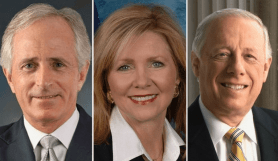
The Senate seat being vacated by Senator Bob Corker’s [R-TN] decision not to run for re-election has become a Democrat “flip” priority. Chuck Schumer personally recruited former Tennessee Governor Phil Bredesen [a Democrat, of course] to run for the seat. Bredesen is several links up the food chain from the typical Democrat running in Tennessee [usually just placeholders because nobody thinks they’re going to win anyway]. He was a very popular Governor considered by many in both parties to have been a very effective one as well.

In the August 2 primaries, hardly anybody would argue against the assumption that Bredesen is a shoo-in for the Democrat Party nomination, or that U. S. Congresswoman Marsha Blackburn [R-TN] is a shoo-in for the Republican nomination — Bredesen because of my foregoing observations, and Blackburn because she’s a well-known and highly-respected Republican in a deep red state [in my opinion, she’s one of the sharpest knives in the House drawer].

This survey attempted to determine how Blackburn and Bredesen would fare in the November 6 General Election.

The Media Outlet Reporting The Results

The Tennessean is about as liberal as you can get in the media world, and it is an affiliate of the USA Today network, which is also clearly liberal. So, it is certainly no surprise that any characterization of the results of this [or any] poll in that publication would support the narrative of a “Blue Sweep” in the 2018 mid-term elections. They will no doubt report on many surveys between now and then, and their characterizations will all be tilted in the same way. If Blackburn wins, but by less than ten points, they will then join narrative like that following the recent 52.6 percent to 47.4 special election victory of Debbie Lesko [R-AZ] in a district that President Trump carried by more than 20 points in 2016 — “more evidence that the margin is closing and setting the stage for a huge retake of the U. S. Government by Democrats.”

The Facts Versus How The Results Were Reported

How Reported. … The headline read “Democrat leads Marsha Blackburn by 3 points in new Tennessee Senate poll.” Within the article, the following statement is inaccurate at worst, and misleading at best: “Democrat Phil Bredesen is ahead of Republican Rep. Marsha Blackburn in the race for an open Tennessee Senate seat. … Bredesen led Blackburn narrowly, 46 percent to 43 percent. … 11 percent were undecided.” Although the next sentence seems like an attempt at “balanced” reporting, [i.e., by “disclosing” a caveat], even it is misleading: “Bredesen’s lead is within the 4-point margin of error.

Just The Facts. … These are the only conclusions that the survey revealed could reasonably be quoted as supporting with a 95% chance of being correct:

  • Percent of people supporting Bredesen: 42.1 – 49.9
  • Percent of people supporting Blackburn: 39.1 – 46.9
  • Percent of people who are undecided: 7.1 – 14.9

    👉🏿  So the facts are that …

  • Bredesen might be ahead of Blackburn by as much as 49.9 to 39.1 or as little as 49.9 to 46.9, or
  • Blackburn might be ahead of Bredesen by as much as 46.9 to 42.1, and
  • The percent of people who are undecided might be as little as 7.1 or as big as 14.9.

    👉🏿  And the only conclusion that can be reasonably substantiated is …

  • This poll is meaningless in terms of predicting any possible outcome of this election.

Our Takeaway

Minimizing Interval and Confidence Levels in most of the poll reporting we see may avoid mesmerizing readers / listeners / viewers with details that might result in loss of their interest in the coverage. However, it also enables creation of impressions that simply are not warranted. Each of my readers can decide on his/her takeaway from this post. My takeaway is “Never trust any one media outlet’s characterization of the results of a poll; either a) take the time to do the math yourself and form your own conclusion with the logic I’ve used here, or b) access multiple sources of ‘news’ / ‘fake news’ and try to net their views into your own composite.”

Thanks for reading this post, and if you regularly follow my Blog, for that, too. Please consider sharing this or other posts with your friends, colleagues and associates.

img_7026 Charles M Jones

Charles M. Jones

The Paradigm Shift And The Upcoming Elections

I developed this web site and began posting to this blog in the summer of 2016 for one reason: I felt that the upcoming Presidential election was the most important in my lifetime, and I wanted to do the best I could to ensure that as many people as I could reach would understand how significant their vote would be in that particular election. Given the outcome of that election and what has transpired since then, I now believe the mid-term elections coming up this November may be even more important.

A Quick Review — November 8, 2016 To Now

My opinions are those of one person among millions, and each person reading this can make up his/her own mind on which if any of these points he/she agrees or disagrees — so without elaborating, here’s my synopsis:

    • We have a President who I don’t like, personally — but I can be encouraged by the fact that this would have been true regardless of who won in 2016.
    • We have a President who doesn’t fit into any of the molds into which traditional politicians [in both parties] and talking heads in the media [both liberal and conservative] — to whom I’ll hereinafter refer collectively as “The Swamp” — try to put all elected officials, particularly the President. In my opinion, that’s a good thing, and would clearly not have been the case had the 2016 election gone the other way [Hillary Clinton is a standard, run-of-the-mill, traditional politician who would easily have fit into a set of standard molds].
    • We have a President who has “rocked all of the boats in all of the lakes.” Rather than just taking each day/week/month as it comes and at least allowing for the possibility that there could be a sensible rationale and pattern behind his seemingly knee-jerk actions, The Swamp spends all its time doing two things: 1) insistently attempting to sort all this out and either force him into an established mold or come up with a new mold that can make it easier for them to “classify” him; and 2) doing everything possible to paint him in a negative light and block everything he tries to do.
    • We have a President who has accomplished a tremendous amount in his first sixteen months in office in spite of what is clearly the heaviest resistance ever for an incoming president — and who realizes the simple fact that a generation from now, it will be his accomplishments, not his personality, or his Tweets, or how many feathers he ruffled while in office, that will dictate how his presidency is viewed.
    • We have a Swamp — most but not all of whom, are Democrats — that will not rest from its efforts to block literally everything President Trump attempts to do until he is out of office by whatever means is necessary to unseat him.

Why The 2018 Mid-Terms Are Crucial

Given where we are, we, the people, have the capacity this November to decide whether or not we are OK with governmental deadlock for at least two more years. Of the outcomes that are possible on November 8, only one will express our desire to continue on the substantially altered path on which we decided to embark in 2016, and only one will express our desire to totally reject that path and [by implication, whether intentionally or not] go back to the previous path. Any of the others will result in [probably not our desire, but nonetheless the path we will have chosen by wasting our votes or choosing not to vote at all] — you guessed it, at least two more years of deadlock. We all need to be thinking about that now — not a few days or even hours or minutes before we go to the polls not only in November, but in the primaries leading up to November.

The Paradigm Shift’s Progress Will Be Key

If you “go with the flow” and assume that the Paradigm Shift I keep writing about either isn’t happening or is taking a lot longer than folks like me predict, you’ll look at polls, listen to media talking heads and panels, and conclude that the probability the Democrats will regain majority status in the House is high and that there’s a good chance they’ll regain majority status in the Senate as well.

But if you look at the pieces of evidence that show how rapidly the Current Paradigm is dying and recognize that the upcoming elections could quite possibly defy conventional predictions and historical precedents [as was the case in 2016], you’ll conclude that the possibility that the Republicans will maintain and possibly even strengthen their majorities in both chambers is by no means just a long shot.

At some point this Summer, I intend to go into a mode with my posts very similar to the mode I was in when I first started them in 2016 — focusing on the November 8 elections and trying to make as many people as I can reach understand that their vote counts, and that by moving the Legislature either toward stronger Republican positions or stronger Democrat positions, they will be making a big difference in the future of this country. In many ways, the same logic applies to these midterms that I stressed so much in the Presidential election: each voter needs to understand that by voting a “protest vote” for somebody other than a Republican or a Democrat — or by not voting — he/she will be unwittingly voting for either the Republican or the Democrat [these voters — or non-voters — simply won’t know which one they voted for].

Possible Scenarios

When I shift into that mode, I will, as I did in 2016, outline the possible scenarios and what the resulting environment would be if each of them plays out as the chosen path when the voters have spoken. Some of the outcomes look very encouraging, but some could create even worse governmental deadlock than we’ve had for the past four years. Stay tuned …

Thanks for reading this post, and if you regularly follow my Blog, for that, too. Please consider sharing this or other posts with your friends, colleagues and associates.

img_7026 Charles M Jones

Charles M. Jones

The Androgynous Scouts Of America

35508When I read of the latest chapter in the history of the Boy Scouts of America this week, it was like watching a video of the last nail being driven into the coffin of that organization.

This Cinco de Mayo was particularly significant to me. The fifth of May was the date in 1959, about a month after my 14th birthday, when I became an Eagle Scout. As I mentioned in one of my posts [What I Learned As A Boy Scout], I doubt that most people understand what is involved in earning that rank, and what the mindset of a boy in his pre-teen and early teen years has to be to achieve that goal.  Nothing I could write here could produce that understanding, but let me say that a love for God and country is at the root of that mindset.

During Cinco de Mayo week this year, the Boy Scouts announced that girls would now be accepted for membership, and that they were changing their name to Scouts BSA. In 2015, they began accepting homosexual and transgender men as leaders, and in 2017 they began accepting homosexual and transgender boys as members. Now, in 2018, they have announced that girls can become members.

It’s interesting that the new name is Scouts BSA rather than Scouts USA. Also interesting, as confusing as the terms “boys” and “men” apparently are to transgender people, is that in announcing the 2015 and 2017 changes the organization made at least a token attempt to minimize overall confusion by temporarily retaining them. At the current pace of metamorphosis, though, any terminology tied to a person’s sex will no doubt disappear soon.

It is now evident that becoming completely “inclusive” has replaced the organization’s original mission “to prepare young people to make ethical and moral choices over their lifetimes by instilling in them the values of the Scout Oath and Law” [referring to versions of those creeds that have existed unchanged since the organization’s founding in 1910]. The ultimate end of the trend established over the past few years is very clear, so I decided to save them a lot of time and just present them with a new set of founding principles that should serve them well going forward. Here it is. …

New Founding Principles

Note. It would be an educational experience for any reader of this blog post to compare the italicized phrases with the phrases they replace in the current versions. Anyone interested in doing that can click this link to display the current versions [just Mission and Vision statements, and current versions of the Scout Oath and Scout Law that are referenced within them — the policies I’ve included below are my speculations, admittedly with a grain of sarcasm]: BSA Mission And Vision.

Organization Name. The Androgynous Scouts Of America [ASA]

Values. Our core values are self expression, equality, inclusiveness, and tolerance.

Mission And Vision. Mission. The mission of the Androgynous Scouts of America is to prepare young people to make socially acceptable and politically correct choices over their lifetimes by instilling in them the values of the Scout Oath and Law.  Vision. The Androgynous Scouts of America will prepare every eligible youth in America to become a responsible, participating citizen and leader who is guided by culturally acceptable norms.

Scout Oath. On my honor I will do my best to do my duty as a natural part of the Cosmos to my country, and to obey the Scout Law; to help other people be true to themselves at all times; to keep myself in good physical and mental health, and to always be one with Nature. Scout Law. A Scout is Trustworthy, Loyal, Helpful, Friendly, Courteous, Kind, Tolerant, Cheerful, Thrifty, Inclusiveness-minded, Clean, and Respectful Of Nature.

Admission Policy. All persons 11-17 years of age are welcome to apply for membership in the ASA, regardless of their race, color, creed, national origin, sexual orientation, or preferred sexual identity on the date of their application. Regarding the age limitation, it is not our intent to discriminate on the basis of age. People younger than 11 are encouraged to joint the Cub Scouts. People older than 17 may submit applications, each of which will be considered on a case-by-case basis. Regarding sexual orientation and preferred sexual identity, those preferences at the time of original application must be so listed, but can be changed at any time by filing the appropriate form to ensure that ASA records remain correct.

Advancement Policy. Advancement levels include Tenderfoot, 2nd Class, 1st Class, Star, Life and Eagle. Earned merit badges are among the requirements for the three highest ranks. Some of these merit badges are mandatory and some of them may be selected from among options suitable to each individual. To the extent anyone aspiring to a particular rank in this progression feels that his/her/their ability to achieve that rank is limited because of physical or emotional restraints related to their biological sex or preferred sexual identity at a particular point in time, a participation medal will be awarded as a substitute so that progression to the next rank can be pursued.

Policies Governing Activities.

    • Outdoor [Hiking, Camping, etc.]. All latrines must allow access to all members based on their preferred sexual identity at the time of needed use. Tent-mates at events involving overnight camping will be assigned by random selection. Should anyone desire reassignment, such reassignment will be granted only if both original assignees and both new assignees agree with the change.
    • Civic. Participation in demonstrations and other forms of support or protest are not sponsored or funded by ASA, but individual and troop- or council-level participation is a decision left to individuals and local troops and councils.
    • Social. No chaperones are provided by ASA. Relationships between consenting preteens and teenagers are private personal matters, and the ASA does not interfere in those matters.
    • Programmatic. All troop- and council-level meetings — as well as programs such as camporees — must be developed from a gender-neutral perspective. Content and themes must not be interpretable as oriented toward either biological sex.

Would I Do It Now?

It was shortly after my twelfth birthday when I decided I wanted to be an Eagle Scout. It’s difficult to accurately go back in time and say what I would have done at that age given the circumstances that exist today, but I think my decision about being a Scout at all — much less committing to what would be required of me to earn the Eagle Scout rank — would have been “No thanks, that organization doesn’t match up to my worldview and value system.”

Thanks for reading this post, and if you regularly follow my Blog, for that, too. Please consider sharing this or other posts with your friends, colleagues and associates.

img_7026 img_3358

Charles M. Jones

Things That Matter (In Politics)

Corker-Blackburn-Bredesen

A few years ago, Charles Krauthammer published an excellent book entitled Things That Matter.  That title for this post, with the parenthetical “(In Politics)” won out over the first runner-up, “Wake up, Bob!” It’s a shame that our elected leaders can’t just “tell it like it is” rather than have to tiptoe through the mechanics of how our government actually works realizing that anything they say can be twisted into something entirely different. Outgoing Senator Bob Corker knows as well as anybody in Washington that a Republican loss of their razor-thin one-seat Senate majority, even if they keep their House majority, will clinch at least two more years of deadlock — and that retention of or even a strengthening of their Senate and House majorities will at least not worsen the current situation and maybe even make it much better. I also believe he is an honest man, a businessman who did a reasonably good job of wading through The Swamp during the past twelve years to become about as effective as a Senator as it is possible to be these days. Unfortunately, being an honest man and being an effective elected official — even if not seeking re-election and on the way out — is like walking a tightrope from a political perspective.

From a Republican perspective, Corker’s very tepid endorsement of Representative Marsha Blackburn— who is viewed as a shoo-in for the Republican nomination — is problematic. Although Tennessee is considered solid Republican territory, her opponent in the General Election will almost certainly be Democrat Phil Bredesen — a very popular previous Governor considered by many in both parties to have been a very effective one as well.  Corker has even been quoted recently as referring to him as “a very good mayor, a very good governor, a very good business person.”

Words Matter — Both The Articulated Ones And The Omitted Ones

I believe very firmly — and have written about this quite a bit in my posts to this Blog — that a New Paradigm is well on the way to “taking over” as the Current Paradigm. Unfortunately, the current political environment is still in the Old Paradigm — hanging on by its fingernails, but nonetheless still setting the ground rules. This, coupled with ideological polarity that has become more entrenched than it’s ever been in my lifetime, has essentially neutered our system of government — the commonly-used phrase for referring to this condition being deadlock.

Until the New Paradigm can pry loose the white-knuckled fingers of this political component of the Old Paradigm and let it fall to the bottom of the ravine between the paradigms, we have to live with the way things are, and endorsement of a non-incumbent by an outgoing incumbent is important when the outgoing incumbent is popular and viewed as having been successful. Corker is such an outgoing incumbent.

Corker’s above-mentioned remarks about Bredesen, even though true in my opinion, could cost Blackburn votes she would otherwise have definitely gotten just because she’s a Republican and has a pulse [nothing negative toward her intended — in my opinion, she’s one of the sharpest knives in the House drawer]. In a race as tight as this one could turn out to be because she faces a Democrat several links up the food chain from the typical Democrat running in Tennessee [usually just placeholders because nobody thinks they’re going to win anyway], any such loss of votes from her “base” could cost her the election.

Corker appeared on CNN recently and made similar positive comments about Bredesen while offering a very tepid endorsement for Blackburn. He didn’t even mention Blackburn by name, but said he had sent the maximum campaign contribution to “the Republican nominee on our side,” adding that he plans to vote “for this person.” When CNN’s Dana Bash suggested that he did not seem very enthusiastic about Blackburn, Corker replied: “Well, Dana, you know I’m supporting the nominee. I’ve worked with the nominee for some time, and I don’t know what else to say.”

Enter “Spin” And Media Bias …

Enter at least two of the most liberal media outlets in the country to maximize spin from Corker’s political screwup [or successful attempt to purposely increase the odds of a flip of his Senate seat — I really don’t want to entertain that thought]. A CNN recap of that interview featured this caption: Corker gives worst endorsement of all time. A USA Today article carried the headline Democrats cheer Senator Corker’s praise for Bredesen.

Corker [who was Mayor of Chattanooga when Bredesen was Governor] was quoted in media coverage as saying that he has worked well with Bredesen in the past, considers him a friend and will not campaign against him this fall — and that he intends to vote for Blackburn but suggested Bredesen could appeal to some Republicans in November. “I think he’s got real appeal — I don’t think it, I know it,” Corker said.

Well, I won’t bother with the mechanics of changing the title of this post, but as I wrap up writing the content I’m tempted to go back to the first runner-up, “Wake up, Bob!”

It’s Just Simple Current-Paradigm Math

It will be very interesting to see how the mid-term elections go this November. If statisticians, pollsters and pundits are proven wrong [as they were in the 2016 elections] and Republicans actually increase their margins of legislative majority — particularly in the Senate — we could be in for some really big strides for the better in this country. If they’re proven right and Republican majorities are weakened or even lost, we might as well all get ready for at least two more years of even worse deadlock than we had during Obama’s second term and have had so far in Trump’s first term.

I certainly hope Senator Corker’s politically stupid remarks don’t become one of the things we look back on after the November 6 elections and number among the things that caused the statisticians, pollsters and pundits to be proven right in their predictions.

Thanks for reading this post, and if you regularly follow my Blog, for that, too. Please consider sharing this or other posts with your friends, colleagues and associates.

img_7026 img_3358

Charles M. Jones

A Bridge Too Far

M Wolf

Thankfully, I’d never heard of Michelle Wolf before the media was full of “breaking ‘news’” about her “comedy” performance at the White House Correspondents’ Dinner on Saturday April 28. And, had what she said been even remotely in the realm of common decency, I’d no doubt be having trouble recalling her name a few days later.

The title of this post comes from the 1977 war film bearing that title, which came from a comment attributed to a British Lieutenant-General, who in reference to a largely unsuccessful operation intended to allow the Allies to break through German lines and seize several bridges in the occupied Netherlands, told his commanding officer “I think we may be going a bridge too far” in reference to the intention of seizing the Arnhem bridgehead over the Rhine river.

With all the flack in a huge flow of headlines I saw about this in my news feed on Sunday April 29 — even liberal media sources saying that Ms. Wolf “stepped over the line” — I decided to actually watch the 20 minute video of her part of the program. About half way through it, I literally had to force myself to continue. I absolutely couldn’t believe thatanybody — liberal, conservative, Democrat, Republican, whatever — could stoop that low and articulate that kind of filth even in an event like the White House Correspondents’ Dinner.

“Full Disclosure” — Where I’m Coming From

I said when I started up this web site a couple of months before the 2016 elections why I was doing it. I also said that although I wanted to fully disclose my deep-seated Christian faith up front, I intentionally wanted to avoid making the site or the posts to this blog being characterized as “Christian” or even “religious.” I explained all of that in depth in the pages of this site — e.g., Home Page, Who I Am, Why I’m Doing What I Do, and What I Do. I would strongly encourage anyone reading this post — regardless of how you view yourself  from a political or religious perspective — to at least do a cursory review of those pages. I am not writing here only as a Christian — I am writing from a perspective of common human decency that I believe millions of people share with me regardless of whether or not their ideological and political leanings align with mine. Also, particularly if you don’t share my worldview, consider this sample of statements about Ms. Wolf’s remarks by liberal media executives:

Margaret Talev, President, White House Correspondents Association. “Last night’s program was meant to offer a unifying message about our common commitment to a vigorous and free press while honoring civility, great reporting and scholarship winners, not to divide people. Unfortunately, the entertainer’s monologue was not in the spirit of that mission.”

New York Times. “Ms. Wolf’s political comedy routine … was scathing, confrontational and impolite. … The correspondents’ dinner, the past weekend’s fiasco shows, … seems not to know what its purpose is.”

Maribel Perez Wadsworth, President of the USA TODAY Network and Publisher of USA TODAY [from a letter she wrote to Margaret Talev, President, White House Correspondents Association]. “I realize that this is not the first time a speaker at the dinner has sparked controversy. We, however, should not be the controversy. … Some have said that showcasing Michelle Wolf is a celebration of the First Amendment. … In truth, Ms. Wolf represents one point of view, and it is her right to share it. But should we in the press be the ones to give her the stage? Is it appropriate that we invite a celebrity to launch a relentless, and often vulgar, attack on the very people we cover? … I know you agree our credibility is far too important to compromise over a 20-minute abdication of the high road and a few cheap laughs.”

You Be The Judge

Reluctantly, I am including a link to the full 20-minute video here — reluctantly because I hate to do anything that could increase the number of people reached by Ms. Wolfe’s remarks [here’s the link: Michelle Wolf – WHCD]. However, if you haven’t seen it, I believe you should watch it, because in my view this video could be a “litmus test,” something that could reveal just how many people in this country believe as I do that it’s “a bridge too far.”  I honestly believe that number is a clear majority — possibly even two thirds, maybe even more — spanning all political and religious persuasions.

If you consider yourself in this majority, please read on. If not, please read on anyway. … If even one person who does not identify with this majority now becomes one who does as a result of reading this post, the time I spent writing these thoughts will have been well spent — or I’d like to think, well invested.

A Call To Action

What else beyond this could possibly be needed to bring all decent people in this country to the realization that we can no longer just say after something like this “Gosh, that was ‘over the line’“ and then just go about our business and not speak up and/or do something? Let me ask all people reading this post, whatever your political and religious persuasions, to look for and find ways that you, personally, can speak up — or better yet, do something to let this country — and the world —know that what this woman said is not within what the vast majority of Americans would say is within reasonable and acceptable bounds around “freedom of expression.”

To my Christian Readers

I appeal to my Christian readers with this charge to us in the Bible. … “Contend earnestly for the faith which was once for all entrusted to the saints” [Jude 3 NKJV/NIV]. And consider these words of wisdom from great leaders from the past. … “If I profess with the loudest voice and clearest exposition every portion of the truth of God except precisely that little point which the world and the devil are at that moment attacking, I am not confessing Christ, however boldly I may be professing Christ” [Martin Luther. ] … “Silence in the face of evil is itself evil.  God will not hold us guiltless.  NOT to speak IS to speak, NOT to act, IS to act” [Dietrich Bonhoeffer.]

To My Non-Christian Readers

I’ll have to admit that it’s difficult for me to understand how anybody, regardless of their worldview and belief system, could consider Ms. Wolf’s remarks appropriate. Since any argument I could offer would stem from my worldview and therefore be invalid on its face from your perspective, all I know to do is ask you to back away from the detail and the political “spin” and just view them through the lens of basic human decency. I can’t help but believe that doing so will lead you to the conclusion that what she said just wasn’t right.

Thanks for reading this post, and if you regularly follow my Blog, for that, too. Please consider sharing this or other posts with your friends, colleagues and associates.

img_7026 img_3358

Charles M. Jones
The Elephant NOT In The Room

Polling Place Voting Booths

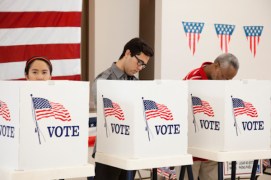
In all the media coverage on political issues [which is a HUGE percentage of all coverage], it’s interesting that almost nothing is ever reported about “the elephant in the room” — or as the title I chose for this post probably more accurately ties my theme here to that commonly-used phrase, “the elephant NOT in the room.” The elephant NOT in the room is about 144 million people who rarely if ever vote.

A Closer Look At The Elephant

Voter Turnout

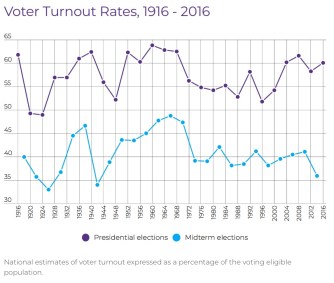
The voter turnout rate for midterm elections — such as the one coming up this November — is reliably lower than for presidential elections. In 2014, only 36% of eligible voters voted, while 64% [144 million] stayed home. Even in presidential elections, turnout averages only about 60%. Think about that. On average, three of every eight people you see when walking down the street never vote, and only five of eight vote on the person who will be their next President.

According to a recent USA Today / Suffolk University poll, people who don’t vote cite several reasons for their lack of participation in this fundamental element of our democracy:

    1. They don’t trust politicians,
    2. They don’t think their vote will change anything,
    3. They consider the electoral choices uninspiring, or
    4. They simply don’t have the time and transportation to get to their local polling place.

Please note. … If anybody said their reason for not voting was that they think everything is fine with our country and its leadership [i.e., so those who are voting seem to be doing a good job], the percentage was so low that it didn’t make it into the list of reasons the pollsters considered statistically significant.

The Most Powerful People In America?

I could build a pretty good case that these 144 million people who never vote could be the most powerful people in America — and that the second most powerful group of people could be the 72 million of them who only vote in Presidential election years. So to all of them, I’d offer this advice: Wake up! You have the power to change this country to whatever you think it should be rather than leaving that to a minority of people who currently have a much louder voice than yours. In number, you are at least five to six times the largest margin of victory of any U. S. President in our history [61.5% by Lyndon Johnson in 1964 — about 16 million votes]. Since 1820, only four Presidents have received 60% or more of votes cast [a 20% margin of victory], and only nine have received 55-60% of votes cast [a 5% to 10% margin of victory].

To those who cite reason #1, I’d advise them to consider what President James Garfield said: “The people are responsible for the character of their [leaders]. If [they] be ignorant, reckless, and corrupt, it is because the people tolerate ignorance, recklessness, and corruption.  If [they] be intelligent, brave, and pure, it is because the people demand these high qualities [in the people who] represent them.” President James Garfield [bracketed substitutions by me — his remarks were directed specifically at the Legislature, but are clearly applicable to all elected officials].

To those who cite reason #2, I’d advise them to read the history of past elections in which every vote clearly made a difference — most recently, the 2017 election in Virginia for a House of Delegates seat which actually resulted in a tie and was literally decided by the flip of a coin.  At first, Democrat Shelly Simonds thought she’d won the race by a single vote. But the next day, a panel of judges ruled that a ballot — originally thrown out by officials — should be counted in favor of her opponent, Republican David Yancey, making the election result a tie. The ensuing coin toss shifted the victory to Yancey. One additional vote for either candidate would have changed the outcome of that election.

To those who cite reason #3, what can I say — in many elections, you’re absolutely correct! However, President Garfield’s words point the finger of blame to — you guessed it: “We have met the enemy, and he is us,” as Pogo [Walt Kelly] said [a twist on the words of a message from American naval officer Oliver Hazard Perry in 1813 after defeating and capturing British Royal Navy ships in the Battle of Lake Erie: “We have met the enemy, and they are ours.]”

To those who cite reason #4, I’d say, “Name at least five of the many things in the past five days that you found time for and transportation to that were far less important than exercising what is probably the most precious right you have as an American citizen.”

I’ll close with this food for thought: “In the end the ultimate threat to the American republic will be America.  The problem is not with wolves at the door but termites in the floor.” Os Guinness

Thanks for reading this post, and if you regularly follow my Blog, for that, too. Please consider sharing this or other posts with your friends, colleagues and associates.

img_7026 img_3358

Charles M. Jones

Political Lessons From … Music?

m17000_1

People who know me well know that I have a passionate appreciation for music [not to be confused with much out there these days that is called “music” but is something else]. Interestingly, some recent bipartisan action by our legislators to address some archaic music licensing practices gave me an idea — maybe there is something we can learn from music that can help us get our polarized, deadlocked government off dead center and actually producing meaningful results for our country. A piece of bipartisan legislation that recently advanced unanimously from the House Judiciary Committee proves that there are at least some things that don’t immediately shoo both Republicans and Democrats into their corners ready to come into the ring swinging when the bell rings to start Round 1.

Yes, Bipartisan

You read that correctly — I did, in fact, say “bipartisan”. I know that’s a concept that seems to have been completely lost, but it actually happened. This bill — the Music Modernization Act — is on a fast track to becoming law after the House Judiciary Committee, which has been very bitterlydivided by partisan politics, unanimously recommended the legislation. I honestly don’t remember the last time I heard remarks from legislators like these. …

“Let no one say that we cannot in a bipartisan manner musically fix a very important and crucial part of the American economy,” Rep. Sheila Jackson Lee [D – Texas] said. Rep. Hakeem Jeffries [D-New York] said the bipartisan success shows the nation that “when you bring a coalition of unusual suspects — a conservative [Republican] from rural Georgia and a progressive Democrat from … Brooklyn — things get done.”

And Bart Herbison, executive director of the Nashville Songwriters Association International, called the unanimous vote a “historic moment.” “The fact it was unanimous makes me very optimistic it gets through the rest of the procedures,” Herbison said. “We still have a way to go in terms of a full House vote and the Senate. But, look, it’s a great day.”

The legislation aims to improve the ease of licensing a song for streaming services by creating a new nonprofit organization, run by publishers and songwriters, that will now be in charge of identifying rights holders and paying digital royalties.

Compromise Not Just Within The Government

In addition to the bipartisan support the bill gained from lawmakers, it also came together after a series of compromises by music industry stakeholders. Virtually every corner of the music industry supports the bill. Key parts of it are: 1) In exchange for the new licensing system, songwriters and publishers will forfeit some of the ability to sue streaming companies like Spotify and Apple Music for not properly licensing their songs; 2) The standard that the federal rate court uses to set the digital royalty rates for songwriters and publishers is changed to a free market standard; 3) It closes a loophole in federal copyright law that caused artists whose songs were recorded prior to 1972 not to be paid royalties when their music is played over internet radio; and 4) It codifies the existing practice of paying music producers compensation stemming from digital royalties earned by artists.

First Music, Then …

I’d be willing to bet that of the dozens of key bills that would be great for this country if they could become law, most actually could become law if Representatives and Senators would just approach them the way they approached the Music Modernization Act — i.e., first, just look at a bill on its merits [ignoring the party affiliation of its sponsor]; second, find points within it on which there might likely be immediate consensus [surely, there are alwayssome]; third, don’t assume that there is no way consensus can be reached on other points [i.e., focus on finding conceptual approaches to addressing differences rather than immediately jumping into half-hearted efforts to hash out details under pre-programmed party-driven “principles”]; and finally, quit hiding behind procedural rules that always seem to win out [e.g., the filibuster in the Senate, and absolute authoritarian control of the House Speaker and Senate Majority Leader over what even gets to floor votes].

Music is a creative activity. It would be great if some of the creativity that crept into the House Judiciary Committee in the Music Modernization Act deliberations could find its way into all of our legislative chambers.

A Quick Side Note. … The image I chose for this post is the score to Polanaise in A Flat Major, by Frederic Chopin — one of my very favorite pieces of music. It’s hard for me to grasp the sheer genius of a person who could sit down at a piano with a blank sheet of paper and a pen and come up with something like that.

Thanks for reading this post, and if you regularly follow my Blog, for that, too. Please consider sharing this or other posts with your friends, colleagues and associates.

img_7026 Charles M Jones

Charles M. Jones

Note: Much of the content in this post was extracted from two articles in the 4/12/18 edition of the Nashville Tennessean, some paraphrasing and some directly quoting those articles.

Nashville Transit Proposal Vis-A-Vis The Paradigm Shift

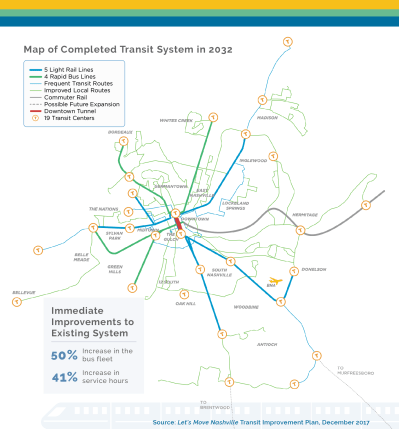
1_TFN_MapSince my target audience is national rather than state or local, I tend to avoid writing in this Blog about topics that are clearly of interest mainly to people in the state and city where I live. However, one highly visible and controversial Nashville-specific topic right now presents to me an opportunity to “kill two birds with one stone.”  For the benefit of people in the Nashville metro area, I will indicate my rationale for clearly identifying with one side of the current controversy. For the benefit of those people and everyone else in this country, I’ll describe the situation from the perspective of how the Current Paradigm, hanging on by it’s fingernails while the New Paradigm continues rushing in at a rapidly accelerating pace, is still not totally dead.

The Local Aspect [Prerequisite To The Paradigm Shift Perspective]

The topic, from a local perspective, is a May 1 referendum that will be a “Go / No-Go” decision on a proposed $8.95 billion [note the “b”] mass transit system anchored around a hub-and-spoke light rail network that includes a 1.8-mile underground tunnel through downtown to the hub, 26 miles of track to form the spokes, a rapid bus network on four other roads, improvements to the city’s current bus system, and 19 transit centers that would include park-and-ride and other transit options. Funding, in addition to revenue from fares when the system is fully operational [15 years from now], would be from increases for 50 years to four taxes: local sales tax [1% increase, raising the overall sales tax rate from 9.25% to 10.25%]; hotel/motel tax [0.625% increase], business and excise tax [20%]; and rental car tax [1.2% increase].

I can wrap up this Local Aspect section by quickly summarizing my Letter To The [Tennessean] Editor that was published in the 4/3/18 edition. …  This mass transit plan could easily have been pulled from dusty archives in Chicago or New York or Boston — where it may have been “innovative” in the first half of the last century. If it is approved, we are “betting the farm” on the philosophy that citizens will design their lives around a fixed transit infrastructure. There was absolutely no “Point A to Point B” thinking in the design. “Innovative” thinking in 2018 would start with observing traffic and commercial/residential development patterns to develop a matrix of specific points of origin [Point A] to specific destinations [Point B], then using sophisticated mathematical modeling to determine a route matrix, and finally factoring in options like bike-sharing, autonomous vehicles, ride-sharing services, etc. $8.95 billion over 15 years is $597 million per year. On that budget, I’d be willing to bet that a much better and more flexible and adaptable plan could have been devised that we could have begun actually using this year.

The Bigger Picture: Paradigm Shift Perspective

Elements of Current Paradigm thinking run throughout the two-year process of developing and gaining approval of this plan. As I mentioned in my letter referenced above [no Point A to Point B thinking], all the people involved did was gather statistics from other cities with rail-based hub-and-spoke systems [“ridership” as a percent of population; fares; operating costs; whether operating below, at or above cost; etc.], translate those statistics to Nashville’s demographics, get estimates of construction costs [little more than educated guesses at this point], develop a budget, and begin the marketing and sales effort. All of that is Current Paradigm thinking. Only the people who are the opponents of this plan are exhibiting New Paradigm thinking by at least mentioning alternative conceptual approaches seriously.  Proponents only mention them in rebuttal mode: “That won’t work because …”, “That’s pie in the sky thinking; we need something more doable now” [apparently forgetting that “now” for their plan is 2034], etc.

Twenty Days From Now …

We’ll know the outcome in twenty days [May 1], probably shortly after or possibly several hours after the polls close. My guess is that the proponents will win if for no other reasons than 1) the fact that they have more money for media ads [and so far seem to be successfully creating an atmosphere of “the sky is falling”, “this is our chance”, “it’s now or never”, etc., to make voters feel like they will be dooming Nashville’s future if they vote “No”], 2) the entire description of this massive proposal on the ballot is only 244 words, and 3) a very small percentage of voters will have actually read even that short synopsis, and the vast majority will be swayed more by the media coverage than by the facts.  If they do, I can predict three things with almost certainty: 1) the project will not be finished on schedule in 2034; 2) the total costs to date in 2034 will be at least $13-15 billion [a 50% overrun], probably more; and 3) traffic in Nashville will be at least as bad as it is now, possibly worse.

If it passes, and if I’m still around in 15 years, somebody please remind me of how accurately I predicted this in 2018.

Thanks for reading this Charles M. Jones, and if you regularly follow my Blog, for that, too. Please consider sharing this or other posts with your friends, colleagues and associates.

img_7026 img_3358

Charles M. Jones
The Role And Toll Of Polls

MediaLogos

A local news article in a recent issue of the [Nashville] Tennessean initially caught my attention not because of the subject matter, but because of the way it was titled — NASHVILLE GENERAL Poll: Residents support more funding for struggling hospital. The question that immediately came to mind as I read that title was whether the wording of the question pollsters asked might have influenced the results, resulting in this headline. As I read the article, I was drawn more to what it revealed about polling than to the actual content related to the hospital.

The Role Of Polls

Polls, if taken following strict rules of statistical math to ensure the proper size and stratification of the pool of respondents, can be very useful. However, the slightest bend or twist from these rules can produce bias in the results. That why you’ll see certain polls emphasized in one set of media outlets and other polls emphasized in another set of media outlets. Bias can be introduced into a poll in at least two ways I can think of even if rules that ensure randomness [e.g., sample size] are followed.

First,, the polling medium [“land line” phones, cell phones, snail-mail mail-outs, email mail-outs, door-to-door, etc.] can introduce bias because different strata in the population are more apt to have access to — or to be responsive to pollsters using — various polling media [strata in this context meaning segments by race, age, sex, education, marital status, etc.].

Second, different ways of wording questions can cause people to feel “obligated” to pick a particular  answer from a list of choices even if that answer is not fully consistent with what they would write as a free-form answer if given that opportunity. Surveys sent out by political parties [the main purpose of which is to solicit contributions, not to determine what voters think about issues] are the “poster children” of this source of bias — “__Yes __No: Do you support our strong position on a woman’s right to make her own decisions about her reproductive health and our support of Planned Parenthood as a key partner in helping them navigate through difficult personal decisions regarding unwanted pregnancies?” or “__Yes __No: Do you support our strong position that securing our borders is an absolute prerequisite to development of a successful Immigration Reform plan, and that building a wall on our sudden border is a necessary component of securing our borders?” Any Democrat would feel pressured to answer “Yes” on the first question, and any Republican would feel pressured to answer “Yes” to the second.

Many Democrats, if given the opportunity to write a free-form answer to the question to which “Yes” clearly means “I’m pro-abortion,” might write an answer that would not be so easily characterized that way. Many Republicans, if given the opportunity to write a free-form answer to the question to which “Yes” clearly means “Yes, I fully support the Republican stance on Immigration,” might write an answer that would not be so easily characterized that way.

The Toll Of Polls

Toll, in the context in which I’m using it here, refers not to the costs of conducting polls, but to the impact on public perception. As I’ve pointed out above, bias can — and I believe often does — play a significant role in interpretation and reporting of the results — and the results, particularly when presented through the biases of the media outlets through which they become public, have a tremendous impact on how the public’s view of the issues covered by polls is formed.

So What Conclusion(s) Can Actually Be Drawn?

I’ll conclude by getting back to the article that brought this concept to the forefront of my attention this week — the article that led with the headline “Residents support more funding for struggling hospital.” Well of course they do! Who is going to answer “No” to that question if the hospital is characterized as a “safety net facility for the poor and uninsured?” 

The only conclusion that can actually be drawn from this particular poll is that people like the idea of government support for the underprivileged. It made no connection between the touchy/feely aspect and the more practical aspect that would likely have affected the answer of many of the people who were polled — i,e., the cost to taxpayers of this particular ongoing and constantly-increasing expenditure vis-a-vis the tradeoffs, like what other costs might ultimately have to be cut if we continue this funding. And I doubt if even a tenth of one percent of the people polled have any idea whether the $35 million current support level is adequate or not — or whether the “emergency” increase is a true need or one generated by less than optimal management over the years of funding support already received.

In closing, I should emphasize that the point I’m making here has nothing to do with this hospital or whether or not they need the increased governmental support they seek. The point is that polls need to be interpreted in light of the considerations I’ve brought out here.

Thanks for reading this post, and if you regularly follow my Blog, for that, too. Please consider sharing this or other posts with your friends, colleagues and associates.

img_7026 img_3358

Charles M. Jones

Regulating Technology — Civi, Caveo!

A March 26 article I read in USA Today amplified an impression I’ve had for several years — that regulation of technology presents challenges I honestly don’t see our current law-making process [and certainly not the average profile of person currently in office] capable of handling effectively.

The new law about which the article was written has been dubbed the CLOUD act. It was one of the many “earmarks” inserted into the massive $1.3 trillion spending package passed last week. Its purpose seems innocuous enough, and on the surface, logical — to simplify the process for the U.S. government and its allies to get evidence of serious crimes and terrorist threats when that evidence is stored on a server in another country.

I’m happy to see efforts to replace laws that technology has long-since made obsolete. The CLOUD Act is an attempt to update a 32-year-old law that was passed before the World Wide Web existed. That obsolete law, the Stored Communications Act, is the subject of a case before the U.S. Supreme Court — a case that is now moot because of Congress’ approval of this new law.

However, detractors of this particular law make some interesting points that suggest we are probably in store for many unforeseen consequences that will stem from it. Consider, for example, these observations:

    • The law could make it easier for nations with human rights abuses to spy on dissidents and collect data on Americans who communicate with foreign nationals.
    • The law allows foreign governments to wiretap on American soil, using standards that don’t comply with U.S. law, and gives the executive branch the power to enter into agreements with other nations without congressional approval [from a joint letter to Congress from several civil liberties groups].
    • Twenty-four groups said the law permits foreign police agencies to obtain information about people in the United States without having to follow the search-and-seizure rules imposed by the U.S. Constitution, and that it could give foreign governments access to information they could use to torture their opponents.

I’m sure there are or will be arguments about these observations, but my point in listing them here isn’t to endorse these specific assertions. My purpose in listing them is that whether they are 100% accurate or not, they bring visibility to the concept of unintended consequences in the context of regulation in general, and specifically [and I believe, peculiarly] regulation of technology.

If I tie my impressions as I read this article with similar items in media coverage over the past several years [at what feels to me to be a rapidly-increasing frequency], my general disdain for the competency of our current elected leaders to effectively deal with regulatory challenges in technology is potentially becoming greater than that for their competency to effectively deal with our unsustainable fiscal path. Consider these technological challenges:

    • Drones. Getting a grip on licensing needs, and knowledge that should be required of those seeking licenses, is progressing much less quickly than the technology itself.
    • The problems FaceBook is facing, as evidenced by its recent stock slide and two items in the media just this week … Facebook ads apologize for Cambridge Analytica scandal [3/26/18] and Facebook falls on the ropes, stunned by heavy backlash: FTC to probe potential misuse of personal data [3/27/18], both in USA Today.
    • Technical restraints that attempts at Gun Control and Immigration Reform legislation have exposed. Observing media coverage of arguments on both sides of these issues makes it clear that our capacity to implement something as simple as better background checks is limited to a considerable extent by antiquated and disjointed systems controlled by many different agencies at various levels of government.
    • Cyber warfare that is clearly going on. It’s difficult to access any media coverage in any medium on any given day without being keenly aware that we do not have a handle on this issue — and that we are by no means leaders either in capitalizing on the underlying technologies or in defending ourselves against those who have done so more effectively.
    • Robocalls. Anybody who has ever registered with the FTC’s Do Not Call registry knows that this feeble attempt at regulation was nothing more than a way for politicians to say they “did something about this issue.” An article just this week revealed just how massive a problem this is and how far behind regulators are in dealing with it [FCC approves plan to cut down on millions of pesky robocalls, USA Today, 3/27/18].
    • Autonomous vehicles. Read/listen/watch any media source on any given day to see this as yet another example of regulation trailing technology.

So be on the look out for many unintended consequences and after-bad-things-happen / didn’t-see-that-coming adjustmentsOr as the title of this post suggests, Civi, Caveo! [Citizen, Beware!].

Thanks for reading this post, and if you regularly follow my Blog, for that, too. Please consider sharing this or other posts with your friends, colleagues and associates.

img_7026 Charles M Jones

Charles M. Jones