An Alarming Development — P.S.

UAL Cartoon 2017-04-18On 11/22/16, I posted to this blog an item entitled An Alarming Development [that link will take you there]. The basic theme might be looked back upon as a caveat about screening of what individual citizens can see in the media [and more importantly, who decides what content is “allowed”]. The “alarm bell” for me that prompted that post was an article about “fake news” that basically said Google, FaceBook and Twitter [et al] were being pressured to screen out “fake news”.  While that may sound good on the surface, it raises the question as to who decides what is fake and what is real [I have since posted additional blogs on the subject of “Fake News”, e.g.: News [Or NNTN?] Circa 2017; Fake News Or Just Meaningless News?; Announcing My New App News4Me].

The reason I’m posting this item this week is that this is one of those insidious trends that can sneak up on us, as a society, and “grab us” before we realize what has happened [by which time it would probably be too late to reverse the trend because our culture would have already “adapted” to being manipulated in this way].

I chose the seemingly unrelated cartoon about United Airlines as the image for this post because, in my opinion, the media has correctly pounced on the recent incident of physical removal by force of a passenger from one of its flights as a way of enforcing their policies for dealing with overbooking situations.  All airlines overbook because it makes perfect sense financially to do so. All airlines use this technique to maximize actual passenger counts [and therefore profits]. United’s failure was not in using that technique; it was in not having policies in place [and employees trained and empowered to “do what is right” rather than just blindly follow procedures] to effectively manage a situation like the one that occurred that day [no volunteers to get “bumped” to another flight, even with incentives offered]. That incident will end up costing United at least millions, and quite likely tens — maybe scores, maybe hundreds — of millions of dollars, when simply letting incentives go as high as necessary to get the seats needed would have been, probably at most, a few thousand [or $10,000, or whatever] more than they had already offered [practically everybody has some incentive value at which getting involuntarily “bumped” is “an offer they can’t refuse”].

The operative phrase in the above paragraph is “in my opinion”.  Although all of the media coverage I’ve seen on this incident has been pro-passenger and anti-United, I’d be surprised if there are not at least some people of the opinion that the issue was overblown and United was within its rights to “do whatever was necessary” to enable the flight to proceed. The reason I’ve gone into this level of depth on this incident is because it relates directly to the broader issue I’m writing about — What is appropriate “news” coverage? and 2) Who decides what is “appropriate”?

What Is “Appropriate”?

So what content is “appropriate”?  Although it’s difficult for me to imagine how anybody could actually think posting a murder on FaceBook in real time [which was done just a few days ago] is “appropriate”, I suppose there are probably some people out there who believe it is the killer’s First Amendment right to post whatever he wants, including himself in the act of killing another person in cold blood. On the other end of that spectrum might be a newspaper editorial saying, in so many words, that we all need to listen to each other better and respect each other more regardless of our political leanings and party affiliations. Between these two extremes literally unquantifiable numbers of situations, each one no doubt garnering support from any philosophical direction one might pick [see the Loss Of A Common Value System page at this site for some additional insight from this perspective].

Who Decides What Is “Appropriate”?

And who decides what is “appropriate”? This is probably the bigger, more insidious issue.

An article in today’s USA Today [see it here: USA Today Article 4/18/17] about the above-mentioned posting of a murder on FaceBook, while sounding good on the surface [FaceBook says “We know we need to do [a] better” job of finding and deleting this kind of content], still sounds an alarm about over-censoring of content [not this content, in my opinion, but that’s my opinion].

If there is no screening of content, it’s completely up to the reader/listener/viewer to decide. If there is any screening, the potential is there for “somebody” to determine “appropriateness” based on his/her ideological beliefs, thereby screening out content that the reader/listener/viewer never even has the opportunity to read/hear/see. Leaning too far toward the latter [any screening] would no doubt end up with the worst-case ultimate outcome — totalitarianism. Leaning too far toward the former [no screening] causes all of us to have to filter through the barrage of content and decide for ourselves what is “appropriate” [see my post News [or NNTN?] Circa 2017 for a guideline for personal self-screening].

So …

I know I may sound overly skeptical or even paranoid about this, but to me, this is something we all need to not only be keenly aware of, but to “monitor” closely these days. Otherwise, George Orwell may have been off on the date in his 1949 book 1984, but right on the money in his subject matter!

img_7026 Charles M Jones

Charles M. Jones

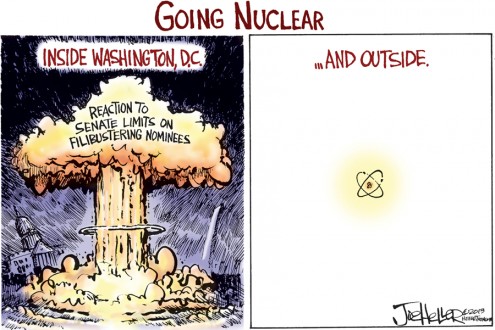
“Going Nuclear” On Gorsuch — And? …

IMG_3287

I honestly don’t understand why Mitch McConnell’s 4/6/17 decision to extend Harry Reid’s 2013 “nuclear option” method of getting federal judgeships through Senate confirmations and apply it to Supreme Court confirmations as well was such a big deal. To me, it’s just another confirmation of what I’ve been saying since starting this web site and making posts to its Blog section — that a major paradigm shift is well underway in this country [see the A Major Paradigm Shift Well Underway page at this site]. Democrats would have tried to filibuster any SCOTUS nominee — it wasn’t about Neil Gorsuch.  And, despite all the rhetoric about this filibuster being “payback” for the Republican filibuster of President Obama’s nominee [Merrick Garland] last year, it wasn’t about that, either. They are determined to block President Trump at every point possible, and it is likely that many more filibusters are in the pipeline [you can certainly bet on that for any healthcare bill that is characterized as a repeal of the ACA (rather than improvements/enhancements to it)].

The next step, which practically all Senators in both parties are saying would “destroy the Senate as we know it” [those actual words have been used by some Senators in media interviews], would be to just go ahead and drive the last nail in the coffin of the whole filibuster concept and remove it from Senate rules altogether. That last step would be to extend what Reid [a Democrat] and McConnell [a Republican] have already done to apply to legislation as well — and the way I see it, that would be a good thing.

Original Rationale For The Filibuster No Longer Valid

I’m not a history buff, but from a little research I found that the original rationale for the filibuster was that the minority party should not be totally powerless — i.e., if Senators in that party were so adamantly opposed in principle to something that they would do everything possible to block it, maybe it would be best to provide a mechanism for them to do so. The logic was probably that this mechanism would ensure that minority opinions were at least heard and understood before the Senate voted on an issue, thereby possibly enabling the minority to gain majority support for at least some of the modifications they considered to be the most important.

So why isn’t that rationale still valid? Here’s a brief synopsis …

Senate rules first allowed for filibusters in 1806, though the first filibuster actually occurred more than 30 years later, in 1837. They continued to be rare for more than another century.

Prior to 1917, as long as a senator kept talking on the floor, a bill could not move forward, and ending the filibuster was up to the filibustering senators. In 1917, the Senate adopted the cloture rule, under which two thirds of senators could vote to force an end to debate and bring the question under consideration to an up-or-down vote. The two-thirds requirement was later changed to the current three-fifths [60%].

For the next sixty years, the filibuster continued to be used sparingly. In 1975, though, the Senate made a change that made it significantly easier to filibuster by adopting rules that allow other business to be conducted while a filibuster is, technically underway. Since then, senators have not needed to stand up on the floor and make their case to their colleagues and their constituents in order to halt legislation. Instead, these “virtual filibusters” can be conducted in absentia.

The filibuster has been used 1,300 times since 1917. However, the vast majority of those filibusters have taken place in recent years. Filibuster use began to increase dramatically in the 1970s. Even so, there still had only been a grand total of 413 Senate filibusters by 1990. Over the last 12 years, however, the filibuster was used nearly 600 times!

These filibusters aren’t just being used to extend debates or stall votes—today, senators filibuster motions to proceed, preventing bills from being debated at all. A device intended to promote comprehensive discussion has turned into a tool to keep ideas from even being heard. Filibusters on motions to proceed prevent the Senate from even being able to consider ideas for how to solve our country’s big problems. For years now, small numbers of senators representing as little as 11% of the country have kept the Senate from even discussing important legislation that has passed committee review.

“Virtual filibusters” allow small numbers of senators to effortlessly place personal political agendas above the work of government with no consequence. As a result, even routine Senate functions like approving executive appointees get mired in partisan politics, resulting in [numerous] vacancies on federal judiciary benches. Major pieces of legislation … have enjoyed majority support in the Senate yet died in the face of filibusters for lack of cloture.

Legislation that should pass into law has been canceled and courts have been thrown into disarray, but the senators who have helped make that happen have never needed to actually make a case to their colleagues or their constituents.

Source: About The Filibuster.

It would be difficult to find a more convincing example to serve as evidence that a paradigm shift is clearly underway in America’s government.

Four current facts render the original rationale for the filibuster no longer valid: 1) the extremely polarized environment [two parties whose ideologies as well as their philosophies on government’s role are so far apart that there is a huge chasm between them]; 2) a “herd mentality” within both parties that usually results in “bloc votes” along party lines [although the failure of the first attempt to repeal and replace the ACA shows that the Republicans are not quite as monolithic as the Democrats in this context]; 3) a total focus on gaining, maintaining, or restoring party dominance, and on personal reelection [for all the warm and fuzzy rhetoric about helping people, it’s the power focus that drives individual actions of individual lawmakers]; and 4) a huge swath of what one radio talkshow host calls “low information voters” [unfortunately, this is probably the largest single segment of voters].

These facts, coupled with what I strongly believe is the beginning of the end of the two-party system in America [see these links at this site: Revisiting Hope And ChangeBinary Party Affiliation Choices — We Need Something Better], are moving us rapidly toward more and more tight-margin votes — which, if the “last plank left” in the filibuster rule remains in place, will produce even more gridlock than we have seen in recent years. This dysfunctional government [see the Dysfunctional Government page at this site] is clearly a part of the Current Paradigm that is rapidly giving way to the New Paradigm.

So “Shoot For The Moon”, Senator McConnell!

So Senator McConnell, just go ahead and “shoot for the moon”, as players of at least one card game say when bidding a hand they think can win them every trick. Go ahead and get rid of the filibuster altogether. You’ll catch a lot of flack initially, but the blistering speed with which you will be able to get great things done will ultimately be what you, Speaker Ryan, others in party leadership, and President Trump and his administration will be remembered for decades from now.

img_7026 Charles M Jones

Charles M. Jones

Cut! [But Not My Program]

db00ff025da945b957b19cfa4ce54a06One of the main reasons I set up this web site and began my weekly posts to its blog section is the simple fact that if this country does not get its fiscal house in order and get on a sustainable path to financial
stability, all the ideological battles being fought with so much fervor these days will become moot
— because we will reach a point at which we will have no choice but to focus all of our attention on temporarily getting past one financial crisis only to realize that another one is not far in the future. I won’t repeat what I’ve said before on the details, but a quick review of this site’s Unsustainable Fiscal Path page will provide more depth. We are much closer to being in the situation Greece and other countries have gotten themselves into — teetering on the edge of financial insolvency — than most Americans [and unfortunately, most of those in our leadership] realize.

The Scarlett O’Hara Mindset …

In my blog posts, I have focused on other more philosophical/ideological issues, but my opinions on those issues are expressed in the context of my keen understanding of our underlying financial situation [i.e., that we are on an unsustainable fiscal path, which if not altered will ultimately result in rendering ideological issues irrelevant]. As I look back over how our leadership has dealt with this underlying and insidious financial problem for decades now, I’m reminded of Scarlett O’Hara’s [Vivien Leigh] famous line in Gone With The Wind, “I don’t want to think about that today; I’ll think about that tomorrow” [see this 70-second video clip for Rhett Butler’s [Clark Gable] “Frankly, my dear, …” line (0:00-0:15), followed by Scarlett’s line I’m referring to here (0:15-1:10): Scarlett (there’s an ad at the beginning, but you can click to skip it at the bottom right once it starts)]. I don’t recall the context [which was offered sarcastically, I’m sure, knowing his general philosophy about government], but Ronald Reagan referred to this line during his presidency. Some administrations — under the “reigns” of both parties — have made at least some progress on the fiscal responsibility front. However, all administrations — under the “reigns” of both parties — have failed to address the problem at its root. …

The “Not In My Back Yard” Mentality …

Since release of the Trump Administration’s first budget proposal recently, the news media is abuzz with doom and gloom about all the good things implementation of that budget will throw by the wayside and how many people will be adversely affected. Interestingly, though, most Americans generally answer “No” when asked if it’s okay for the federal government to continue spending beyond its means. Unfortunately, what that dichotomy reveals is a mentality that is as old as our government itself — a “not in my back yard” mentality when it comes to finding ways to bring our spending in line with our income. That is, “Cut those programs to the bone, but leave my program(s) intact”!

Unfortunately, there are only two ways to deal with this mentality and also achieve the goal of getting our spending in line with our income [either, or a combination of the two]: 1) find a way to reach consensus on what should be cut and/or how we can ensure that revenues will increase as planned; or 2) cut across the board, spreading the “pain” to all areas so nobody “wins” and nobody “loses” the “not my program(s)” battle.

Ideally, method #1 should be the best way. An attempt to do just that resulted in the Simpson-Bowles Deficit Reduction Plan, which was a 2010 bipartisan report on the best way to fix the national debt.  It offered six steps that would have reduced the budget deficit to 2.3% of GDP [Gross Domestic Product] by 2015, thus lowering the debt by $3.8 trillion by 2020. Obama essentially ignored this plan, so it was never adopted, thus triggering “sequestration” and the 2013 “fiscal cliff” crisis. “Sequestration”, a major part of the Budget Control Act of 2011 [which didn’t actually go into effect until March 2012], was a direct result of Obama’s shelving of the Simpson-Bowles plan, and was at least a step in the direction of method #2. None of that really matters much at this point, though, because as we have seen, “sequestration” has since been “modified” [worked around] to a degree that one could question whether or not it still exists [when the plan was released in December 2010, the deficit was at 8.65% of GDP and the total national debt was at 92.09% of GDP; in December 2015, they were at 2.44% and 103.84% of GDP; in December 2016, they were at 3.18% and 105.87% of GDP — the highest national debt level since 1946 (World War II)!].

So since 2010, instead of “lowering the debt by $3.8 trillion by 2020″ as the Obama-ignored Simpson-Bowles plan projected, actions [or better said, lack of actions stemming from the Scarlett O’Hara mindset] by our leadership, fueled by our “not in my back yard” mentality”, increased the debt by $6 trillion as of 2016 — and absent a plan much more “drastic” than the 2010 Simpson-Bowles plan, by 2020 it will be somewhere in the low 20s of trillions of dollars!

And About “Cuts” …

First, let’s make sure we all understand what lawmakers and administration officials mean when they say “cuts”.  Nobody in my recent memory [in either party] has ever used this term to mean actual immediate cuts in existing expense levels — it’s all about “cuts” in future programmed increases in expenditures. In the infamous “government shutdown” of 2013, all the highly-publicized “pain” was nothing but political theatrics designed to assign blame on “them, not us” — 6th grade classes having to cancel their White House and Capitol tours, barricades at the entrances to the most popular national parks and monuments, etc. Nobody was actually terminating or laying off people immediately [or if they were, it certainly was not because of the “shutdown”].

For whatever it’s worth, as a senior executive in some fairly large companies during my career, I never had any “future programmed budget increases” [and would have been laughed out of the Board room had I asked for them]. And, even after I was managing to the budgets I did have, there were times when I had to make some very painful mid-year decisions to enable real cuts in current expenses that would show up on the company’s next quarterly operating statement. In one case, the percentage level of cuts was several times what any government bureaucrat would consider “devastating”.

And even more interesting about the business and industry setting, there isn’t much sympathy for managers and executives who don’t take budget cuts in stride and focus on finding innovative ways to “do more with less“. Contrast that to the top Veterans Affairs bureaucrat who, in testimony when called on the rug for the extreme [egregious wouldn’t be much of a stretch] mismanagement of that agency, had the audacity to suggest that giving the department more funding was a major part of the answer.

One more important point I’d offer before “closing out” this post — a word about “Continuing Resolutions” [CRs]. This smoke-and-mirrors tactic is probably one of the worst things that our clever lawmakers ever dreamed up to allow the Scarlett O’Hara mindset [to which I alluded above] to govern their actions when it comes to this pesky financial problem. CRs are simply cop-outs — a smoother way of saying “Kick the can down the road” — or to paraphrase Scarlett, “I don’t want to think about that today; I’ll think about that after the next election”.

And The Answer Is …

[Drumroll as The Price Waterhouse Coopers Partner Opens The Envelope 😊] …

The bottom line is that we all need to understand that our fiscal house will never return to stability without somebody’s program(s) being eliminated or at least curtailed from a funding perspective.  However, we also need to realize that funding reductions do not have to always mean functional reductions! [see my description of comparatives in business and industry, above; developing that culture in government, particularly our federal government, would literally be a sea change — or as President Trump has put it, would require “draining the swamp”].

If we have ever had a legislature and an administration in place that could get on top of this situation, it is now. I honestly hope that they — all of them, collectively — will come around to understanding that, and get it done.

In future posts [in conjunction with some structural changes and new pages on this web site], I plan to focus on the two areas where I believe our biggest opportunities lie if we are to get back to a sustainable path to a future that avoids financial collapse: 1) our budget; and 2) healthcare, the one component of it that is already the largest and most problematic component [and that will, absent major changes in approach, reach a point of totally consuming every discussion of financial viability].

Thanks!

img_7026 Charles M Jones

Charles M. Jones


Big Things Are Coming My Way Soon!

IMG_1373
Big Things Are Coming My Way Soon!

This week, I heard about a 3/26/17 60 Minutes [CBS] segment on Fake News [a subject I’ve gotten into in some of my blog posts — e.g., Fake News Or Just Meaningless News? and News [or NNTN?] Circa 2017]. Somehow, this turned out to be a kind of epiphany for me. Thanks to 60 Minutes, I now know how to become a much more widely read blogger and draw millions of hits to this web site. I’m writing this post to let my current followers know about this early on so you’ll be able to say you knew me before I was famous.

If you’d like to watch the video, you can follow this link: 60 Minutes – Fake News – 3/26/17 [whether this plays automatically depends on your computer operating system and which web browser you use — I think it may do a commercial first; once you’re in the broadcast replay, you can drag the positioning bar to get to this segment, which is from 16:09 to 29:15].

One of the most interesting [and eye-opening] parts of the segment was the information about “bots” — computer software agents that generate large volumes of “likes” on FaceBook and “retweets” on Twitter [and similar replicators on other social media like Instagram]. There was actually a guy interviewed on the segment who utilizes this technique and sometimes gets over 100 million “hits” on his posts. That, in turn, gets him on the radar screens of Social Media companies and makes his posts show up on their “trending now” lists. That, in turn, results in mention of him by talking heads on TV programs, and … well, you get the picture.

So Here’s The Plan

I’ve only had a few days to think this through, and I’m sure I’ll need to make some refinements, but here’s the plan as I see it at this writing. …

    • First, I’ll learn all about bots and work out the details of how to use them.
    • Next, I’ll proceed with some content ideas that would probably be sure-fire “go-viral” hits on their own — but with the bot technology will no doubt be catapulted to major “trending now” items on Social Media platforms. One example of an arrow in this quiver is self-accompanied “performances” of a verse or two and the chorus from a ballad-style song I wrote during the 2016 campaign [some of the verses need modification, since they were written before the election outcome was known]. I never got around to putting any of that into finished form for posting, but with lyrics to over 30 verses and several tune ideas already done, this one is almost “shovel ready” [to pick up on Barack Obama’s famous “misstatement” from his 2007 campaign, which he later qualified by saying those projects turned out to be “not quite as shovel-ready as we thought”].
    • Next, I’ll pick one of these content ideas, develop it into specific blog segments, and begin posting them. After each post, I’ll turn the bots loose and let them do their thing.
    • Once my posts are being seen by millions, I’ll identify specific causes I want to promote and develop content around those causes. Examples might include helping our leaders in Washington use common sense in repealing/replacing Obamacare and getting our fiscal situation under control [common sense seems to be an unknown concept in those circles these days].
    • This is where it really gets interesting, because at this point, I’ll be able to use both real news — and when it furthers my cause, fake news — to gain traction and produce content that can flood the media.

Observing how the media operates over the past year to year and a half has shown me how easy it is to create a fake news story and have it proliferate coverage for days at least, sometimes weeks or even months. The 60 Minutes segment was kind of like icing on the cake in that it helped me understand more clearly the methodology for using the media to push an agenda. With my site and blogs now attracting millions of followers, anything I post will at least be noticed by media outlets that will now include my offerings in the stuff they sift through each day [actually, hourly or even realtime by the minute] for their next “Breaking News” graphic.

All I have to do is write a post that says I’ve learned that “it has been reported” that “X did Y” or “X said Y” [X could be a person, an organization, a government agency, etc.; Y could be an action or a statement]. The media picks up on it within days [if not hours], and it’s a major “news” story because it’s “juicy” and fits into various agendas within the media. From there …

Day 1: “Reports from ‘undisclosed sources’ indicate that X did Y. We’re researching this and will report more details as we uncover them. Stay tuned.”

Day 2: “X vehemently denies that he/she did Y, but we’re finding more and more reports that he/she did. Our investigation is continuing.”

Day 3 [maybe 4, 5, …]: “Let’s bring in our panel of experts to discuss this ‘issue’ “. 

And there you have it.

Again, I felt that those who already follow me deserved this pre-production notice of this endeavor. Once I’ve executed this plan and am being followed by millions, I won’t forget those who followed me when I was still one of the “little people”.

Thanks!

img_7026 Charles M Jones

Charles M. Jones

Guide For Participants in Congressional Hearings

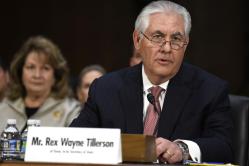
Tillerson HearingWatching coverage over the past few months of Congressional hearings on Cabinet nominees, and now on the “Russian invasion” against the U.S., I’ve had a strange sense of déjà vu — kind of like “I’ve seen this movie before”. After thinking that through a bit, I realized that this feeling stems from the fact that these hearings are precisely like last year’s hearings on the Benghazi embassy attack, the Clinton email scandal, etc. The only difference between the former group of hearings and the current group is which party is taking the “half full” view and which party is taking the “half-empty” view [see my post “Fake News”? (Or Is It Just Meaningless “News”?) for more depth on that phraseology]. In the former hearings, questions from Republicans stemmed from a half-empty view [where there’s this much smoke, there must be a fire somewhere], and questions from Democrats stemmed from a half-full view [there is no evidence / this is just partisan witch-hunting]. In the current hearings, questions from Republicans stem from a half-full view [ditto previous translation], and questions from Democrats stem from a half-empty view [ditto previous translation].
This was kind of an epiphany for me — the seed of an idea that has now developed into the Guide For Participants In Congressional Hearings that I am announcing via this blog. I think you will agree that if this catches on, it will be a huge time-saver for our dedicated public servants in both branches of the Legislature, freeing up hundreds of thousands — maybe millions — of person-hours of staff time devoted to preparing them for these kinds of hearings. This freed-up time, then, can be devoted to actual productive work — the possibilities are mind-boggling. There will, of course, be a time of transition to allow our legislators and their staffs to get their “sea legs”, since atrophy has already set in from the long dearth of productive activity. I am confident, however, that those with any signs of life other than a pulse will be able to rise to the occasion.

So Here It Is! … [Cick Here For Fanfare]

Step 1 — Participant Profile Development

Just answer these simple questions:

    • I am a __Senator __ Representative from __ [State] {if Representative, __ Congressional District}
    • I caucus with [__Democrats __Republicans] {Check one (If you think you are truly “Independent”, see Note 1)}
    • I am considering running for President in 2020 or 2024: [__Yes __No __Maybe] {Check one}

Step 2 — Subject Of Hearing

The purpose of this Hearing is to {Check one}:

__ 1 Confirm somebody nominated by the President [who is in my party] for _________________ [Position]

__ 2 Confirm somebody nominated by the President [who is in “the other party”] for _________________ [Position]

__ 3 Investigate this issue raised by my party: _______________________________ [Issue]

__ 4 Investigate this issue raised by “the other party”: _________________________________ [Issue]

Step 3 — Generation Of Initial Opening Statement And Question List [Automated Step]

A draft Opening Statement will now be generated, followed by a preliminary list of questions for you to ask at the Hearing.

Step 4 — Review And Screening Of Initial List [Manual Step Now, But See Note 2]

If you checked #1 or #3 in Step 2, the Opening Statement will have an overall tone that is positive and supportive, and questions will be what you might call “soft” — e.g., “Do you think being a Supreme Court Justice is an honor, and do you feel that you are qualified for this role?” If you checked #2 or #4 in Step 2, the Opening Statement will have an overall tone of skepticism and cautiousness, and questions will be what you might call “hard” — e.g., “Since your controversial Smith v. Brown ruling was overturned on appeal, have you stopped issuing rulings that reflect your personal ideological positions — please answer Yes or No?”

All you have to do is check the items you want retained in the final list — and if you wish, make edits in your Opening Statement. Be aware, however, that the automatically-generated information stems from a very sophisticated algorithm that is designed to maximize your chances of re-election, so by making edits you may be unwittingly reducing those chances.

Step 5 — Generation Of Script For Hearing [Automated Step]

This is what you will need to have with you in the Hearing. For maximum effectiveness at the Hearing, you should read through this very carefully in advance, paying particular attention to the embedded tips on optics [voice intonation, facial expressions, hand and body language, etc.].

Step 6 — Participation In Hearing

Don’t forget to bring your script, and as you give your Opening Statement and ask your questions, to pay very close attention to the imbedded tips on optics.

Step 7 — Review Of Transcripts From Hearing [Partially Manual Step Now, But See Note 2]

First, run the transcript text through the screening agent that is part of this guide. It is designed to find excerpts that best relate to “hot button” issues that will resonate with your particular constituents. From the generated list, pick those you feel are best suited for incorporation into your overall campaign strategy, and refine them into “talking points”.

Step 8 — Resume Daily Routine

Keep campaign talking points handy at all times, and actually memorize the ones you think are most critical to your re-election. You never know when a media pundit may want to interview you, and maximizing public exposure is a critical part of any re-election campaign strategy.

That’s It! … It’s That Simple

Once you’ve used this guide for one Hearing, you will have mastered the technique. Using the guide for future Hearings will be as easy as falling off a log — and you will have the satisfaction that you are making your party proud! [Except possibly not if you checked Yes or Maybe to the Step 1 question “I am considering running for President in 2020 or 2024” — the output from Step 3 might have produced some items that will ruffle the feathers of your party’s leadership.]

Note. … this Guide is available only to Legislators as an App for Apple and Android devices. It is not available to the general public because that would allow their constituents to see what drives the thinking of their elected officials on a day-to-day basis. That, in turn, would likely result in a massive “un-election” of all incumbents over the next three election cycles. Although I think that might actually be a good thing, I’d hate to think that I was the cause of such a massive upheaval that the country might not be quite ready to absorb.

What Readers Of This Blog Post Can Do

Send this link to this post to the two Senators from your state, and to the Representative for the Congressional district in which you reside.

———-

Notes

  1. There is no need for you to proceed. This Guide will only be useful for legislators who understand current reality. Keep yourself informed about it, though — as the Paradigm Shift that is now underway intensifies, this guide will either a) be updated accordingly or b) become obsolete and no longer useful [see the page A Major Paradigm Shift Well Underway at this site].
  2. The basic technology to automate major parts of, and ultimately all of, these steps already exists. However, providing that level of automation will require considerably more time. Because so much legislator and staff time is currently being wasted, I felt that focusing on getting out a workable initial version was most important right now; hence this release being announced today. I’ll follow up with future enhanced versions that will automate these steps.

img_7026 Charles M Jones

Charles M. Jones

“Dear President Trump” Letters

Untitled

“Dear President Trump” Letters …

On March 15, President Trump was here in Nashville. Late last week, David Plazas, the Opinion Editor of the Tennessean asked his readers to submit letters to the President for publication the day of the President’s visit. I’m honored that mine was among those that “made the cut” and was published.

According to Mr. Plazas, 160 letters were received. He categorized them as follows: 65 (41 percent) directly criticized the president and 38 (24 percent) praised and welcomed him; supporters wrote that they are praying for him and hoping for his success; critics generally said they want him to stop tweeting and release his tax returns; the remainder consisted of requests, questions and suggestions on a variety of policy matters; the top five issues addressed were the Affordable Care Act and the proposal to replace it, the president’s behavior and his fitness to serve in office, the environment and climate change, immigration reform, and holding Mr. Trump accountable to fulfilling his campaign promises.

Also included in this section was an excellent “Open Letter to President Donald J. Trump” by Jon Meacham, a widely-known presidential historian, contributing writer to The New York Times Book Review, contributing editor at TIME, and Pulitzer Prize-winning author who now lives in Nashville. The letter basically drew from President Trump’s apparent fascination with President Andrew Jackson [the 3/15 visit to Nashville coincided with Jackson’s 250th birthday, and included a tour of the Hermitage, Jackson’s residence, now a museum], drawing both parallels and differences. In my opinion, it was very well written — and should be well received by President Trump if he reads it.

For anyone wishing to see the entire section of the Tennessean referenced above, click on this link: Letters to Trump – Tennessean 2017-03-15.

Some Observations

I’m writing this post to offer some observations about the President’s visit, the kinds of letters that people wrote, and the Tennessean‘s coverage the following day.

Mr. Plazas’ categorization of the letters from readers was pretty accurate.  As usual, there was a fair number of “You need to do this on Issue X” and “You need to do that on Issue Y” letters as well as “We’re with you 100%” and “You need to resign” letters.  I tried to take a higher road approach.  Here’s the letter I sent [that was published]:

Dear President Trump:

Thank you for visiting Tennessee, and welcome to our state! And thanks to The Tennessean for allowing its readers to offer letters to you. Although I voted for you, I would be writing this same letter to Mrs. Clinton had she been elected and visited our state as president now.

I honestly hope that our country can get over the extremely polarized atmosphere that currently exists and move on in two ways: 1) support you as our duly elected president, whether we voted for you or not, in your efforts to do what you promised you’d do if elected; and 2) shift any of our collective energy currently going into protests and demonstrations into planning and executing a strategy to elect somebody else in 2020 if that’s what we want.

That’s the way this country is supposed to operate.

Charles M. Jones, Franklin 37067

The next-day issue in the Tennessean was VERY encouraging. The overall “tone” was like that for any presidential visit to our state might have been, and the content was focused on what the President actually said, without the ever-present left-skewed bias in phraseology. Although there were references in some of the coverage to what some of the protesters were saying, those references were simply stated as part of the overall “flow” of the text, not magnified and expanded on as is so often the case in the media’s coverage of President Trump these days. In all, 4 of 15 pages in the front section of the paper were on the Trump visit, and only one article in one corner of the third of those four pages carried a headline about protesters — “President’s Rally Draws Crowd Of More Than 2,500 Protesters” [that article was only about 20% of that page’s content, making it only 5% of the total coverage]. Hats off to the Tennessean!

From where I sit, it would be great if there was more coverage these days with the overall “tone” in these two editions of the Tennessean [which, I might add, is a generally very liberal newspaper]. That would indicate to me that the media is finally coming around to realizing that things are not the way they have always been, and that they need to re-think who their readers are [i.e., that a whole lot of people don’t fit into the liberal mindset most of them seem to have].

I realize that there is some risk the other shoe may drop tomorrow, and I may have to retract my kudos to the Tennessean if they have “the other side” dominating tomorrow’s paper — let’s hope not!

Thanks!

img_7026 Charles M Jones

Charles M. Jones

Lessons From The Great Horse Manure Crisis Of 1894

It’s interesting to me that some things from many years ago that I remember just vaguely now are things I think today I should remember more clearly — and vice versa: some things from many years ago that I remember very vividly today are things that seem now like trivia I should have long-since forgotten about. One thing in the latter category is an article I read in the Scientific American when I was in college [back then, that magazine was a much more scientifically erudite publication than it is today]. The article was in their “50 [and 60, and 70, and … ] Years Ago” section that contained a brief synopsis of what was notable in each of the stated timeframes. I found it both fascinating and humorous at the same time. As I think back on it today, it brings to mind a lesson I think we can learn from gloomy predictions of the future some people are making today.

The article was about what since has been referred back to by many writers as The Great Horse Manure Crisis Of 1894. Someone back then observed a problem that was getting steadily worse, portending a looming crisis: within a few decades, large cities that depended on thousands of horses for their daily functioning would be anywhere from 2 or 3 feet to 9 feet or more deep in horse manure [because the number of horses their projected populations would require would render their manure disposal methods inadequate].

He even did the math: In New York in 1900, the population of 100,000 horses produced 2.5 million pounds of manure per day, which all had to be swept up and disposed of; he even factored in land area and the resulting buildup, removal capacity under current methods, etc. [re: Edwin G. Burrows and Mike Wallace, Gotham: A History of New York City to 1898, Oxford University Press, 1999].

In 1898 the first international urban-planning conference convened in New York. It was abandoned after three days, instead of the scheduled ten, because none of the delegates could see any solution to the growing crisis posed by urban horses and their output.

Enter Stage Left … A Paradigm Shift

The fundamental problem with most predictions of this kind, and particularly the gloomy ones, is that they make a critical, false assumption: that things will go on as they are [or in the terminology I’ve used on the pages of this site and blogs posted here, they stem from Old Paradigm thinking — see A Major Paradigm Shift Well Underway]. This assumption in turn comes from overlooking one of the basic insights of economics: that people respond to incentives. In a system of free exchange, people receive all kinds of signals that lead them to solve problems. In this case, better manure removal processes were never needed to avoid the crisis because of the invention of the internal combustion engine [the history of which goes back at least as far as 1680, but potential commercial feasibility came about with creation in 1876 of the first modern internal combustion engine by Nikolaus Otto]. The real solution to the manure problem, however, stemmed from conversion of this invention into mass-produced automobiles through the entrepreneurial and capitalistic genius of people like Gottlieb Daimler and Henry Ford, rapidly eliminating the source of the problem [while improving, I might add, the overall quality of life in many other ways].

Lessons And Takeaways

There are two lessons we can learn from this.  First, human beings, left to their own devices, will usually find solutions to problems, but only if they are allowed to; that is [for example], if excessive regulatory burdens do not quell innovation and creativity. Left to political mechanisms, problems will not be as effectively solved [if at all].  Left to themselves, our great grandparents solved the great horse-manure problem. If things had been left to the urban planners, they would almost certainly have turned out worse.

A second lesson we can learn is that those within our elected leadership [in both parties], as well as the appointees of the majority party, who are trying to project how the ideas on which President Trump campaigned will translate into laws under the Old Paradigm need to realize that his modus operandi, brash and unorthodox as it may be, stems from a recognition that the paradigm is shifting.  The traditional politicians still in “Old Paradigm mode” would be wise to ask themselves: 1) What is different about this New Paradigm [as compared to what I think is still the Current Paradigm, but which I may be just now realizing is rapidly becoming the Old Paradigm]? and 2) What changes in my way of thinking do I need to make in order to be successful in it?

Finally, people in the media need to learn that the above logic applies to many [I would argue most] of them as well — i.e., applying Old Paradigm coverage techniques to events unfolding in the New Paradigm simply does not work, and if they continue to try to fit the New Paradigm “square peg” into their Old Paradigm “round hole”, they will find themselves rapidly becoming irrelevant.

Thanks!

img_7026 Charles M Jones

Charles M. Jones

Note. My description in this post of the horse manure crisis was paraphrased from this article: https://fee.org/articles/the-great-horse-manure-crisis-of-1894/.  Some amount of actual text from that article appears here as well. The reason I did not include quote marks in those cases is that the extracted text was rearranged considerably to fit the theme of this post.

Announcing My New App News4Me

preview-4I am pleased to announce via this post that my new app News4Me is available for pre-order now, with first available downloads scheduled for April 1, 2017. I started this Web Site on a shoestring, and have not yet built in the logistical capabilities to enable online ordering. I will do that by April 1, but to accommodate the massive numbers of people who will no doubt be clamoring to get this app as soon as possible, I am allowing preorders to be secured by entering your email address at the end of this post and clicking Submit.

News4Me is designed to provide a stream of simple, straightforward news, stripped of all opinion and commentary — as Sgt. Friday of the old Dragnet TV series would say, “Just the facts, Ma’am”. Initial testing of the prototype version was quite a challenge because hardly any content passed through the original versions of the app’s screening algorithms. This initial release, however, consistently produces 2 to 5 minutes of video and about a half page of text on weekdays. On weekends, output goes down to about 1 to 2 minutes of video and a few sentences of text.

News4Me applies a highly sophisticated set of algorithms to media news feeds to distinguish between simple facts and biased interpretations of those facts. For the same reason that Google closely guards the algorithms that made its search engine the Gold Standard, I must do the same with the details of the algorithms that drive News4Me. Just to show the power of News4Me, however, I can describe some of the concepts on which the algorithms are based. The following rules, listed here as a few examples just to show the tremendous power of News4Me‘s algorithms, are among the many screening algorithms in News4Me:

    • Screen images that contain both channel and/or program logos of news organizations across the bottom of the screen and one person’s image, but also with any words in his/her narrative like “I think”, “some are claiming”, “alleged”, “undisclosed sources say”, “protesters”, “the left”, “the right”, etc. [these are just examples — this is a very long list].
    • Screen images that contain both channel and/or program logos of news organizations across the bottom of the screen and more than one person at a desk or counter [clearly a “panel of experts” expressing their opinions].
    • Screen images that contain multiple people, at least one of whom is carrying a placard [clearly a demonstration].
    • Sound tracks that have multiple people talking at one time [clearly a poorly-moderated panel discussion].
    • All re-Tweets [obviously just a supportive or rebutting remark about the original Tweet].

Features In This Initial Release

Most of the major sources of both news and fake news will be included in News4Me‘s input feed, including the following:

    • Broadcast networks ABC, CBS, NBC and Fox.
    • Cable channels CNN, Fox News, MSNBC, and PBS.
    • Cable channels CNBC and Fox Business Channel [business and financial focus].
    • Web sites, FaceBook pages and Twitter feeds of all of the above sources, plus those of the New York Times, the Washington Post, and the Wall Street Journal.

Adjustments That Will Be Made By July 1, 2017

Based on feedback from users, we will make any modifications to News4Me‘s algorithms that appear to be warranted.

Additional Features Under Consideration

    • Bias profiles, allowing users willing to recognize their own biases to codify them and set News4Me to stream to them only news that is biased toward their own views.  [For some more depth into how this will work, see my post Binary Party Affiliation Choices — We Need Something Better].
    • The ability for users to permanently filter out news sources that consistently fail to produce any content that passes News4Me‘s built-in filters.

I am confident that widespread use of this app will, over time, result in a better-informed population, and it has been my pleasure to develop it as a service to my country. All profits from sales of this $1.00 app will be donated to charities that enhance quality of life for all mankind. 

[For pre-orders, enter your email address below and click Submit]

Thanks!

img_7026 Charles M Jones

Charles M. Jones

Go back

Your message has been sent

Warning
Warning

Warning.

Fake News Or Just Meaningless News?

News Or Commentary?

In my adolescent and teen years through high school, there were 15-minute evening news broadcasts on network radio and TV [ABC, CBS and NBC — no cable back then], and in any particular town like mine, one or maybe two newspapers — and of course, no internet. Generally speaking, I guess, the myriad sources of news nowadays would be viewed as progress from that time, but as I access the sources I follow for news, I wonder about that. I find it increasingly difficult to find content that is what actual news is supposed to be — simple factual reporting about events of the day.

I remember well when evening news broadcasts went to 30 minutes, ushering in the addition of commentary. Initially, there was a fairly clear shift within each program from news to commentary, so if your main interest was just in news, you could still get most if not all of it in the first half of the program. At some point, that shift became less clear. Then came cable, then [not necessarily just because of cable] news programs expanded to an hour, with more and more commentary that was less and less distinguishable from “just the facts” reporting. Then came the internet, and … well, here we are.

I have mentioned in a previous post that in order to get a full picture of any given situation, one has to consider at least two if not several sources, and from everything gathered during that process, decide for him/herself what constitutes “just the facts” [see News [or NNTN?] Circa 2017]. A complicating factor in doing that effectively are two troubling facts:

    1. “Journalism” doesn’t mean today what it did decades ago because the overwhelming majority of today’s “journalists” received their education from liberal schools, and they are heavily biased toward liberal views.
    2. 90 percent of U.S. media is controlled by six corporations [see this Link to Source]. We can logically assume that they are driven by at least two factors that bring into question their objectivity: 1) their responsibility to their shareholders to maximize profits; and 2) the worldview of their top leadership [i.e., the context within which these leaders make decisions about what does and does not make it into their publications and broadcasts].

Half Full Or Half Empty?

Practically everybody is familiar with the meme about two people looking at the same glass that is filled to the half-way point with water [one sees a half full glass; the other sees a half empty glass]. Let’s use that metaphor in context with the two complicating factors mentioned above to describe “news” reporting of President Trump’s actions so far, the Cabinet he has appointed, and what he says in speeches [and of course, in Tweets!].

If you view the “glass” [the Trump presidency] as half empty, that will be the focus of your fact-searching and analysis and phraseology; if you view it as half full, then that will be the focus of your fact-searching and analysis and phraseology. You can go to almost any article in liberal newspapers such as the New York Times, or watch almost any “news” program on liberal channels such as CNN, to see the overwhelming bias against Trump [overwhelming because there are so many more liberal outlets than conservative outlets].

A classic example [out of many] of half-empty reporting just this week was in the 2/22/17 coverage of new DHS immigration procedures announced 2/21. On the 2/21pm Fox News program, the emphasis was on the fact that the focus of the procedural announcement was simply on enforcing existing laws [i.e., on just what was done, not on whether it was good or bad or on what might — in somebody’s opinion — happen]. In the 2/23 USA Today paper, the bold headline was “Millions could be deported”, and the article was focused on that [which was largely conjecture, but the article made no effort whatsoever to interject that qualifier].

Another example of half-empty reporting was Trump’s repudiation of anti-Semitic vandalism [of headstones in a Jewish cemetery] and rhetoric lately during his recent visit to the Smithsonian’s National Museum of African American History and Culture. USA Today’s headline [representative of headlines in many other liberal outlets] was “Trump too late on hate, critics say”, and the article focused on that rather than on Trump’s actual remarks.

Just Ignore It?

Here’s an idea.  … I believe much of this kind of “news” would die away quickly [because there would be no “controversy” to drive headlines] if all Administration officials decided to just refuse to participate in interviews where trivial questions are being focused on, responding with “We’ve decided to quit wasting time on media-conjured ‘issues’ … I’d be happy to discuss progress, plans, policy, etc., if you’d like to get into those kinds of questions. Otherwise, I need this time for more productive work”.

Something I mentioned briefly in a post some time back was the very astute observation of Peter Thiel  who said during the final few weeks of the 2016 campaign “The media takes Trump literally but not seriously; his supporters take him seriously but not literally” … e.g., on the Southern border wall. If the liberal media could come to grips with that reality, then that, too, would diminish if not eliminate all the foolish word-chasing going on.

The thirst of liberal media analysts for “issues” with Trump is causing them to miss the main themes behind what he is doing and saying — i.e., they find a detail to pounce on and get into the weeds of that detail to create a “story” which they then print and broadcast until everybody dreads even hearing any more about it.

A great example is all the hype over the Executive Order on tightening the immigration screening processes. Coverage was focused on details within the order, causing the main point President Trump made during all that flack to be lost in the “noise” — i.e., that we don’t know if terrorists are merging in among refugees, and we need to know. The emphasis on the fact that no terrorist attacks have been from those 7 countries has completely overshadowed that very important point.

And it’s not just that we don’t know the potential magnitude of the threat of actual domestic terror activity. A USA Today article today [2/24/17] exposed the fact that at least five European nations have learned that they have accidentally paid taxpayer-funded welfare benefits such as unemployment funds, disability pensions and housing allowances to Islamic State militants who have used the money to wage war in Iraq and Syria [Click here for article]. {The nations are Denmark, Sweden, France, Belgium and Great Britain.}

So … when accessing “news”, keep in mind that, in the spirit of caveat emptor [let the buyer beware], it’s caveat lector/auditor/visorum [let the reader/listener/viewer beware]!

img_7026 Charles M Jones

Charles M. Jones

“The Left”, “The Right”, “Moderates”, …

left_right_political_spectrum_011-2The Left”,The Right”, “Moderates”, … Outdated Pigeonholes!

It’s interesting to me how practically all media pundits [both liberal and conservative], in their reporting and commentary about “goings on” these days, use the terms The Left”,The Right”, and “Moderates” to describe what they apparently view as monolithic blocs of people who all fit neatly fit into one of these three categories. Other terms like The Far Left Wing” or Sanders/Warren Wing,The Far Right Wing” or Tea Party Wing, and “Mainstream Politicians” also get into the dialog, and could possibly delineate five [maybe six] assumed blocs rather than three.

At the breakneck speed of developments over the past four months, last September seems like an eternity ago. However, my observation here of apparent media pigeonholes reminded me of my 9/28/16 blog post entitled Binary Party Affiliation Choices — We Need Something Better [Read It Here]. I’ve also written, in blogs and in the pages of this web site, about the major Paradigm Shift that is underway in this country [e.g., see this site’s page A Major Paradigm Shift Well Underway; also, search for “Paradigm” on the Home Page to see references to several blog posts].

I honestly believe that politicians — as well as media pundits — who think this way will fall from relevance along with the other components of the Old [and generally, still Current] Paradigm. New Paradigm thinkers are those who fully understand the scope of what I have referred to often in posts to this blog as The Trump/Sanders Phenomenon, and are adapting to it.

A New Focus For This Web Site and My Blog Posts

I mention these observations as a backdrop for describing part of a new focus for this web site and the posts I make to its Blog section. Let me begin that description by backing up a bit and saying that I believe there are [and will continue to be through current and future shifting paradigms] just two basic “camps” into which everybody, either consciously or subconsciously, fits: Liberals [most of whom stem from a Naturalistic Worldview] and Conservatives [most of whom stem from a Theistic Worldview] {For an expansion of the concept of Worldviews, see Why I’m Doing What I Do}. Liberals seem to be trying to shift the terminology describing them to “Progressives”, but I believe that is nothing more than a ploy to attach a connotation of “movement in a desirable direction” to themselves [thereby making it easier to depict Conservatives as “stuck in the past/present and not moving on to better things”]. For that reason, I’ll stay with Liberals.

This binary distinction is actually worse [less accurate, less useful] than the rapidly-becoming-useless three- to six-bloc categorizations described above — and therein lies the seed that can begin to sprout into a solution. Before proceeding to describe my view of that solution and then my plan for moving this site and my blogs to what I’ll call Phase 2, I’ll try to summarize in the next section the basic concept first presented in the above-mentioned 9/28/16 blog post entitled Binary Party Affiliation Choices — We Need Something Better [Read It Here].

Custom-Tailored Political “Parties”

The system I described in that post would allow people to indicate where they are on a far left to far right scale in each of, say, ten specific issues, with their answers resulting in mapping to a specific point on a left-to-right spectrum.  Taking it a step farther, each person could then form his/her own “Custom-Tailored Party”, or CTP — i.e., connect [through emails and/or texts and/or web/app interaction designed by that “Custom-Tailored Party”, or probably more efficiently through existing social media like FaceBook, Twitter, etc.] with everybody who is within some plus or minus “band” around his/her position on the left-to-right spectrum. The final refinement suggested for this CTP system was the ability for each person to place a weight on each issue.  This weight could be 1, 2 or 3, with 2 meaning average weight for that person, 1 meaning less important/critical than his/her average and 3 meaning more important/critical than his/her average.

The [Now-Developing] New Paradigm

Now let’s assume that the tool is in place — i.e., it has become widely known about, millions of Americans have used it to find and “join” their custom-tailored political “party” [CTP], and the campaign for the first election whose outcome could be controlled by this New Paradigm is getting underway. What would make this a better system? Consider the following:

    • Campaign Financing. As the Eric Cantor and Hillary Clinton losses [and probably other campaigns less widely publicized] clearly demonstrated, money is no longer as dominant as it has been in determining which candidate will win an election. Something similar to “crowdfunding” [currently popular for business startups, social good projects, etc.] could completely change the campaign financing landscape.
    • Conventions. These expensive events could become continuous online processes, costing a tiny fraction of what the big events currently cost.
    • Debates. These could be conducted as Social Media [SM] events rather than “filtered” by media giants and “journalists” — scheduled, as they are now, but live on SM, with SM producing questions based on real-time “topic volumes” identified by the SM providers.
    • Polls. Pollsters could randomly poll online and weight samples according to the size of each “party”. Much detail needs to be worked out on this to ensure true randomness and integrity of results, but it is definitely doable — also, current polling methodologies have already exhibited serious flaws, anyway, and are not considered as reliable as they have been in the past, so this part of campaigns needs fixing.
    • Actual Voting? … In the long term, the actual voting process could potentially be done online, but there is MUCH detail to be worked out to make that a reality.

Stay Tuned …

In some of my future posts [not all of which will be on this theme], I’ll develop this concept in more depth. A second part of the new focus for this web site and posts I make to its Blog section will be to present what I believe are pragmatic, workable solutions to this country’s problems — the first of which will be a conceptual framework for a healthcare system to replace the rapidly-crashing Affordable Care Act [ACA, aka “Obamacare”]. As I make changes to the overall structure and organization of the site, I will post announcements about them separately from the overall theme and direction of my blog posts.

Thanks!

img_7026 img_7043

Charles M. Jones