Political Spin 101

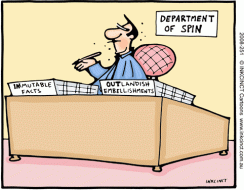
As I’ve read, listened to, and watched the “news” coverage this week about two issues, it has become glaringly apparent to me that who best recognizes “spin” opportunities and capitalizes on them is the winner in any particular “news” cycle.

The “Issue”

Let’s take a look at two high-visibility items from the last week or so — new border control enforcement policies and the 568-page Inspector General’s report about the conduct of the FBI and James Comey during an investigation into Hillary Clinton’s emails. As usual, the real issues never get widespread coverage in the media — people on the Left [and media outlets on “their side”] extract or formulate bullet points that support the conclusions they feel should be drawn, and people on the Right [and media outlets on “their side”] extract or formulate bullet points that support the conclusions they feel should be drawn. Regardless of the subject matter, the two sets of bullet points are always diametrical opposites.

Recognizing The Spin Opportunity

What I just described is a classic spin opportunity. They are always present, and each “side” is constantly on the lookout for the Mother Lode — the “issue” that can quickly gain traction and almost instantaneously “go viral.” Two spin opportunities in this past week have clearly been front-runners [those mentioned above], but the one that emerged as the Mother Lode was clearly the new border control enforcement policies.

Before going on, let me say that I think this whole matter was handled poorly, and I’m as much opposed as anybody to doing things that make children feel unsafe or insecure — for any reason. I should also “disclose,” however, that I fall into the camp of people who believe we need much better capabilities not only to do everything possible to eliminate illegal immigration, but also to shore up our processes for admitting legal immigrants.

Capitalizing On The Opportunity [AKA Winning The Spin Game]

Once either party has correctly identified a spin opportunity, the question becomes “How do we capitalize on this opportunity?” Let’s take a look at the winning “issue” — new border control enforcement policies —to see how cleverly this was done in that case.

What are the actual facts? … All the Administration has done recently is begin enforcing existing laws that have been on the books since the 1990s — developed under both Democrat and Republican administrations, many with bipartisan support. You have to do two things to ferret out why things suddenly seem so “different” and “inhumane”: 1) get into the weeds of exactly how those laws are worded; and 2) become personally familiar with how those laws are being [yes, are being, not could be] twisted by people like drug smugglers, people involved in human trafficking, people who make good money getting people into the country illegally, … and potentially, terrorists. Of course, 99.9% of the population will never do either of these things.

To get into a full-blown exposé on these two points is far beyond the scope of this or any of my blog posts. Let me just step one foot into the weeds of the laws. Minors cannot be detained in the same detention facilities in which adults are detained. There is a 20-day limit on the amount of time minors can be kept in custody until their cases can be adjudicated, which is far more time than is needed in almost all cases where adults who have children with them are caught entering the country illegally. There are also provisions for special handling of situations in which the adult involved is asking for asylum [e.g., because of persecution in their home country], and for good reasons adjudication of these situations often requires much more time — often considerably more than 20 days.

Again, going through a full exposé on this is beyond the scope of this blog [these are just two details out of hundreds], but if you just think about these two things, and keep them in mind when you watch / listen to / read “news” stories about this, it’s not hard to figure out how 1) malevolent players could manipulate these two laws and 2) scenes of children being separated from parents by agents who are following the law can show up and “go viral.”

What was the Democrat spin strategy? … The Democrat spin strategy in this situation was a no-brainer. Any dummy could have developed and managed it. Simply get video clips that can be captioned “babies being ripped from the arms of their mothers” and perform routine social media procedures for making any particular thing “go viral.” Capitalize on every opportunity for media interviews to say how shameful it is for this heartless administration to do this to children. Send key Democrats to border counties to make speeches and produce clips for the upcoming campaign. … etc.

What was the Republican spin strategy? … The Republican strategy was to bring visibility to the simple fact that our existing immigration laws are far out of date and need to be overhauled — and the equally-at-fault Democrats who caused this dilemma need to come to the table and work with us to get this fixed.

Who Blinks First?

Which strategy “won” [and why]? … Although probably well-intentioned, and generally more factually correct, the Republican strategy started off on the wrong foot because pictures and video clips like those described above constantly flashing across TV screens achieved Mother Lode status and tended to drown out almost all other “news.” It actually doesn’t matter what the facts are because of what I mentioned earlier: 99.9% of the population will never get into this much detail; they’ll simply go with whatever spin strategy is winning.

It’s possible that the Republican spin strategy [“Let’s fix this together while fixing the bigger immigration problem]” could have turned more positive and overcome the Democrat spin strategy [“Shame on you! Quit breaking up these poor families! Have a heart! This is not American!]” I wasn’t among those betting on that one, though.

I do, however, agree with what I’ve heard at least two “panel experts” say in the last 24 hours — that although “Schumer, Pelosi and Company” appear to have “won” in the short term, it is quite possible that they shot themselves in the foot in doing so. That’s another thing beyond the scope of this blog post, but I’m considering it for a future post. As a “teaser” here, though, I’ll simply say that this whole circus was never about “the children,” “families,” or “American values” like compassion — it was about politicians in BOTH parties focused on the upcoming mid-term elections.

Diversion Tactic

There’s something more fundamental going on in situations like this one. Despite his image problems [which he is not the first president to have], President Trump has done two things very successfully: 1) he’s shaken up the “status quo” and caused people in all parties and all countries to think outside of their boxes; and 2) he has taken bold, decisive steps on practically every front [rather than following in the footsteps of almost all — but not all — of his predecessors: throw out small “test balloons” and then gradually turn up the volume if nothing embarrassing happens.]

If he/she so chooses, one could look at this latest Mother Lode spin opportunity [the immigration “issue]” in the context of timing — i.e., amidst several news items about good things going on in America, and the increasing volume of positive statistics that outline a much improved situation — and conclude that any Mother Lode spin opportunity is always needed to divert the public’s attention from positives to negatives.

Thanks for reading this post, and if you regularly follow my Blog, for that, too. Please consider sharing this or other posts with your friends, colleagues and associates.

img_7026 Charles M Jones

Charles M. Jones

The Power Of The Media – Part 1

IMG_0072.png

In the past several days, it’s been difficult to find media coverage of any topic other than the Trump-Kim summit meeting in Singapore. Even articles and broadcasts not directly reporting on the event itself have often been on peripheral topics about one of the two leaders or one of the two countries. One such article that caught my attention at first did so because its catchy title made it seem like a good human interest perspective: North Koreans flipping over first taste of hamburgers [Link to The Article]. It was indeed that — a good human interest perspective — but some of its content actually gave me some interesting insight into the power of the media.

More Power Than We Realize?

Because I believe it’s a big problem that is at the root of much of the polarized, controversial atmosphere in which we find ourselves today, I’ve written quite extensively about the media here in the United States [e.g., News Or NNTN Circa 2017, Fake News Or Just Meaningless News?, Semi-Fake News, Announcing My New App News4Me]. This post is more focused on the power of the media, with content stemming from a seemingly innocuous and light-hearted article about hamburgers.

There’s a technique I use often when I’m trying to better understand controversy over an issue, and to gain a better understanding of the sources of disagreement. During my career, I used it with clients in my consulting days and in my interactions with people in organizations I worked for and in businesses I ran. The technique is to try and envision a spectrum, with the most extreme defining points imaginable at each end of the spectrum. For most issues, it is extremely unlikely that all people will flock to one extreme end of that spectrum or the other — almost without exception, opinions will distribute more evenly throughout it. That way of visualizing an issue can be very useful in helping people find common ground — which in turn can form a basis for compromise.

For example, the extreme ends of the spectrum on gun control might be “There is no reason for anybody in America to own a gun” on one end and “The First Amendment gives every American the right to own any number and type of guns he/she may desire to own” on the other. Very few if any uber-liberals would completely align with the former “pole” and very few if any uber-conservatives would completely align with the latter.

In applying that concept to my “revelation” as I read the hamburger article, these quotes by the owner of the restaurant were informative:

“The overwhelming majority of North Koreans had absolutely no idea what a hamburger was. … In fact, they didn’t even have a word for the all-American food because the English language is banned in North Korea.”

“(Customers) found it very interesting, different. They had never seen burgers and French fries before, never had cola. Even paper cups with plastic lids were new. It was a totally different experience for them.”

Think about that for a moment. When the information people are allowed to see is completely controlled by a person, a company, a group of companies, or even by their own government, complete detachment from reality can be the result. When this environment prevails through multiple generations — as it has in North Korea — the citizenry becomes so far removed from reality that exposure to it can be a shocking experience.

Back To The Future — 380 B.C.

Actually, Plato described this phenomenon about 2,400 years ago in The Allegory of the Cave in his Republic. …

The Allegory Of The Cave describes an environment in which three prisoners are tied to some rocks, their arms and legs bound and their heads tied so that they cannot look at anything but the stone wall in front of them. They have been there since birth and have never seen anything outside of the cave. Behind them is a fire, and between them is a raised walkway. People outside the cave walk along this walkway carrying things on their heads [animals, plants, wood and stone,] so the prisoners never see anything but the shadows on the wall. In his dialog with Socrates, Plato postulates that since the prisoners had never seen the real objects, they would believe that the shadows of the objects were “real.”

The alarming part I would note here — maybe a caveat we should consider — is that a prisoner who escaped and saw “reality” was received with fear by those he came back to so he could share his “enlightenment.” It was easier for them to rationalize their “reality” than to face the fact that “reality” was outside their “Universe.”

Where Are We?

So, the environment in North Korea would clearly define one end of a spectrum on freedom of the press: “Total governmental control, allowing the citizenry exposure only to government-censored or even government-produced content.” The other end of this spectrum would be something like “No bounds on what anybody wishes to say or write, even if it unjustifiably affects others negatively.” 

Think about these two extremes. In America, we are clearly not at either of the “poles.” If we were closer to [but not at] the North Korea “pole,” most of the media would be scrambling for content to fill their publications and broadcasts because half of what we get now is “he said / she said” analysis — endless panels analyzing the latest remarks some public figure has made, what they imply about the person, what larger issues they raise, whether libel is a possibility, whether the remarks themselves are a basis for prosecution of an implied crime the person making them may have committed, etc. If we were closer to the other “pole,” what we see now would be an even more chaotic sea of noise than it is.

Could It Be? …

It may seem ridiculous to even suggest that America could become such a controlled-media environment. Think about it, though, in context with this post and with some insidious and concerning recent revelations about goings-on in Social Media [inappropriate censoring practices driving agendas of company executives, inadequate ability to screen out outright hacks designed specifically to control what unsuspecting citizens see, etc.]  Spotting North-Korea-style controlled media is easy. Spotting more insidious content control isn’t. Questions worth pondering are “Which type is worse?” and “Does the latter type ultimately lead to the former?”

Thanks for reading this post, and if you regularly follow my Blog, for that, too. Please consider sharing this or other posts with your friends, colleagues and associates.

img_7026 img_3358

Charles M. Jones

An Underreported Factor


In a post shortly after the 2/14/18 mass shooting at Marjory Stoneman Douglas high school near Miami [Post-Killings Bandwagons], I posed a question that an article I read this week prompted me to delve into in more depth. For context, I’ll repeat my opening remarks in that post:

Not surprisingly, the tragic shooting in a Florida high school on February 14 brought out the usual political atmosphere — each party rolling out its bandwagon to rally their faithful around “what to do”, with their respective media adherents being the first to jump on. As usual after tragedies like this, the “do something” options put before us after this one were painted by politicians as binary — i.e., get on our bandwagon or theirs.

The Democrat bandwagon is always tighter gun control laws. The Republican bandwagon is better processes for dealing with mental health issues. Both sides stress why their approach is best, and both sides quote those parts of statistics and research that support their mantra and discredit that of the other side. This goes on until the media outlets sense that coverage of the most recent tragedy is no longer attracting readers / listeners / viewers, coverage fades, and that tragedy just moves into the statistics bank.

In the rest of that post, I posed the question I mentioned above — Why just two bandwagons? — expanding it to ask What potential culprits are there that nobody ever brings up in these flurries of activity after another attack because they already have their canned bandwagon rhetoric ready to pull out and set in motion? I proceeded to elaborate on at least one — the “dark side” of technology, particularly video games. I said then “or at least many of them.” Well, that brings me to the article I read this week — I think I should have said “or certainly most of them.”. …

Shouldn’t We At Least Consider This Potential Culprit?

Get this. … All of the top five video games in the past year have a basic theme of fighting and combat: Activision, Blizzard’s Hearthstone and Overwatch, Tencent’s League of Legends, Epic Games’ Fortnite, and PUBG Corporation’s PlayerUnknown’s Battlegrounds.

Now consider those facts in context with the two cartoons I chose as the images for this post [for added perspective, a review of my post Mass Murders Accelerating would also be worthwhile in emphasizing the point I’m making here.]

So what is that point? Just for more emphasis, here are a few more statistics that — at least for me — help build a case for it [i.e., for the point.] Worldwide gaming industry revenue as of April 2018 was $127.9 billion, $30.4 billion of it in the United States. Access on mobile devices [smartphones] is now more than 50% of total. Almost three-quarters of Americans ages 14-to-21 either played or watched multiplayer online games or competitions in the previous year. Half of adults under 30 have played or watched online games, as have a quarter of adults overall. Strikingly, for many people, watching other people play video games is just as popular as playing games themselves. A 58 percent majority of teens and young adults (ages 14-21) have watched people play video games on websites like Twitch and YouTube, while 59 percent report playing online multiplayer games. Almost half of teen and young adults, 45 percent, both play and watch video games. Among U.S. adults overall, 18 percent play, 16 percent watch and 9 percent do both. 89% of boys and 56% of girls age 14-21 played or watched video games in the past 12 months. Teen and young adult competitive video game players tend to play frequently and for long periods of time. 47% of them play almost every day or every day, rising to 66% who play at least a few times a week. And among competitive gamers under 21 who play almost every day or more, 6 in 10 play for three or more hours on a typical day. [Sources: www.newzoo.com and www.washingtonpost.com]

So the point is, the prevailing bandwagon mentality may be covering up a “sleeping giant” that could be the real culprit. I don’t think my observations prove that this “sleeping giant” is in fact this rapidly-accelerating prevalence of violent games, but I think they do show that it should be among the top contenders for further consideration.

Thanks for reading this post, and if you regularly follow my Blog, for that, too. Please consider sharing this or other posts with your friends, colleagues and associates.

img_7026 img_3358

Charles M. Jones

The Opioid Crisis

shutterstock_745206598_0

This post is about the opioid crisis, and will be a bit different from most of my posts. One of the news feeds that I monitor published an article on this issue that was a real eye opener for me. 

Time Out …

Since what I will express here will be from a perspective that clearly stems from my Worldview, I feel that I should disclose that up front and encourage anyone reading this post to understand that Worldview. The best way to do that is to view the Who I Am page at this web site, perhaps following links within it as necessary to get the full context.

As will also be evident from the Who I Am  page, I must admit that I grew up in an environment in which I was never approached by anybody about drugs, and to my knowledge there was no drug trafficking going on in my hometown at that time. I realize I could have just been naive, not knowing what was “really going on,” but I think I was reasonably “connected” and would have been “in the know” had there been such activity.

I made these introductory comments only to say that I have to admit that I don’t fully understand the “opioid crisis,” or for that matter, the “drug problem.” But something about this particular article caused me to back away, rise above the day-to-day detail in the news, and try to get a better fundamental understanding of this issue.

The Problem

The article I read was Opioid Crisis: Fentanyl deadlier than heroin in the 5/26/18 edition of the [Nashville] Tennessean, which is part of the USA Today network. Here’s the part that caught my attention and prompted me to write this post:

“Death, it turns out, is no deterrent. Asked to explain the severity of the crisis, police and public health officials told the same story in separate interviews: When word gets out that a bad batch of fentanyl has killed a few people, many addicts don’t try to avoid it. They go looking for it. “From what we understand, the addicts want that,” said [a municipal health official who coordinates responses to mass overdoses]. “They want the biggest high they can find. They want to go the brink, and possibly get brought back with Narcan and not tip over that edge. It’s a crazy concept. Two years ago, we thought we were going to come in and say ‘You don’t want this fentanyl stuff. It is deadly, even as small as a grain of sand.’ But that is when they say – ‘Where is it?’”

Stop reading, pause for a moment, and just think about that. There are people who want “the biggest ‘high’ they can find” even if they know that the risk of death in obtaining it is very high. In order to understand that and at least try to put myself in the place of a person with that mindset, I have to try as best as I can to literally take off my “real brain” and “put on the brain” of a person whose background and current situation has put them in that state of mind. That’s not an easy thing to do, but I believe my attempt at it has given me an epiphany of sorts.

The Solution?

Unfortunately, this epiphany has also made me realize that government will never be able to solve this problem regardless of how much money is thrown at it and how many “programs” and “initiatives” are funded with that money. Why? Because the problem is not a result of human activity [drug cartels, the thousands of dealers in their distribution framework, “big Pharma,” or whatever] that laws and regulations can control at least to some degree. It is a problem of the human heart.

There is big money to be made in drugs for exactly the same reason there is big money to be made in smartphones. … or forward-thinking vehicles [more fuel efficiency, better electronics, etc.] … or whatever. That reason is that there is a high demand for it. Among the simplest of basic economic principles is that until supply rises to meet demand, prices [and therefore profits] remain high.

Until we attack this issue at its roots, solutions will continue to elude us. The “tap root” is that as a nation, we have lost too many of the fundamental components of our founding. There are no more absolutes. Everything is relative, so each person has to decide for himself/herself what is true, what is false, what is right, what is wrong, what is good, what is bad. 327 million people trying to do that produces a practically limitless number of “sets of principles and rules.” The result — many people simply cannot handle that complexity.

Some who can’t deal with the complexity affiliate with sects, organizations, political parties, “movements,” etc., if they can find one or more with which they feel they can best identity. Some can’t find such an identity and just want to “escape” and “feel good,” even if they know it’s temporary.

I realize that many current addicts began by taking prescription drugs — prescribed by a doctor — for bonafide health conditions those drugs could treat. One thing led to another, and they ended up finding themselves “hooked” and seeking illicit ways of getting the drugs on a continuing basis.

Although I personally believe that what many addicts are trying to fill is a void inherent in all of us that can be filled only by God, I also realize that assuming that is the answer would still result in “outlier” situations [one of the finest Christian couples I’ve ever known lost a son to drugs in the prime of his life].

So, regardless of how an addict became an addict, getting at the root cause will require gaining a better understanding of why a person would want “the biggest ‘high’ they can find” even if they know that the risk of death in obtaining it is very high.

The Real World

The way our government operates, it is unlikely that this “grass roots” approach will be in the picture. Some more expedient approach will become the most talked about, will gain momentum, and will result in a “program” [and possibly a package of laws and regulations]. It will get funded and proceed into the bureaucratic abyss. Everybody will feel good, there’ll be a flurry of media coverage for a while, and then our leaders will move on to other things. Just as with Social Security, Medicare, Medicaid, the War On Poverty, etc., some elected official or person running for office will observe in a decade or two that after the billions of dollars spent to date, the problem is no better [and maybe worse] than it was “back in 2018,” make it a “campaign issue,” and … well, you get the picture.

Sorry to sound cynical, but this just seems to me to be a problem that will follow this “solution” track. If only the leaders trying to “get something done” on this were readers of my blog, they’d be able to understand the key I’ve found and avoid all of that — so please pass this on to any of them you know.😊

Thanks for reading this post, and if you regularly follow my Blog, for that, too. Please consider sharing this or other posts with your friends, colleagues and associates.

img_7026 Charles M Jones

Charles M. Jones

The Trouble With Polls

political-polls-are-no-longer-intended-to-reflect-public-opinion-30384120

In a recent post [The Role And Toll Of Polls], I addressed some issues with polls that relate to bias that can be introduced into them even if technical rules that ensure randomness are followed to the letter. One example was simply the words and phrases used in formulating the questions in the poll. Some articles I read this week about the results of some polls brought to mind another issue that should prompt all of us to be a bit more deliberative in interpreting media coverage about their results.

Just The Facts, Ma’am

For those of you who remember the Dragnet TV series [1950s to 1960s], Sergeant Joe Friday’s often-used line in interviewing witnesses of crimes is germane here — in response to a witness asking, “Well how much detail do you want to know?”, his answer was “Just the facts, Ma’am.”

Unfortunately, it’s not “just the facts” that the media reports about poll results. Without getting into the weeds of the statistical theory and mathematical formulae, I’d like to just present how the results of one of the polls I read about were characterized — how the article was headlined, and the clear narrative intended in the article’s content — as compared with what conclusions can realistically be drawn from the actual numbers [“just the facts”].

In case it matters, I had a Minor in Mathematics in earning my degree with a Major in Engineering, and an area of considerable concentration within that Minor, as well as within my Major [Industrial and Systems Engineering] was Probability and Statistics.

The Survey

The Senate seat being vacated by Senator Bob Corker’s [R-TN] decision not to run for re-election has become a Democrat “flip” priority. Chuck Schumer personally recruited former Tennessee Governor Phil Bredesen [a Democrat, of course] to run for the seat. Bredesen is several links up the food chain from the typical Democrat running in Tennessee [usually just placeholders because nobody thinks they’re going to win anyway]. He was a very popular Governor considered by many in both parties to have been a very effective one as well.

In the August 2 primaries, hardly anybody would argue against the assumption that Bredesen is a shoo-in for the Democrat Party nomination, or that U. S. Congresswoman Marsha Blackburn [R-TN] is a shoo-in for the Republican nomination — Bredesen because of my foregoing observations, and Blackburn because she’s a well-known and highly-respected Republican in a deep red state [in my opinion, she’s one of the sharpest knives in the House drawer].

This survey attempted to determine how Blackburn and Bredesen would fare in the November 6 General Election.

The Media Outlet Reporting The Results

The Tennessean is about as liberal as you can get in the media world, and it is an affiliate of the USA Today network, which is also clearly liberal. So, it is certainly no surprise that any characterization of the results of this [or any] poll in that publication would support the narrative of a “Blue Sweep” in the 2018 mid-term elections. They will no doubt report on many surveys between now and then, and their characterizations will all be tilted in the same way. If Blackburn wins, but by less than ten points, they will then join narrative like that following the recent 52.6 percent to 47.4 special election victory of Debbie Lesko [R-AZ] in a district that President Trump carried by more than 20 points in 2016 — “more evidence that the margin is closing and setting the stage for a huge retake of the U. S. Government by Democrats.”

The Facts Versus How The Results Were Reported

How Reported. … The headline read “Democrat leads Marsha Blackburn by 3 points in new Tennessee Senate poll.” Within the article, the following statement is inaccurate at worst, and misleading at best: “Democrat Phil Bredesen is ahead of Republican Rep. Marsha Blackburn in the race for an open Tennessee Senate seat. … Bredesen led Blackburn narrowly, 46 percent to 43 percent. … 11 percent were undecided.” Although the next sentence seems like an attempt at “balanced” reporting, [i.e., by “disclosing” a caveat], even it is misleading: “Bredesen’s lead is within the 4-point margin of error.

Just The Facts. … These are the only conclusions that the survey revealed could reasonably be quoted as supporting with a 95% chance of being correct:

  • Percent of people supporting Bredesen: 42.1 – 49.9
  • Percent of people supporting Blackburn: 39.1 – 46.9
  • Percent of people who are undecided: 7.1 – 14.9

    👉🏿  So the facts are that …

  • Bredesen might be ahead of Blackburn by as much as 49.9 to 39.1 or as little as 49.9 to 46.9, or
  • Blackburn might be ahead of Bredesen by as much as 46.9 to 42.1, and
  • The percent of people who are undecided might be as little as 7.1 or as big as 14.9.

    👉🏿  And the only conclusion that can be reasonably substantiated is …

  • This poll is meaningless in terms of predicting any possible outcome of this election.

Our Takeaway

Minimizing Interval and Confidence Levels in most of the poll reporting we see may avoid mesmerizing readers / listeners / viewers with details that might result in loss of their interest in the coverage. However, it also enables creation of impressions that simply are not warranted. Each of my readers can decide on his/her takeaway from this post. My takeaway is “Never trust any one media outlet’s characterization of the results of a poll; either a) take the time to do the math yourself and form your own conclusion with the logic I’ve used here, or b) access multiple sources of ‘news’ / ‘fake news’ and try to net their views into your own composite.”

Thanks for reading this post, and if you regularly follow my Blog, for that, too. Please consider sharing this or other posts with your friends, colleagues and associates.

img_7026 Charles M Jones

Charles M. Jones

The Paradigm Shift And The Upcoming Elections

I developed this web site and began posting to this blog in the summer of 2016 for one reason: I felt that the upcoming Presidential election was the most important in my lifetime, and I wanted to do the best I could to ensure that as many people as I could reach would understand how significant their vote would be in that particular election. Given the outcome of that election and what has transpired since then, I now believe the mid-term elections coming up this November may be even more important.

A Quick Review — November 8, 2016 To Now

My opinions are those of one person among millions, and each person reading this can make up his/her own mind on which if any of these points he/she agrees or disagrees — so without elaborating, here’s my synopsis:

    • We have a President who I don’t like, personally — but I can be encouraged by the fact that this would have been true regardless of who won in 2016.
    • We have a President who doesn’t fit into any of the molds into which traditional politicians [in both parties] and talking heads in the media [both liberal and conservative] — to whom I’ll hereinafter refer collectively as “The Swamp” — try to put all elected officials, particularly the President. In my opinion, that’s a good thing, and would clearly not have been the case had the 2016 election gone the other way [Hillary Clinton is a standard, run-of-the-mill, traditional politician who would easily have fit into a set of standard molds].
    • We have a President who has “rocked all of the boats in all of the lakes.” Rather than just taking each day/week/month as it comes and at least allowing for the possibility that there could be a sensible rationale and pattern behind his seemingly knee-jerk actions, The Swamp spends all its time doing two things: 1) insistently attempting to sort all this out and either force him into an established mold or come up with a new mold that can make it easier for them to “classify” him; and 2) doing everything possible to paint him in a negative light and block everything he tries to do.
    • We have a President who has accomplished a tremendous amount in his first sixteen months in office in spite of what is clearly the heaviest resistance ever for an incoming president — and who realizes the simple fact that a generation from now, it will be his accomplishments, not his personality, or his Tweets, or how many feathers he ruffled while in office, that will dictate how his presidency is viewed.
    • We have a Swamp — most but not all of whom, are Democrats — that will not rest from its efforts to block literally everything President Trump attempts to do until he is out of office by whatever means is necessary to unseat him.

Why The 2018 Mid-Terms Are Crucial

Given where we are, we, the people, have the capacity this November to decide whether or not we are OK with governmental deadlock for at least two more years. Of the outcomes that are possible on November 8, only one will express our desire to continue on the substantially altered path on which we decided to embark in 2016, and only one will express our desire to totally reject that path and [by implication, whether intentionally or not] go back to the previous path. Any of the others will result in [probably not our desire, but nonetheless the path we will have chosen by wasting our votes or choosing not to vote at all] — you guessed it, at least two more years of deadlock. We all need to be thinking about that now — not a few days or even hours or minutes before we go to the polls not only in November, but in the primaries leading up to November.

The Paradigm Shift’s Progress Will Be Key

If you “go with the flow” and assume that the Paradigm Shift I keep writing about either isn’t happening or is taking a lot longer than folks like me predict, you’ll look at polls, listen to media talking heads and panels, and conclude that the probability the Democrats will regain majority status in the House is high and that there’s a good chance they’ll regain majority status in the Senate as well.

But if you look at the pieces of evidence that show how rapidly the Current Paradigm is dying and recognize that the upcoming elections could quite possibly defy conventional predictions and historical precedents [as was the case in 2016], you’ll conclude that the possibility that the Republicans will maintain and possibly even strengthen their majorities in both chambers is by no means just a long shot.

At some point this Summer, I intend to go into a mode with my posts very similar to the mode I was in when I first started them in 2016 — focusing on the November 8 elections and trying to make as many people as I can reach understand that their vote counts, and that by moving the Legislature either toward stronger Republican positions or stronger Democrat positions, they will be making a big difference in the future of this country. In many ways, the same logic applies to these midterms that I stressed so much in the Presidential election: each voter needs to understand that by voting a “protest vote” for somebody other than a Republican or a Democrat — or by not voting — he/she will be unwittingly voting for either the Republican or the Democrat [these voters — or non-voters — simply won’t know which one they voted for].

Possible Scenarios

When I shift into that mode, I will, as I did in 2016, outline the possible scenarios and what the resulting environment would be if each of them plays out as the chosen path when the voters have spoken. Some of the outcomes look very encouraging, but some could create even worse governmental deadlock than we’ve had for the past four years. Stay tuned …

Thanks for reading this post, and if you regularly follow my Blog, for that, too. Please consider sharing this or other posts with your friends, colleagues and associates.

img_7026 Charles M Jones

Charles M. Jones
The Androgynous Scouts Of America

35508When I read of the latest chapter in the history of the Boy Scouts of America this week, it was like watching a video of the last nail being driven into the coffin of that organization.

This Cinco de Mayo was particularly significant to me. The fifth of May was the date in 1959, about a month after my 14th birthday, when I became an Eagle Scout. As I mentioned in one of my posts [What I Learned As A Boy Scout], I doubt that most people understand what is involved in earning that rank, and what the mindset of a boy in his pre-teen and early teen years has to be to achieve that goal.  Nothing I could write here could produce that understanding, but let me say that a love for God and country is at the root of that mindset.

During Cinco de Mayo week this year, the Boy Scouts announced that girls would now be accepted for membership, and that they were changing their name to Scouts BSA. In 2015, they began accepting homosexual and transgender men as leaders, and in 2017 they began accepting homosexual and transgender boys as members. Now, in 2018, they have announced that girls can become members.

It’s interesting that the new name is Scouts BSA rather than Scouts USA. Also interesting, as confusing as the terms “boys” and “men” apparently are to transgender people, is that in announcing the 2015 and 2017 changes the organization made at least a token attempt to minimize overall confusion by temporarily retaining them. At the current pace of metamorphosis, though, any terminology tied to a person’s sex will no doubt disappear soon.

It is now evident that becoming completely “inclusive” has replaced the organization’s original mission “to prepare young people to make ethical and moral choices over their lifetimes by instilling in them the values of the Scout Oath and Law” [referring to versions of those creeds that have existed unchanged since the organization’s founding in 1910]. The ultimate end of the trend established over the past few years is very clear, so I decided to save them a lot of time and just present them with a new set of founding principles that should serve them well going forward. Here it is. …

New Founding Principles

Note. It would be an educational experience for any reader of this blog post to compare the italicized phrases with the phrases they replace in the current versions. Anyone interested in doing that can click this link to display the current versions [just Mission and Vision statements, and current versions of the Scout Oath and Scout Law that are referenced within them — the policies I’ve included below are my speculations, admittedly with a grain of sarcasm]: BSA Mission And Vision.

Organization Name. The Androgynous Scouts Of America [ASA]

Values. Our core values are self expression, equality, inclusiveness, and tolerance.

Mission And Vision. Mission. The mission of the Androgynous Scouts of America is to prepare young people to make socially acceptable and politically correct choices over their lifetimes by instilling in them the values of the Scout Oath and Law.  Vision. The Androgynous Scouts of America will prepare every eligible youth in America to become a responsible, participating citizen and leader who is guided by culturally acceptable norms.

Scout Oath. On my honor I will do my best to do my duty as a natural part of the Cosmos to my country, and to obey the Scout Law; to help other people be true to themselves at all times; to keep myself in good physical and mental health, and to always be one with Nature. Scout Law. A Scout is Trustworthy, Loyal, Helpful, Friendly, Courteous, Kind, Tolerant, Cheerful, Thrifty, Inclusiveness-minded, Clean, and Respectful Of Nature.

Admission Policy. All persons 11-17 years of age are welcome to apply for membership in the ASA, regardless of their race, color, creed, national origin, sexual orientation, or preferred sexual identity on the date of their application. Regarding the age limitation, it is not our intent to discriminate on the basis of age. People younger than 11 are encouraged to joint the Cub Scouts. People older than 17 may submit applications, each of which will be considered on a case-by-case basis. Regarding sexual orientation and preferred sexual identity, those preferences at the time of original application must be so listed, but can be changed at any time by filing the appropriate form to ensure that ASA records remain correct.

Advancement Policy. Advancement levels include Tenderfoot, 2nd Class, 1st Class, Star, Life and Eagle. Earned merit badges are among the requirements for the three highest ranks. Some of these merit badges are mandatory and some of them may be selected from among options suitable to each individual. To the extent anyone aspiring to a particular rank in this progression feels that his/her/their ability to achieve that rank is limited because of physical or emotional restraints related to their biological sex or preferred sexual identity at a particular point in time, a participation medal will be awarded as a substitute so that progression to the next rank can be pursued.

Policies Governing Activities.

    • Outdoor [Hiking, Camping, etc.]. All latrines must allow access to all members based on their preferred sexual identity at the time of needed use. Tent-mates at events involving overnight camping will be assigned by random selection. Should anyone desire reassignment, such reassignment will be granted only if both original assignees and both new assignees agree with the change.
    • Civic. Participation in demonstrations and other forms of support or protest are not sponsored or funded by ASA, but individual and troop- or council-level participation is a decision left to individuals and local troops and councils.
    • Social. No chaperones are provided by ASA. Relationships between consenting preteens and teenagers are private personal matters, and the ASA does not interfere in those matters.
    • Programmatic. All troop- and council-level meetings — as well as programs such as camporees — must be developed from a gender-neutral perspective. Content and themes must not be interpretable as oriented toward either biological sex.

Would I Do It Now?

It was shortly after my twelfth birthday when I decided I wanted to be an Eagle Scout. It’s difficult to accurately go back in time and say what I would have done at that age given the circumstances that exist today, but I think my decision about being a Scout at all — much less committing to what would be required of me to earn the Eagle Scout rank — would have been “No thanks, that organization doesn’t match up to my worldview and value system.”

Thanks for reading this post, and if you regularly follow my Blog, for that, too. Please consider sharing this or other posts with your friends, colleagues and associates.

img_7026 img_3358

Charles M. Jones

Things That Matter (In Politics)

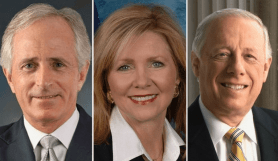
Corker-Blackburn-Bredesen

A few years ago, Charles Krauthammer published an excellent book entitled Things That Matter.  That title for this post, with the parenthetical “(In Politics)” won out over the first runner-up, “Wake up, Bob!” It’s a shame that our elected leaders can’t just “tell it like it is” rather than have to tiptoe through the mechanics of how our government actually works realizing that anything they say can be twisted into something entirely different. Outgoing Senator Bob Corker knows as well as anybody in Washington that a Republican loss of their razor-thin one-seat Senate majority, even if they keep their House majority, will clinch at least two more years of deadlock — and that retention of or even a strengthening of their Senate and House majorities will at least not worsen the current situation and maybe even make it much better. I also believe he is an honest man, a businessman who did a reasonably good job of wading through The Swamp during the past twelve years to become about as effective as a Senator as it is possible to be these days. Unfortunately, being an honest man and being an effective elected official — even if not seeking re-election and on the way out — is like walking a tightrope from a political perspective.

From a Republican perspective, Corker’s very tepid endorsement of Representative Marsha Blackburn— who is viewed as a shoo-in for the Republican nomination — is problematic. Although Tennessee is considered solid Republican territory, her opponent in the General Election will almost certainly be Democrat Phil Bredesen — a very popular previous Governor considered by many in both parties to have been a very effective one as well.  Corker has even been quoted recently as referring to him as “a very good mayor, a very good governor, a very good business person.”

Words Matter — Both The Articulated Ones And The Omitted Ones

I believe very firmly — and have written about this quite a bit in my posts to this Blog — that a New Paradigm is well on the way to “taking over” as the Current Paradigm. Unfortunately, the current political environment is still in the Old Paradigm — hanging on by its fingernails, but nonetheless still setting the ground rules. This, coupled with ideological polarity that has become more entrenched than it’s ever been in my lifetime, has essentially neutered our system of government — the commonly-used phrase for referring to this condition being deadlock.

Until the New Paradigm can pry loose the white-knuckled fingers of this political component of the Old Paradigm and let it fall to the bottom of the ravine between the paradigms, we have to live with the way things are, and endorsement of a non-incumbent by an outgoing incumbent is important when the outgoing incumbent is popular and viewed as having been successful. Corker is such an outgoing incumbent.

Corker’s above-mentioned remarks about Bredesen, even though true in my opinion, could cost Blackburn votes she would otherwise have definitely gotten just because she’s a Republican and has a pulse [nothing negative toward her intended — in my opinion, she’s one of the sharpest knives in the House drawer]. In a race as tight as this one could turn out to be because she faces a Democrat several links up the food chain from the typical Democrat running in Tennessee [usually just placeholders because nobody thinks they’re going to win anyway], any such loss of votes from her “base” could cost her the election.

Corker appeared on CNN recently and made similar positive comments about Bredesen while offering a very tepid endorsement for Blackburn. He didn’t even mention Blackburn by name, but said he had sent the maximum campaign contribution to “the Republican nominee on our side,” adding that he plans to vote “for this person.” When CNN’s Dana Bash suggested that he did not seem very enthusiastic about Blackburn, Corker replied: “Well, Dana, you know I’m supporting the nominee. I’ve worked with the nominee for some time, and I don’t know what else to say.”

Enter “Spin” And Media Bias …

Enter at least two of the most liberal media outlets in the country to maximize spin from Corker’s political screwup [or successful attempt to purposely increase the odds of a flip of his Senate seat — I really don’t want to entertain that thought]. A CNN recap of that interview featured this caption: Corker gives worst endorsement of all time. A USA Today article carried the headline Democrats cheer Senator Corker’s praise for Bredesen.

Corker [who was Mayor of Chattanooga when Bredesen was Governor] was quoted in media coverage as saying that he has worked well with Bredesen in the past, considers him a friend and will not campaign against him this fall — and that he intends to vote for Blackburn but suggested Bredesen could appeal to some Republicans in November. “I think he’s got real appeal — I don’t think it, I know it,” Corker said.

Well, I won’t bother with the mechanics of changing the title of this post, but as I wrap up writing the content I’m tempted to go back to the first runner-up, “Wake up, Bob!”

It’s Just Simple Current-Paradigm Math

It will be very interesting to see how the mid-term elections go this November. If statisticians, pollsters and pundits are proven wrong [as they were in the 2016 elections] and Republicans actually increase their margins of legislative majority — particularly in the Senate — we could be in for some really big strides for the better in this country. If they’re proven right and Republican majorities are weakened or even lost, we might as well all get ready for at least two more years of even worse deadlock than we had during Obama’s second term and have had so far in Trump’s first term.

I certainly hope Senator Corker’s politically stupid remarks don’t become one of the things we look back on after the November 6 elections and number among the things that caused the statisticians, pollsters and pundits to be proven right in their predictions.

Thanks for reading this post, and if you regularly follow my Blog, for that, too. Please consider sharing this or other posts with your friends, colleagues and associates.

img_7026 img_3358

Charles M. Jones

A Bridge Too Far

M Wolf

Thankfully, I’d never heard of Michelle Wolf before the media was full of “breaking ‘news’” about her “comedy” performance at the White House Correspondents’ Dinner on Saturday April 28. And, had what she said been even remotely in the realm of common decency, I’d no doubt be having trouble recalling her name a few days later.

The title of this post comes from the 1977 war film bearing that title, which came from a comment attributed to a British Lieutenant-General, who in reference to a largely unsuccessful operation intended to allow the Allies to break through German lines and seize several bridges in the occupied Netherlands, told his commanding officer “I think we may be going a bridge too far” in reference to the intention of seizing the Arnhem bridgehead over the Rhine river.

With all the flack in a huge flow of headlines I saw about this in my news feed on Sunday April 29 — even liberal media sources saying that Ms. Wolf “stepped over the line” — I decided to actually watch the 20 minute video of her part of the program. About half way through it, I literally had to force myself to continue. I absolutely couldn’t believe thatanybody — liberal, conservative, Democrat, Republican, whatever — could stoop that low and articulate that kind of filth even in an event like the White House Correspondents’ Dinner.

“Full Disclosure” — Where I’m Coming From

I said when I started up this web site a couple of months before the 2016 elections why I was doing it. I also said that although I wanted to fully disclose my deep-seated Christian faith up front, I intentionally wanted to avoid making the site or the posts to this blog being characterized as “Christian” or even “religious.” I explained all of that in depth in the pages of this site — e.g., Home Page, Who I Am, Why I’m Doing What I Do, and What I Do. I would strongly encourage anyone reading this post — regardless of how you view yourself  from a political or religious perspective — to at least do a cursory review of those pages. I am not writing here only as a Christian — I am writing from a perspective of common human decency that I believe millions of people share with me regardless of whether or not their ideological and political leanings align with mine. Also, particularly if you don’t share my worldview, consider this sample of statements about Ms. Wolf’s remarks by liberal media executives:

Margaret Talev, President, White House Correspondents Association. “Last night’s program was meant to offer a unifying message about our common commitment to a vigorous and free press while honoring civility, great reporting and scholarship winners, not to divide people. Unfortunately, the entertainer’s monologue was not in the spirit of that mission.”

New York Times. “Ms. Wolf’s political comedy routine … was scathing, confrontational and impolite. … The correspondents’ dinner, the past weekend’s fiasco shows, … seems not to know what its purpose is.”

Maribel Perez Wadsworth, President of the USA TODAY Network and Publisher of USA TODAY [from a letter she wrote to Margaret Talev, President, White House Correspondents Association]. “I realize that this is not the first time a speaker at the dinner has sparked controversy. We, however, should not be the controversy. … Some have said that showcasing Michelle Wolf is a celebration of the First Amendment. … In truth, Ms. Wolf represents one point of view, and it is her right to share it. But should we in the press be the ones to give her the stage? Is it appropriate that we invite a celebrity to launch a relentless, and often vulgar, attack on the very people we cover? … I know you agree our credibility is far too important to compromise over a 20-minute abdication of the high road and a few cheap laughs.”

You Be The Judge

Reluctantly, I am including a link to the full 20-minute video here — reluctantly because I hate to do anything that could increase the number of people reached by Ms. Wolfe’s remarks [here’s the link: Michelle Wolf – WHCD]. However, if you haven’t seen it, I believe you should watch it, because in my view this video could be a “litmus test,” something that could reveal just how many people in this country believe as I do that it’s “a bridge too far.”  I honestly believe that number is a clear majority — possibly even two thirds, maybe even more — spanning all political and religious persuasions.

If you consider yourself in this majority, please read on. If not, please read on anyway. … If even one person who does not identify with this majority now becomes one who does as a result of reading this post, the time I spent writing these thoughts will have been well spent — or I’d like to think, well invested.

A Call To Action

What else beyond this could possibly be needed to bring all decent people in this country to the realization that we can no longer just say after something like this “Gosh, that was ‘over the line’“ and then just go about our business and not speak up and/or do something? Let me ask all people reading this post, whatever your political and religious persuasions, to look for and find ways that you, personally, can speak up — or better yet, do something to let this country — and the world —know that what this woman said is not within what the vast majority of Americans would say is within reasonable and acceptable bounds around “freedom of expression.”

To my Christian Readers

I appeal to my Christian readers with this charge to us in the Bible. … “Contend earnestly for the faith which was once for all entrusted to the saints” [Jude 3 NKJV/NIV]. And consider these words of wisdom from great leaders from the past. … “If I profess with the loudest voice and clearest exposition every portion of the truth of God except precisely that little point which the world and the devil are at that moment attacking, I am not confessing Christ, however boldly I may be professing Christ” [Martin Luther. ] … “Silence in the face of evil is itself evil.  God will not hold us guiltless.  NOT to speak IS to speak, NOT to act, IS to act” [Dietrich Bonhoeffer.]

To My Non-Christian Readers

I’ll have to admit that it’s difficult for me to understand how anybody, regardless of their worldview and belief system, could consider Ms. Wolf’s remarks appropriate. Since any argument I could offer would stem from my worldview and therefore be invalid on its face from your perspective, all I know to do is ask you to back away from the detail and the political “spin” and just view them through the lens of basic human decency. I can’t help but believe that doing so will lead you to the conclusion that what she said just wasn’t right.

Thanks for reading this post, and if you regularly follow my Blog, for that, too. Please consider sharing this or other posts with your friends, colleagues and associates.

img_7026 img_3358

Charles M. Jones

The Elephant NOT In The Room

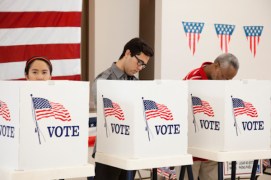
Polling Place Voting Booths

In all the media coverage on political issues [which is a HUGE percentage of all coverage], it’s interesting that almost nothing is ever reported about “the elephant in the room” — or as the title I chose for this post probably more accurately ties my theme here to that commonly-used phrase, “the elephant NOT in the room.” The elephant NOT in the room is about 144 million people who rarely if ever vote.

A Closer Look At The Elephant

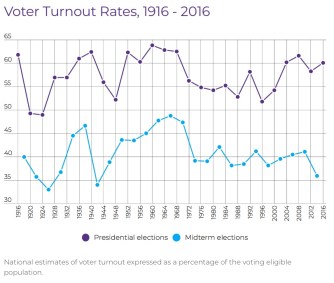
Voter Turnout

The voter turnout rate for midterm elections — such as the one coming up this November — is reliably lower than for presidential elections. In 2014, only 36% of eligible voters voted, while 64% [144 million] stayed home. Even in presidential elections, turnout averages only about 60%. Think about that. On average, three of every eight people you see when walking down the street never vote, and only five of eight vote on the person who will be their next President.

According to a recent USA Today / Suffolk University poll, people who don’t vote cite several reasons for their lack of participation in this fundamental element of our democracy:

    1. They don’t trust politicians,
    2. They don’t think their vote will change anything,
    3. They consider the electoral choices uninspiring, or
    4. They simply don’t have the time and transportation to get to their local polling place.

Please note. … If anybody said their reason for not voting was that they think everything is fine with our country and its leadership [i.e., so those who are voting seem to be doing a good job], the percentage was so low that it didn’t make it into the list of reasons the pollsters considered statistically significant.

The Most Powerful People In America?

I could build a pretty good case that these 144 million people who never vote could be the most powerful people in America — and that the second most powerful group of people could be the 72 million of them who only vote in Presidential election years. So to all of them, I’d offer this advice: Wake up! You have the power to change this country to whatever you think it should be rather than leaving that to a minority of people who currently have a much louder voice than yours. In number, you are at least five to six times the largest margin of victory of any U. S. President in our history [61.5% by Lyndon Johnson in 1964 — about 16 million votes]. Since 1820, only four Presidents have received 60% or more of votes cast [a 20% margin of victory], and only nine have received 55-60% of votes cast [a 5% to 10% margin of victory].

To those who cite reason #1, I’d advise them to consider what President James Garfield said: “The people are responsible for the character of their [leaders]. If [they] be ignorant, reckless, and corrupt, it is because the people tolerate ignorance, recklessness, and corruption.  If [they] be intelligent, brave, and pure, it is because the people demand these high qualities [in the people who] represent them.” President James Garfield [bracketed substitutions by me — his remarks were directed specifically at the Legislature, but are clearly applicable to all elected officials].

To those who cite reason #2, I’d advise them to read the history of past elections in which every vote clearly made a difference — most recently, the 2017 election in Virginia for a House of Delegates seat which actually resulted in a tie and was literally decided by the flip of a coin.  At first, Democrat Shelly Simonds thought she’d won the race by a single vote. But the next day, a panel of judges ruled that a ballot — originally thrown out by officials — should be counted in favor of her opponent, Republican David Yancey, making the election result a tie. The ensuing coin toss shifted the victory to Yancey. One additional vote for either candidate would have changed the outcome of that election.

To those who cite reason #3, what can I say — in many elections, you’re absolutely correct! However, President Garfield’s words point the finger of blame to — you guessed it: “We have met the enemy, and he is us,” as Pogo [Walt Kelly] said [a twist on the words of a message from American naval officer Oliver Hazard Perry in 1813 after defeating and capturing British Royal Navy ships in the Battle of Lake Erie: “We have met the enemy, and they are ours.]”

To those who cite reason #4, I’d say, “Name at least five of the many things in the past five days that you found time for and transportation to that were far less important than exercising what is probably the most precious right you have as an American citizen.”

I’ll close with this food for thought: “In the end the ultimate threat to the American republic will be America.  The problem is not with wolves at the door but termites in the floor.” Os Guinness

Thanks for reading this post, and if you regularly follow my Blog, for that, too. Please consider sharing this or other posts with your friends, colleagues and associates.

img_7026 img_3358

Charles M. Jones