The Politics Of DACA

Personally, although I understand and appreciate arguments against a favored path to citizenship for people in America who qualify for the Deferred Action for Childhood Arrivals program [DACA], I believe this is one segment of our population that we have an obligation to consider separately from other issues labeled as “amnesty” in debates about finding solutions to the extremely complicated issue of illegal immigration. These are people brought here illegally as children. They were too young to know that what their parents were doing was illegal, and they have grown up here and know of no other previous life elsewhere. Many [most, as I understand it] have become productive residents, have jobs, and pay taxes. Many have gotten an education, some at advanced levels. The problem is our fault, not theirs — i.e., our lack of resolve in dealing with the issue of border control and illegal immigration over many decades has resulted in numerous problems, the plight of these people being only one relatively small part of a bigger whole.

The Right Thing To Do [But Don’t Kid Yourself About Supporters’ Motivations]

Whenever politicians even within their own party have differing opinions on an issue, there is at least a modicum of rationale for assuming that the differences of opinion are not party-line focused. However, any time you hear all politicians of one party expressing themselves at every opportunity in a party-line monolithic mode, giving impassioned speeches about the plight of a certain segment of our population and pushing for legislation to “ease their pain”, you can bet that their motivation is not altogether altruistic. This is true regardless of which party is trying to capture the “high-road” [ostensibly the more altruistic] image.

In the case of DACA, it’s the Democrats that are trying [and so far, in my opinion, succeeding] to portray themselves as their advocates. Because of their monolithic solidarity, though, my suspicion got the best of me, so I decided to do a little research. My findings revealed some interesting correlations between their ostensible passion for DACA beneficiaries and just plain run-of-the-mill politics.

Looking Deeper

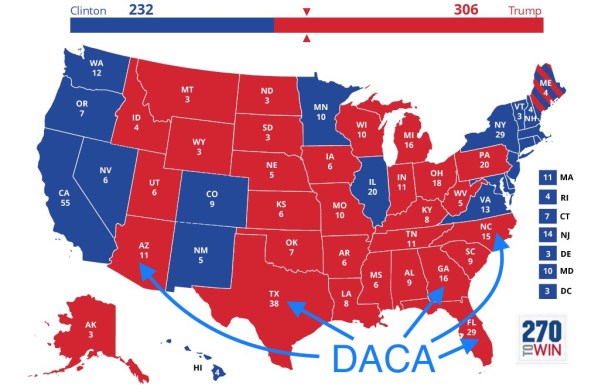
Let’s just look at the numbers. In the 2016 presidential election, all the hype about Hillary Clinton winning the popular vote by 2.9 million votes is meaningless [that’s only a 48.1% to 46.1% victory — neither Clinton nor Trump got a majority of the popular vote]. Clinton lost the Electoral College vote 306 to 232, and that 70% to 30% trouncing was achieved by a margin of only a few hundred thousand votes. Which states? Five states that supplied 109 Electoral votes for Trump [more than enough to have swung the election to Clinton] were in the top ten states in terms of DACA applications — Arizona, Florida, North Carolina, Texas and Georgia. In each of those states, the number of DACA-eligible people not currently in the DACA program averages 30% of the votes that would be required to swing the state from Republican to Democrat in terms of Electoral College votes [the range is 17% in Georgia to 45% in Arizona].

The bottom line is that, under two assumptions, current and future DACA participants would be a major component of the votes that could swing these Trump states to a Democrat challenger if Democrats are able to solidify the perception that they are the true DACA advocates. The two assumptions are 1) that all current DACA participants [who would supposedly ultimately become voters] vote Democrat and 2) all newly-approved DACA participants [i.e., those eligible to vote under a new law] vote Democrat. That would enable Democrats to focus their advertising dollars on other segments of those states’ populations, dramatically improving their chances of turning those states from red to blue on the Electoral map.

It Would Be Great …

It would be great if motivations to support current and potential future DACA participants were pure, and driven by people in our elected leadership who have true concerns for the people in the program — but the truth is, it’s just politics as usual.

Thanks for reading this post, and if you regularly follow my Blog, for that, too. Please consider sharing this or other posts with your friends, colleagues and associates.

Charles M Jones

Charles M. Jones

The Runaway Trolley Problem

The Runaway Trolley Problem is one of those classic hypothetical situations that can be useful in helping us understand difficult trade-off decisions that often arise in dealing with complex issues.  The problem can be summarized as follows. …

There is a runaway trolley barreling down the railway tracks. Ahead, on the tracks, there are five people tied up and unable to move. The trolley is headed straight for them. You are standing some distance off in the train yard, next to a lever. If you pull this lever, the trolley will switch to a different set of tracks. However, you notice that there is one person tied up on the side track. You have two options:

      1. Do nothing, and the trolley kills the five people on the main track.
      2. Pull the lever, diverting the trolley onto the side track where it will kill one person.

Which is the most ethical choice?

This is a pretty good analogy of the current situation with the entitlement programs [Medicare, Medicaid, and if not completely replaced with something that can even theoretically work, the “Affordable” Healthcare Act  (aka Obamacare)] which, if left to themselves with no action very soon, will drive America into bankruptcy in fewer years than most politicians want to think possible.

I have written extensively in posts to this Blog and on the pages of this website [e.g., Unsustainable Fiscal Path] about the fact that if we don’t get our fiscal situation in order pretty soon, our ideological differences will become almost insignificant in comparison to our economic situation.

The “Entitlement Programs Problem” — A Version Of The “Runaway Trolley Problem”

Very few people, even in our leadership, are willing to unequivocally call our entitlement problem what it is  — a train wreck in the making. You don’t need to be a mathematician, an economist, or a financial expert to look at simple trend graphs and conclude that our current fiscal path is not sustainable in the long term, and that entitlement programs are the principal drivers of the problem. We have before us the same kind of choice presented by the Runaway Trolley Problem:

      1. Do nothing and just allow these programs to eventually drive us into bankruptcy [because continuing on our current path is not mathematically possible] — i.e., allow all the millions of current and future beneficiaries to ultimately receive reduced levels of (or potentially lose altogether) whatever benefits they currently receive or would otherwise be eligible to receive in the future. … Analogous to “Don’t pull the lever, and allow five people to die”. After the comma, however, a more accurate analogy would be “and cause 49,244,195 people to lose or receive reductions in benefits and/or be unable to begin receiving expected benefits” [49,244,195 is the 65+ population].
      2. Modify these programs now as required to make them financially sustainable — i.e., reduce the benefits to which future beneficiaries will be entitled, increase the age at which future beneficiaries will begin receiving benefits, reduce benefits being paid now to current beneficiaries, and/or increase taxes to fund the amounts required to pay current and future benefits. … Analogous to “Pull the lever, saving the lives of five people but allowing one person to die”. After the comma, however, a more accurate analogy would be “and increase the payroll taxes 200,241,033 people are paying” [200,241,033 is the 18-to-64 population].

So the ““Entitlement Programs Problem” is a tradeoff decision that is kind of reversed from the “Runaway Trolley Problem“: more like “adversely impact 49 million people later with no action now or four times that many people now by taking corrective action now”.

Would’a … Could’a … Should’a’ / What Now?

The truth of the matter is that this problem, had choice 2 been a decision made decades ago, would not exist today — and the number of people negatively impacted from then to now would have been far smaller than will be the case going forward from now. Chalk that up to the simple fact that politicians make their decisions not based on what is best for the country, but based on [in this order] 1) what maximizes their personal chances of being re-elected and 2) what maximizes their party’s chances of obtaining or maintaining majorities in the Legislature and having a member of their party in the White House. Unfortunately, that mentality results in a propensity to “ kick the can down the road” — i.e., to put off controversial decisions until after the next election [and of course, there’s always a “next election”].

House Speaker Paul Ryan has said that Entitlement Reform is a major 2018 agenda item. Senate Majority Leader Mitch McConnell seems less enthusiastic about that, and it’s hard to read at this time whether President Trump considers it a priority or not. As a current beneficiary of two of these four programs, I hope Speaker Ryan is able to drive toward action now.

Thanks for reading this post, and if you regularly follow my Blog, for that, too. Please consider sharing this or other posts with your friends, colleagues and associates.

img_7026 Charles M Jones

Charles M. Jones

Budgeting 101

For anyone who wonders why Swamp politicians, be they Democrat or Republican, can’t seem to get a grip on America’s finances and put us on a fiscally sustainable path, this Blog post is a must-read. Let’s start with some fundamental facts:

    1. No entity — an individual person, a family, a corporation, or a government — can continuously expend more funds than it takes in for an indefinite number of years. The result of such a scenario is a continuously-increasing debt — and inevitably, at some point in time, the creditor(s) who have granted the bulk of that credit will lose confidence in the debtor’s ability to repay what is owed, or even the interest on it. That, in turn, will result in the creditor(s) taking such actions as refusal to extend additional credit, requiring pay-down of some existing debt before any new loans of smaller amounts will be made [i.e., creating a scenario in which the debtor’s overall debt level is reducing each year], and/or increasing interest rates on new debt.
    2. No government can make all of the people over whom it has authority happy all of the time [it can, however, keep some of the people happy all of the time, and all [or at least most] of the people happy some of the time].
    3. In recent decades and currently, attributes in a person running for office that are most likely to result in his/her being elected to that office have very little if anything to do with his/her knowledge of fiscal or other domestic [or foreign policy] issues. Factors determining electability are more in the realm of name recognition [vis-a-vis that of his/her opponent], speech-making ability, and “charisma”.

The “drain the Swamp” mantra these days, at its core, is a recognition on the part of many that these fundamental facts, which I might add form the basis of the ground rules of the Current Paradigm, must change if anything other than the status quo will prevail until a financial meltdown forces acceleration to a New Paradigm.

For anyone doubting the accuracy of the preceding paragraph, one of the original pages of this site [Unsustainable Fiscal Path] gets into the weeds of why #1 above is a fact and not just a collection of assumptions on my part. The purpose of this blog post is not to attempt to debate #1 [or any of the items] in my fundamental facts list above, but to clarify why Swamp politicians, absent a “wake up call,” will never move the needle on this issue — ergo, “draining the Swamp” may be the only way to get us off the fence voluntarily before we fall off of it.

Demonstrations And Protests Won’t Do It

Demonstrations and protests seem to me to be more prevalent nowadays than they’ve ever been in my lifetime. I realize that it’s possible they just appear to be more prevalent because of our climate of 24-hour, 365-day instantaneous “news” coverage — and in recent years, Social Media posts that can “go viral” within hours if not minutes. I do think it’s accurate to say, though, that they are organized and promulgated much more quickly, and that their usefulness has been outlived. While distant-past versions have played a major role in producing very meaningful and lasting change [e.g., the Civil Rights era], today we have such a plethora of issues simultaneously in the media that they tend to drown each other out and just become general evidence that there are segments of our society who are not happy — and therefore nothing more than evidence of the truth of assumption #2.

Current Swamp Occupants Won’t Change

In retrospect, President John Adams was certainly speaking prophetically over 200 years ago when he said this: “There is nothing which I dread so much as a division of the republic into two great parties, each arranged under its leader, and concerting measures in opposition to each other. This, in my humble apprehension, is to be dreaded as the greatest political evil under our Constitution.” That’s a pretty accurate description of our current situation, which has no doubt evolved [or devolved might be more descriptive] to a much worse state than he must have been imagining when he said that. If Swamp occupants haven’t changed in over 200 years, we would be foolish to think they will change now.

So What Are We Left With?

I think Pogo [Walt Kelly], in summing up his attitude towards the foibles of mankind and the nature of the human condition, had the answer in 1970 — “We have met the enemy, and he is us” [a parody of a message sent in 1813 from U. S. Navy Commodore Oliver Hazard Perry to Army General William Henry Harrison after his War-Of-1812 victory in the Battle of Lake Erie, stating, “We have met the enemy, and they are ours.”].

Interestingly, this 1970 edition of that famous comic strip was a timely confirmation of something President James Garfield had said almost 100 years earlier — “The people are responsible for the character of their Congress. If that body be ignorant, reckless, and corrupt, it is because the people tolerate ignorance, recklessness, and corruption.  If it be intelligent, brave, and pure, it is because the people demand these high qualities to represent them in the national legislature. … If the next centennial does not find us a great nation . . . it will be because those who represent the enterprise, the culture, and the morality of the nation do not aid in controlling the political force.” [Garfield focused these remarks on legislators, but I would broaden them to apply to all elected officials — national, state, and local.]

So what we are left with is us!  And the question before us is “What can we do?”

Our Challenge

Albert Einstein is often quoted as defining insanity as “doing the same thing over and over again and expecting different results.” [he later disputed having said that]. Nonetheless, a quote accurately attributed to him is “We cannot solve our problems with the same thinking we used when we created them.”

Almost 129 million votes were cast in the 2017 presidential election. However, because of our Electoral College system [which I believe is a good thing], only a few hundred thousand votes could have changed the 306-227 outcome. I believe that at least a third, maybe closer to half, of the 129 million people who voted fall into a category one popular radio talk show host calls “low information voters” — basically, people who are easily swayed by the most petty of factors [how the candidate looks, how good a speaker he/she is, liking or disliking one thing he/she said or did in the final weeks or even days of the campaign, etc.]

I’d like to think that the 2016 election was the last one that will have been dominated by the Current Paradigm, and that the Major Paradigm Shift Well Underway in this country is, at least for our elections, complete. If that is the case, those of us who have the will to do so can surely find ways to swing a few hundred thousand low-information voters in our direction. Then, the remaining issue will be to ensure that there is a steady stream of candidates for elected offices who have something in their qualification profiles other than “looks nice on camera”, “speaks eloquently”, and “has charisma”: for starters, maybe one such item could be “has a rudimentary understanding of economics and finance”. Sorry, no capacity to deal with that issue in this post — I’ve already run a little over my self-imposed length for individual posts. I’ll save that for another day.

Thanks for reading this post, and if you regularly follow my Blog, for that, too. Please consider sharing this or other posts with your friends, colleagues and associates.

img_7026 img_3358

Charles M. Jones

Observations Regarding The New Tax Law

Tax Law Cartoon

The media coverage, both in the weeks leading up to the December 20 passage of the new Tax Reform Law now awaiting the President’s signature and in the hours since its passage, has been the starkest example you could find of three things I’ve written extensively about in posts to this blog and in the overall content in the pages of this web site: 1) the extreme [and still worsening] ideological/philosophical polarization within our elected leadership; 2) the heavy bias to the Left in most “mainstream” media outlets; and 3) the alarming number of people in this country who qualify as what one popular radio talk show host calls low information voters.

Intensifying Ideological Polarization

It certainly doesn’t take much research to make this point — consider these remarks by Democrats and Republicans about the new law:

Democrats: “A monumental, brazen theft of the middle class”, showing “moral obscenity and unrepentant greed. … It is a vote to instill a permanent plutocracy in our nation.” … “Armageddon.”

Republicans: “We are about to achieve some really big things, things that the cynics have scoffed at for years, for decades even. This really is a generational defining moment.”

One legislator [a Democrat, of course] recently said “Millionaires will get an average annual tax break of $35,000 a year,” while “millions of middle class taxpayers will see their taxes go up.” This got aired and re-aired multiple times in the “mainstream” media. So my question to that legislator [and to the media pundits who aired this] is “What’s your point? The percentage savings of the millionaires is less than the percentage savings that many more millions of middle class taxpayers will save under this law.”

More Evidence Of Left-Biased Media

In most “mainstream” media coverage of the bill, the general drift is how it “robs Peter to pay Paul” — Peter in this case being the “Middle Class”, and Paul being the very wealthy [the “top 1%”, as Bernie Sanders says] and huge corporations. In the “mainstream” media’s more conservative minority, the general drift is on the potential for economic growth fueling a more prosperous outlook if the Republican logic is correct, but tempered with “What if …” caveats on how the law could hurt Republicans in the 2018 and 2020 elections absent appreciable evidence to the average voter in those years of substantial improvements in the economy.

“Repeat a lie often enough and it becomes the truth.” Although not all of what the “mainstream” media is pushing is actual lies [more accurately, it could often be labeled “partial truths”], this quote by Joseph Goebbels [Adolf Hitler’s Propaganda Minister] has  a great deal of applicability here. An excellent case in point is all the flack in the past few days about the so-called Corker “bribe”. Based on “undisclosed sources,” a component of the law regarding special treatment of real estate companies [which were the source of Corker’s considerable wealth] was characterized as a “last minute change” to get his vote. That has been debunked repeatedly [that provision was at least a month old, going back to the House version of the bill], but it is still being reported on and commented on.

Alarming Number Of “Low Information Voters”

Let me begin expanding on #3 in my introductory paragraph with this quote often attributed to P. T. Barnum: “There’s a sucker born every minute.” [there is no clear evidence that the attribution to Barnum is valid; early examples of its use among gamblers and confidence men can be found]. Now, let me just report some facts, not opinions or “spin” on somebody else’s “spin.”  The new tax law is not skewed toward the rich [I actually did the research with a spreadsheet — figure it out for yourself if you think I’m biased]:

    • First, under the current tax law, a couple whose Adjusted Gross Income is $20,800 or less pays no income tax. Under the new plan, that zero-tax threshold increases to $24,000.
    • For a married couple with Adjusted Gross Income of $59,039 [U. S. median as of 2016 returns], filing jointly and taking the Standard Deduction and [under current law] $8,100 [2 x $4,050] in personal exemptions, tax: under current law, is $4,783; under the new law, is $3,824 [reduction: $960, or 20.1%].
    • For a married couple filing jointly, at the income levels below and with a 5% mortgage five times their income, giving 5% of their income to charity, their taxes are affected as follows:
      • Income $59,039, tax: under current law, is $4,032; under the new law, is $3,824 [reduction: $208, or 5.2%].
      • Income $500,000, tax: under current law, is $83,435; under the new law, is $75,379 [reduction: $8,056, or 9.7%]. Note: a little higher percentage reduction here only because of my choice of income levels — the $750,000 limitation on the mortgage interest deduction in the new law did not “kick in” for this particular couple with a $500,000 income [it did “kick in” at the $5,000,000 level below, shifting those “rich people” to tax increases instead of reductions].
      • Income $1,000,000, tax: under current law, is $209,000; under the new law, is $198,379 [reduction: $10,621, or 5.1%].
      • Income $5,000,000, tax: under current law, is $1,323,635; under the new law, is $1,419,379 [INCREASE: $95,744, or 7.2%].

I put these facts in this section about low information voters because there are literally millions of people who have absorbed negative media spinning of the content of this law. My guess is that when its intended results begin to manifest themselves — and I believe they will — the opinion polls will change dramatically, and in a year the current polls will be looked back upon the same way we now look back upon the polls leading up to the 2017 election [worthless].

So Who’s Right?

The short answer is “Nobody actually knows whether Ms. Pelosi’s “Armageddon” characterization of the law or Speaker Ryan’s “generational defining moment” characterization will prove to be more accurate when viewed in our rear-view mirror a decade or two from now [all ten-year projections, whether optimistic or pessimistic, are based on too many assumptions to be reasonably accurate]. This is particularly true of projections about what net impact, if any, this law will have on our national debt [which as I’ve often said is probably the single most significant number that will define our future — see the Unsustainable Fiscal Path page at this site].

Which “side” is right will determine the degree to which our currently unsustainable path continues its recent turn toward a more sustainable direction. I sincerely hope the Republicans are right — not because I’m a Republican, but because I believe that our current leadership is at least trying to move us toward financial sustainability and moral clarity, and that our leadership under the alternative outcome of the 2017 election would have already made significant progress toward sealing our ultimate doom.

Thanks for reading this post, and if you regularly follow my Blog, for that, too. Please consider sharing this or other posts with your friends, colleagues and associates.

img_7026 img_3358

Charles M. Jones

I’m With Eliza Doolittle …

Audrey-Hepburn-as-Eliza-Doolittle

An interesting thing came to my mind as I watched the December 12 special election in Alabama for former Senator Jeff Sessions’ [now Attorney General] seat go to a Democrat — Eliza Doolittle’s [Audrey Hepburn’s] wistful song Wouldn’t It Be Lovely in the 1964 musical My Fair Lady. In that song, “Eloyza” [as she pronounced her name before her metamorphosis under the direction of Professor Henry Higgins (Rex Harrison)] expressed how “lov-e-ly” it would be if [in so many words] she could live a more affluent lifestyle.

This election presented me with numerous sub-themes to write about, mostly around the general theme of the Major Paradigm Shift Well Underway not only in this country but in the world [i.e., more evidence of the shift, and what we can glean from this particular component of it]. I chose my “Eliza Doolittle epiphany” because it looks forward to what could be rather than backward-to-now to confirm what has been and is taking place.

Back To The Alabama Election …

That imagery in my mind caused me to think “Oh, wouldn’t it be lovely if Doug Jones, the newly-elected Democrat, would realize how much of a change agent he could become in the three years he has until he will surely be unseated by a Republican if he does not become that change agent?”.

Think about it. … Jones, who if he simply plays by the Current Paradigm rules and falls in line behind the Democrat leadership is a “lame duck” Senator from the get-go, has the potential to almost immediately become one of the most powerful people in our elected leadership. And if he rises to that challenge and “plays his cards right”, he could have a bright future ahead of him.

Unfortunately, Doug Jones doesn’t appear to be one of the sharper knives in the drawer, but heck, there are many examples in both parties of people about whom that could be said. So for a moment, let’s forget the fact that Jones is beholden to the Democrat Party because they poured millions into his campaign and brought in party “big guns” to voice their support of him in ads and rallies [which means the Current Paradigm will no doubt prevail, and he will just fall in line and play by the rules]. Let’s just indulge ourselves and fantasize a bit here on what could be if Jones wakes up and smells the coffee. …

What Could Jones Do If He “Sees The Light”?

Overnight, Doug Jones has removed 33% of the Republican margin for any action that requires only a simple majority in the Senate. That margin has dropped from three to two, meaning that before Jones’ January 2018 swearing in, three Republicans can defeat an action promoted by the their leadership, whereas beginning in January only two can kill it — assuming, of course, no yea votes from Democrats and a tie-breaking yea from the Vice President.

If Jones realizes that the money and support he got from Democrats this month is history, and that it is likely that no amount of money or support from them in 2020 [when Sessions’ seat is up for regular re-election] will propel him to victory in that election if he is “just another Democrat” between now and then, he will benefit greatly from voting the way all legislators from both parties should vote — as he believes most of the people in his state [whether they voted for him or not] would want him to vote.

Think about what that could accomplish. … Envision an atmosphere in which he is “in play” [as the media pundits say] in every piece of legislation coming to the Senate over the next three years — i.e., an atmosphere in which he is never a shoo-in nay vote like all the monolithic automatons under Chuck Schumer. Legislation that a Jones yea vote helped pass could no longer be branded by Democrats as purely partisan in 2018 and 2020 election campaigns. Better yet, a yea from a single member of one party can often embolden others to vote with that “renegade”, breaking the “nobody wants to be the first to step out of line” mold.  Building on the momentum of that latter thought, what if that one “ice breaking” action by Jones ended up getting the Senate back into truly bipartisan discussion, with nine or more Democrats potentially opening up the possibility of multiple bills passing with 60 or more votes?

Back To Reality

Sorry, I got carried away there. I won’t hold my breath until I see this scenario unfolding. My guess is that it’ll be business as usual after Jones is sworn in — business as usual meaning that regardless of which party has a majority as thin as 51-49, the majority brings its bills to the floor and the vote is [at best from the majority’s view] 51 yea, 49 nay [or 51 yea, 50 nay if the Vice President’s tie-breaking vote is required]. This brief moment of fantasizing was uplifting, though!

Thanks for reading this post, and if you regularly follow my Blog, for that, too. Please consider sharing this or other posts with your friends, colleagues and associates.

img_7026  Charles M Jones

Charles M. Jones

The Rorschach Test?

Rorschach_blot_01I’ve always been fascinated with the logic behind the Rorschach Test, which ostensibly contributes to the ability of Psychologists to develop a person’s psychological profile. As I read, hear and watch samples of news coverage of events from day to day, it becomes apparent to me that the application of similar logic to the news coverage can allow any objective person to see more clearly that there is indeed A Major Paradigm Shift Well Underway in this country.

The lead image for this post is the first of ten ink blot images used in the test. The most common responses are “bat”, “butterfly” and “moth”. These responses can supposedly provide clues about how subjects tackle a new and stressful task. Other ink blot images provide [to the Psychologist, at least] indications about how a person is likely to manage feelings of anger or physical harm, how he/she relates with other people, his/her perception of self-worth, his/her view of authority, etc.

Applying That Logic To News Coverage Today …

Everybody tends to view news coverage through the “lens” of their Value System [links to USAparadigm page(s)]. A news reporter also [of necessity] factors into his/her coverage the Value System of his/her media outlet’s ownership/management, which drives the editorial screening process [Six Corporations Control …]. So content [the actual objective “story”] that is “filtered” by the Value System of a particular media outlet and its reporters and anchors is viewed by a person whose perception of that “filtered” content is “filtered” by his/her Value System. The result? Just like the impression formed in the mind of a person looking at one of the Rorschach Test ink blot images, the person reading/hearing/watching the news forms an impression of the situation.

If you back away from the detail and look at multiple news stories in multiple media outlets about multiple events on a given day, evidence of the paradigm shift going on abound.  Let’s look at just two examples — the Alabama special election to replace former Senator [now Attorney General] Jeff Sessions [the voters will make the selection on December 13]; and President Trump’s announcement that the U. S. will move its embassy in Israel from Tel Aviv to Jerusalem.

Alabama Senate Race

Alabama’s Senate seats are about as solidly in the Republican camp as any state’s, and everybody assumed that a Republican would easily win the election to replace Senator Sessions. In the Republican primary, the two front-runners were Luther Strange, the appointed temporary replacement and “traditional Republican politician”, and Roy Moore, a known “fly” in the “ointment” of Establishment government. Moore won the primary and will face Doug Jones, an Establishment Democrat, in the General Election on December 13.

U. S. Embassy In Israel

Last June, President Trump signed [as his three predecessors had] a waiver of The Jerusalem Embassy Act of 1995, a law that dictated and funded the relocation of our embassy in Israel from Tel Aviv to Jerusalem no later than May 31, 1999. He simply said that other items on his agenda were taking priority at the time an extension decision was needed, and that he needed more time to consider the matter so that he could make an informed decision and act in an appropriate manner.  Everybody was happy, and seemed to assume that at least on this issue, Trump would simply renege on his campaign promise [as his three predecessors had done] in order to avoid “rocking the boat”. Now, after considering the matter further, he is simply doing what he said he’d do and there seems to be a world-wide uproar complete with predictions of doom.

Paradigm Shift Evidence

These two examples reveal some very clear evidence of the Major Paradigm Shift Well Underway not only in this country, but in the world.

How the Alabama Senate race is playing out is just another of many examples that collectively are clear evidence that we have a two-party system that is working less and less well every day. In one of the links referenced above, Joel Arthur Barker defined a Paradigm Shift as a decline in the current paradigm’s capacity to solve problems and create new things, and a concomitant rise in the ability of a new paradigm to do so. Practically everybody in Senate leadership dissed themselves from Moore when the sexual misconduct allegations first arose, but then Republican leaders began to soften their criticisms when polls showed Moore’s drop in the polls to be temporary. What’s still in the Current Paradigm is that our elected leaders make their decisions based purely on politics and not on what is right or what is best for our country. The “shift” part is that there is clearly a growing anti-Establishment mindset in this country — the voters in Alabama, whether they’re “right” from a broader perspective or not, seem to be saying [at least as indicated by current polls] “If the Establishment is against a candidate, we’re for him” [in fact, that’s how Moore won the Republican Primary — the Establishment pushed hard for his opponent, the incumbent appointee].

Reaction to the President’s announcement about the U. S. Embassy in Israel clearly shows two things about the paradigm shift. The first is simply more — among much — evidence that this President is focused on doing what he said he would do [contrary to his three immediate predecessors, two Democrats and one Republican, all of whom said in their election campaigns that they would do this]. The second is clear evidence that the paradigm shift is worldwide [world leaders tend to assume that one American President will be more or less like his/her predecessors on these kinds of issues, choosing not to “rock the boat” too much, so the “shift” part of this announcement is that a world leader — particularly a U. S. President — did exactly what he said he would do rather than softening his resolve after his election and just “going with the flow”].

It’ll be most interesting to see what the voters in Alabama actually say on December 13, and whether the predictions of doom about the U. S. Embassy announcement amount to anything [that won’t be known for months at least, probably years — any demonstrations going on, denouncements by other world leaders, etc., provide a view far too short-sided to be of any value].

Thanks for reading this post, and if you regularly follow my Blog, for that, too. Please consider sharing this or other posts with your friends, colleagues and associates.

img_7026 img_3358

Charles M. Jones


Social Media Vis-A-Vis The Paradigm Shift

img_3574I doubt that anybody could present a fact-supported case that social media platforms are not an integral part of the Major Paradigm Shift Underway in America. In fact, I could build a strong case that these platforms are a key enabler of the shift, possibly even a major component of the fuel that is driving it.

Consider this. … The most conservative report I found of the average time spent per day by people who use social media, by platform, is: YouTube, 40 minutes; Facebook, 35 minutes; Snapchat, 25 minutes; Instagram, 15 minutes; and Twitter, 1 minute [Source: www.adweek.com]. It is unclear what degree of mix of these numbers applies to a particular person, and therefore whether they are additive — i.e., whether a particular person uses only one of these platforms, two or three of them, or all of them. The most generous reports seemed unrealistically high to me for averages — several hours in some cases.

To the point that is the subject of this post, I think I would be safely conservative in using somewhere between thirty minutes and an hour as the average time that an average person who uses social media spends on one or more platforms.

How Much Time Per Day Do We Control?

The consensus among medical experts on how many hours of sleep a person needs each night is about eight. Various sources I accessed while writing this post indicate that appropriate minimum amounts of time for other “essentials” are 90 minutes for eating and 30 minutes for personal hygiene. Subtracting these times from 24 hours yields 14 hours as the average amount of time each day a person has available for work and discretionary time.

The current business cycle [late 2007 to now] is the longest since 1947, and is one of the slowest-growth periods since the end of World War II. Although both hours worked and output have grown at below-average rates during this cycle, output has grown notably slower than its historical average. The result is an historically low labor productivity growth rate of 1.1 percent [Source: Bureau of Labor Statistics]. Estimates of “average work week” are all over the map because “clocked hours” is the only way to track this statistic and many millions of salaried employees don’t “clock in and clock out”. The average of various surveys I reviewed is 47 hours per week [since it won’t lead to significantly different conclusions here, I’ll use 49 hours per week (7 hours per day) to keep my numbers round]. Subtracting 7 from the 14 above yields 7 hours as the average amount of time each day a person has available for discretionary time [for retired people, of course, the number stays at 14].

So What Activities Got Displaced By Social Media Activity?

Social Media didn’t exist at the beginning of the current business cycle [late 2007], and the smartphone era was only a few months old. So the question to which we should all want an answer is “What did we give up in order to provide the time we spend on social media?”. The obvious corollary question is “Was it a good trade?”. A followup question I find intriguing is “Is there a trend toward increasing amounts of time being spent on social media [and therefore toward more and more other activities losing our attention]?” — and the obvious corollary to that question  is: “Are those trades good ones or bad ones?”.

I don’t have a research staff to ferret out data that would provide fact-supported answers to questions like these, but I’d speculate that what would probably come out of that kind of research would be very similar to the following:

    • Social media are at least partially responsible for the lowest productivity this country has experienced since World War II — for the simple reason that every minute a person “takes off” at work for interaction with people on social media is at least a minute of unproductive paid time [“at least” because of the Learning Curve Effect — i.e., taking one’s mind off of one activity to focus on another requires some “learning curve” time to get back into the “groove” of the first activity].
    • Whatever activities we have given up to provide the discretionary time we spend on social media were probably activities we would not have given up by choosing to do so — i.e., they waned because social media activity left us with less discretionary time available, and they were the ones that fell off our daily “radars” because we “just didn’t have time for them”.
    • Statistics on use of social media by teens indicate that future generations of adults will use social media more than adults today use it [and that what they do on social media will certainly not contribute to increased national productivity].

If I had to summarize my overall point here in a sentence, I’d say that we should all consciously maintain an awareness of how much time we spend on social media, periodically think about what life activities seem to be feeling more “distant”, and make decisions about the relative values to us of activities that consume our time. Just for perspective, assuming an 85-year lifespan, a 40-year-old person who spends 45 minutes a day on social media will within that year have consumed 0.24% of his/her life’s remaining discretionary hours doing so; a 60-year-old, 0.43%; an 80-year-old, 2.14%; and an 84-year-old, 10.71%. So project yourself to the closest of these ages to yours and think of it this way: “This year, do I want to spend …% of the remaining hours of discretionary time in my life doing this?”. I’d love to be a fly on the wall in the room where an average/typical American asks him/herself that question.

Thanks for reading this post, and if you regularly follow my Blog, for that, too. Please consider sharing this or other posts with your friends, colleagues and associates.

img_7026 img_3358

Charles M. Jones

Old Paradigm Thinking ☞ Old Paradigm Solutions

A major mass transit system proposed for Nashville by the current Mayor is long overdue, but I hate to say [because the Nashville metro area is where I live] that the proposal is an attempt to apply “old paradigm” thinking to “new paradigm” needs. My posts to this Blog and the website I set up to host it have an overall “theme” that is much broader in scope than the design of any particular city’s mass transit system — or for that matter, a national design for population mobility.  However, what I’d like to provide in this post is yet more evidence that there is A Major Paradigm Shift Well Underway in this country, and that evidence of that phenomenon is all around us.

The Problem

Nashville needed a mass transit system like the one currently proposed — which will require fifteen years to complete — at least five years ago, probably ten, maybe even more. Traffic in the area covered by this plan is terrible now, and the population is increasing by about 3,000 people per month. The situation here is a classic example of what happens when a population grows orders of magnitude faster than the infrastructure needed to support it.

Old Paradigm Thinking — Old Paradigm Solution

The Mayor’s proposed system is estimated to cost $5.2 billion and take fifteen years to complete, and as anybody who’s ever followed government-funded projects knows, it will ultimately cost much more and take much longer. It is a combination of 26 miles of new light rail, more robust bus service, and a major tunnel below downtown where the new transit lines would run. The only “innovative thinking” expressed as such in the proposal is that the downtown tunnel will use new boring technology being touted in tunneling projects in other areas [similar to the technology being promoted by Elon Musk’s The Boring Company].

Apparently concerned about [or at least frustrated with] some negative views of her plan being expressed in the media, the Mayor contributed to an article that appeared in the 11/21/17 Tennessean. In it, she refuted what she called “transit myths” showing up in the media about flaws in her plan. Detailing her logic here would make this post too long, but her arguments come across to me as “typical politician-speak”, and the article quotes two respected academicians [who do not live in Tennessee] who disagree with her logic [Senior Fellows at the Cato Institute and the Manhattan Institute].

The main revenue generator for financing the project would be a 0.5% hike to Nashville’s sales tax in July 2018 that would jump to 1% in 2023. Proposed increases to the city’s hotel-motel tax, rental car tax and business and excise tax are simply more “taxes in disguise” because they simply increase the already-too-high costs of those services [businesses don’t pay taxes — people do]. As with the physical and functional design, the financing is simply traditional [old paradigm] formulas into which Nashville-specific parameters have been inserted.

From a design and financing perspective, this proposal would probably track pretty closely with decades-ago proposals in other cities.

How About Some New Paradigm Thinking?

I was encouraged that two people writing letters to the editor in the 11/20/17 Tennessean seemed to agree with what I’m saying here:

Letter 1. “It seems to be addressing tomorrow’s problems with yesterday’s tools. Cooperation with Uber, Lyft and other businesses to address the problem would make sense. How about 24/7 passenger minibuses as a method of carpooling? A hundred of them would take 2,400 cars off the streets of downtown. The city could license them and make money instead of spending it. How about airport-style moving sidewalks from the stadium parking lot to downtown? Focus on moving people around downtown instead of moving cars to and around downtown.” Letter 2. “The most important element in getting Nashvillians to use public transportation is not what we do with the arteries, but with the capillaries. Two elements have appeared on the horizon recently: ride-sharing services (Lyft and Uber) and autonomous vehicles. I submit that the most important factor in keeping Nashville roads free of gridlock and pollution is a system of getting people from their homes to a bus or train line. There is no reason that Metro and other cities cannot operate a software-based system of collecting passengers along residential streets on demand, and transporting them to main lines, and doing the same at the destination end. It may cost more for drivers or autonomous technology, but it will cause the buses and trains to be filled and not operate at a loss as most lines do today.”

I read an article recently about how major players in the hotel industry are rapidly moving toward new designs of rooms that are based on trends in consumer habits [I hope Nashville’s Mayor read that article (or sees this post) and absorbs this concept]. The article indicated that their designers “spend hours debating how best to use space, pay[ing] close attention to the types and sizes of bags that people are traveling with. They also study how guests move around the room, [thinking] ‘How do we make it easy? How do we make it seamless? How do we make it intuitive?’ [They don’t want] guests to spend too much time on figuring out where to place belongings. People want to go out and experience the city. No one wants to spend time unpacking. [Designers want to] minimize clutter and maximize space and promote a clean, minimalist area that is functional and easy to access.”

The lesson here? … People designing one thing [e.g., a mass transit system] can often get innovative ideas by observing not just the “history” and current “goings on” related to that thing, but also the “history” and “goings on” related to some other thing [e.g., a hotel room].

I don’t mean to imply that some, maybe most of the current design [the diagram I chose as the first lead graphic for this post] will need to be a part of Nashville’s transit system. My whole point is that the design doesn’t stem from the right starting point [see Closing Thoughts … below] and does not include sufficient “out of the box” thinking [which the second lead graphic depicts].

Closing Thoughts: For Nashvilleans; For Everybody

As for Nashville, I hope more people will speak out on this and move sentiment toward re-thinking the design, starting where initial research should have started in the first place — with the consumer: i.e., the goal should be determining what overall design will optimize, on average, the ability of a person getting from where he/she is at the moment [not necessarily his/her home] to his/her destination — “optimize”, in this context, meaning striking the best balance between the lowest cost and the shortest time.

As for my readers, I hope this post has been enlightening in terms of recognizing that there is indeed A Major Paradigm Shift Well Underway in this country, and if on any given day we look at “goings on” in almost any area of our lives, the evidence is all around us. The more of us who are aware of the paradigm shift, the more likely the rapidly-emerging New Paradigm will be the best match to our future needs.

Thanks for reading this post, and if you regularly follow my Blog, for that, too. Please consider sharing this or other posts with your friends, colleagues and associates.

img_7026 img_3358

Charles M. Jones

A Lesson From “The Orville”?

MV5BYWU3Y2ZlMjUtMzNlNy00ZTFjLTllNTMtOGQ5N2M1MGI0Y2Y4XkEyXkFqcGdeQXVyNjc5Mjg0NjU@._V1_SY1000_SX1500_AL_There is a new TV series this year — The Orville — that I’ve been watching on what I might call a “trial basis” — “trial” because I’m a long-time fan of the original Star Trek series and one of its offshoots [Next Generation] and movies with those casts of characters, but I’m initially skeptical about The Orville because it has a subtle twist of humor. My assessment at this point — keep on watching, but still on “trial basis”.

If you’re a regular reader and I haven’t lost your interest by now, please bear with me here.  If you’re a new reader, who knows? Maybe the title and opening paragraph are what brought you here.  Please stay with me on this. There actually is something here regarding the Major Paradigm Shift Well Underway in America.

Pure Democracy — A Good Thing Or A Bad Thing?

Although Seth McFarland [creator of the Orville] is no Gene Roddenberry [creator of the original Star Trek concept], a common thread between Star Trek and The Orville is story lines that present sometimes intriguing views of various aspects of life [politics, economics, technology, industry and commerce, religion, etc.]. A recent episode of The Orville depicted a very interesting view of the downside to pure democracy [all decisions are 100% made by 100% of the population].

Most academicians agree that a truly pure democracy is not theoretically possible [the main reason being that it would be extremely impractical because too much of the citizenry’s time would be consumed in administrative minutia, leaving no time for that society to produce anything for its economic sustainability].

As succinctly as possible, I’ll describe that episode before concluding with the lesson we can learn from it. … The Orville [the ship] arrived at a planet and sent an “away team” to the surface to do whatever they were supposed to do. One of the away team members did something in a public square that, if done here in America today, would be considered his First Amendment right. In that society though, it was extremely offensive in the eyes of millions of their citizens because it seemed to denigrate one of their most famous and beloved people. Quite a few people took pictures with their “smartphones”, apparently causing those images to merge into a government-monitored FaceBook-like system. Many of them walked up to him and pressed the red button on a badge-like red/green button thing all citizens wore [the team was there incognito, and therefore looked like anybody else]. Within minutes, the police came and arrested him. … To fast-forward a bit, because this guy quickly got to 4 million “red hits” [meaning that many people disliked what he did], he ended up being “on trial” on planet-wide TV. The show was essentially a “trial”. He was able to defend his behavior, apologize for it, or whatever. But at the end of the show, if the number of “red hits” got to 10 million, he would be “sentenced” to “attitude adjustment” — which, based on the persona of another person who had gone through that process, was kind of a prefrontal lobotomy.

The net story here is that, based on nothing more than the fact that a certain percentage of the population disliked what one person did, that person was accused, tried, convicted and sentenced “by the people”. That’s an alarming picture of what a truly pure democracy could become.

Is Our Republic Heading Toward This Kind of Chaos?

If you ask typical “people on the street” what kind of government we have, many, perhaps most, would say “a democracy”, perhaps thinking what they would call a pure democracy. We are not, and never have been, a pure democracy — we are a Republic, which is a representative democracy. It served us well for over two centuries, but in recent decades it has not worked as well as it has in the past — and in the past decade or so, its problems have been magnified in exponential proportions. I wouldn’t be so quick as to blame this on social media, or on the instantaneous news-around-the-clock environment that exists now, but think about “goings on” these days — e.g.:

Somebody [literally anybody with a smartphone who might post something that “goes viral”, or who otherwise has the ear of somebody with influence] accuses a public figure [movie star, politician, executive of an international corporation, …] of something which, if true, is offensive or even immoral at best and illegal at worst. The process that should follow is arrest [if grounds appear to be sufficient], convening of a Grand Jury to determine if there is sufficient evidence to take the case to trial, [if the result is an indictment] a trial, a verdict, and [if the verdict is guilty] a sentence and a date on which it will begin or be carried out.  … However, depending solely on whether the alleged incident shows up on the “radar screens” of “news” media and social media — and if so, how it is characterized — that person could be “indicted”, brought to “trial”, “convicted”, “sentenced”, and figuratively speaking, “executed” [although not so figuratively if his/her life is, for all practical purposes, ruined because of the negative public image that has been created]. Note. … I am not referring here to any current situation in particular. Even a very cursory analysis would reveal a considerable number of examples over many years of what I’m describing here.

I’m nearing my self-imposed limit for the length of my posts to this Blog, but hopefully, I’ve at least shed some light on something that might be worth consideration: As a society, have we been so hung up on our “right to express ourselves” that we have unwittingly shifted in the direction of a “pure democracy” like the one on the planet in the episode of The Orville? If so, I certainly hope we “wake up” before we end up like the proverbial frog in the pot of slowly-boiling water, unable to jump out when we finally realize what’s going on. As you ponder this question, consider the synopsis of the show on the TV listing [emphasis mine]: “Ed gives Kelly command of a team to find two Union anthropologists who disappeared on a planet similar to the Earth in the 21st century”.

Thanks for reading this post, and if you regularly follow my Blog, for that, too. Please consider sharing this or other posts with your friends, colleagues and associates.

img_7026 img_3358

Charles M. Jones

Mass Murders Accelerating

mass-shooting-baptist-church-sutherland-springs-hero_2

Just last week, I referred to the terrible mass shooting in New York that resulted in the death of 8 people and injury of 12 others.  I of course didn’t know at that time that just five days after the New York killings, an even worse [in terms of number of victims] tragedy in Sutherland Springs, Texas would result in the death of 26 people and injury of 20 others.

These two events, only five days apart, prompted me to wonder if it just appears that the rate and severity of these killings is increasing, or if the rate actually is increasing. I decided to do some analysis, and I regret to report that the rate actually is increasing, and at a rapidly accelerating rate.

One Picture Is Worth A Thousand Words

In a moment, I will direct your attention to the graph below that I created from current news items on the web plus one other source that documented details about these kinds of mass murders since 2006 [See this link to that source: Mass Murders Since 2006]. First, let me say to those of you who fog up whenever somebody refers to a graph, assuming the rest of the article is technical, please read on.  This graph simply shows the trend over time of the number of deaths per month from mass murder events, and its visual impact is alarming.

Mass Murders Track-Graph

The Words Behind The Picture [Nowhere Near A Thousand]

Think about what this graph reveals.  The trend is the average cumulative number of deaths per elapsed month since 2006.  This makes it fluctuate less from month to month, so it visually depicts the long-term trend rather than allowing month-to-month fluctuations to give it a “sawtooth” appearance. The following conclusions are evident:

    1. The trend since 2006 [blue line on the graph] is clearly up, but I suppose we could say not alarmingly.
    2. In late 2015, the trend shows a noticeable upward acceleration.
    3. From that point in 2015, even more alarming is the fact that the upward acceleration is much faster if only 2015 to now is considered [orange line]– and if a moving 24-month average is used [red line], the upward acceleration is even faster.

If this were a graph of the price of a stock you bought in 2006, you’d be elated. If it were a graph of automobile deaths since 2006, there would be an uproar in Washington to do something about this out-of-control situation.

Any undesirable statistic that is changing this rapidly and accelerating rapidly will ultimately gain the attention of enough of our country’s leadership to promulgate action. All the noise in the media at this time about increased control over gun ownership is “standard” for those on one “pole” of the deep political divide in America, and all the “red flag” rebuttals about the Second Amendment are “standard” for those on the other “pole”.

A Silver Lining?

There is a peculiarity about this latest shooting spree that should at least cause leaders at both “poles” to think about solutions rather than just rally around their colleagues at their respective “poles” and start spouting off their standard “bullet points”.

That peculiarity is twofold: 1) specific facts now known about the shooter’s history make it abundantly clear that if existing laws and established procedures had been working as intended, the probability that he could have acquired the weapon he used would have been dramatically lower; and 2) had the civilian who chased the shooter and killed him not had his legally-acquired weapon [and the skills and the courage to use it in this perfectly appropriate situation], the shooter would likely have remained at the church longer and produced much more carnage.

I’d like to believe this incident could at least be the initial foundation of a bridge across the giant chasm between the leaders at their “poles” on opposite “banks” — a foundation that could help them see that with that base in place, building the rest of the bridge may not seem so overwhelming a task.

Nice thought on which to ruminate … but I’m not holding my breath.

Thanks for reading this post, and if you regularly follow my Blog, for that, too. Please consider sharing this or other posts with your friends, colleagues and associates.

img_7026 img_3358

Charles M. Jones