Mses. Judd & Ciconne or Ms. Germanotto?

lady-gaga-super-bowlLast Sunday, I was about 2/3 finished with the weekly post I had planned for today when it was time for Super Bowl LI, so I put my writing down to watch the game. As always, I enjoyed watching the last game of the season for the professional-level component of my favorite sport, but this year, something else struck me more than the top-level performances of the New England Patriots and the Atlanta Falcons — so I changed my game plan for this post.

As for my Super Bowl experience … During the commercial time out segments cleverly placed at opportune breaks in action during the game, I watched 30-second commercials that cost $5 million a pop and left me wondering what product had been advertised. Then, although I don’t usually watch half-time shows, I decided to watch this one. The star was a woman I would not have known if I’d seen her on the street that afternoon. Although the show was apparently very well done if you like that kind of thing, it sounded to me like an inaudible collection of gibberish that left me wondering what, if anything had been her basic theme [modern sound systems tend to drown lyrics out — in my ears, at least].

Given the resounding applause and apparent adoration of Ms. Germanotto’s [Lady Gaga’s] fans on the field [and in the stands], her performance was apparently a booming success. Because of her strong support for Hillary Clinton in the 2016 presidential election campaign, media pundits all week had been predicting that she would have some anti-Trump sentiments built into her show. Whether she did or not, I have no idea because, as is the case with most “music” [to use the term loosely] and sound systems these days, I simply could not distinguish enough of the words in most of her lyrics to make sense of them. Her opening, though, seemed at least a little encouraging because I did make out a phrase or verse of God Bless America and “one nation under God, with liberty and justice for all” from the Pledge of Allegiance. It also contained a phrase or verse from Woody Guthrie’s This Land is Your Land, which seemed fine to me until I learned later through some media reports that this has been a theme in anti-Trump protests around the country. But as best I could tell, there were no direct anti-Trump slogans — and interestingly, USA Today’s coverage said “but a political protest never arrived, as Gaga opted for patriotism and unity over making a divisive proclamation” [emphasis mine].

I guess this is the point at which I must confess, if it’s not obvious from what I’ve written in this post to this point, that I am apparently “old”. At 71, I don’t really think of most of my life being in the past [although mortality tables say that is the case], and I’m actually excited about what I’m doing [including but not limited to this web site and my blog posts] and look forward to where my current pursuits might lead. But if “young” people can extract meaning and significance [or entertainment, for that matter] from last Sunday’s Super Bowl commercials and halftime show, I am definitely not one of them, which means that I must be “old” … Q.E.D., as mathematicians would say after proving a theorem [Quod Erat Demonstrandum, Latin for “which was to be shown”].

One thing I did pick up on, unless it was buried in the difficult-to-hear-clearly lyrics, was the absence of vulgarities and vitriolic tone like what spewed out of the mouths of Ashley Judd and Madonna Ciccone in the 1/21/17 Women’s March.  So if Ms. Germanotto’s performance did include any of that kind of thing, my “oldness” mercifully shielded me from it. To the extent she intended the show as a protest against our President and I just didn’t pick up on it, my hat is off to her for rising above the kind of ridiculous profile exhibited on January 21 by Mses. Judd and Ciccone.

Anybody who makes anything other than unsupportive remarks about almost anything President Trump says or does these days is viewed by liberal media pundits as small-minded and unable to understand what a terrible thing his election is turning out to be for America.  When I say something positive about what he is doing, it is not a blanket endorsement of him, the person — his is definitely not the profile I would like the person in the White House to have.  But when I consider the other person who would have moved in had she won last November, and what the outlook would be now, I am elated. There would have been fewer perceived snafus than many believe have occurred in Mr. Trump’s first two weeks in office, but that would simply be because she would not have had to get anything done that quickly in order to maintain the status quo — not because she is a “better” person or would have been a “better” president.  The first two weeks of her administration would have been nothing but celebratory events touting the historic significance of the United States electing its first woman president, a very high percentage of media coverage dedicated to special programming about her life and many accomplishments, appearances by her on all the “respectable” Sunday morning shows, etc. Nobody would have expected her to actually accomplish anything in her first two weeks.

The 1927 poem Desiderata, by Max Ehrmann, contains this line: “Whether or not it is clear to you, no doubt the universe is unfolding as it should”. The poem’s name is Latin for “desired things”.  For those who share my Christian worldview, these excerpts from the Bible, viewed collectively in context with each other, convey the same sentiment: “No one can find out the work that God does from beginning to end” [Ecclesiastes 3:11 NKJV]; “To everything there is a season, a time for every purpose” [Ecclesiastes 3:1 NKJV]. “There is a time for every purpose and for every work” [Ecclesiastes 3:17 NKJV]; “The vision … will surely come” [Habakkuk 2:3 NKJV]; “[God] changes the times and the seasons; He removes kings and raises up kings; He gives wisdom to the wise and knowledge to those who have understanding” [Daniel 2:20-21 NKJV]. Wise words for all of us to consider in the current environment.

Personally, I would prefer that Mr. Trump find ways to be less abrasive if [and only if] he could do that without compromising his clear conviction to do what he believes is right for our country. However, the odds are that the most militant of all the blocs and special interest groups that oppose him [supported by the liberal media through wide coverage], would still be second-guessing his every move even if he had done that part successfully.

I am seeing a major common element to all the demonstrating, the dis’ing from some of Mr. Trump’s remarks and actions by “establishment” politicians [even in his own party], and the insistence of media pundits [liberal and conservative alike] to try to filter everything he does through their traditional lenses [while turning a blind eye to new lenses they need to be developing in the rapidly-unfolding New Paradigm] — resistance to change, which is a natural human tendency. This is yet another manifestation of the major paradigm shift that is underway [see the page Major Paradigm Shift Well Underway at this site].

I, for one, want to give our new President the opportunity to do his job. I do not categorically endorse everything he says and does, but I respect the fact that he is the duly-elected President of our country, and I do believe that he truly desires the “great again” America he promoted in his campaign. I honestly hope we can soon get to a point at which more people see the situation that way and at least consider giving President Trump a little more latitude rather than making an issue out of practically everything he says and does.

Thanks!

img_7026img_7043

Charles M. Jones

[“Expletive Deleted”]

Back Then …

I suppose it might be people in their sixties or older who will remember “first-hand” the famous Nixon tapes that were highly influential in his ultimate resignation from the presidency [a person 18 years old in 1972 would be sixty today].  They were full of insertions of “[expletive deleted]” voice dub-ins to keep his apparently foul mouth from being heard on radio and TV or read in print-media transcripts.

Last Fall to Now …

Fast-forward to last Fall, and Donald Trump’s lewd remarks were plastered everywhere with “bleeps” to eliminate similar expletives. Since both of these men were/are Republicans, I should point out that there are also Democrats who clearly had the same problem.

In going through the media coverage of the January 21 women’s march protesting the inauguration of Mr. Trump as the 45th President of the United States, and being appalled at the vulgarity of some of the speakers, I decided to extract the full text of the two I considered the most egregious. My goal was to look through that text and determine where I would substitute “[expletive deleted]” if wanted to discuss these speeches with my twelve-year-old granddaughter.  Ashley Judd’s speech was 658 words, and contained 11 [expletive deleted]s.  Madonnas was 358 words, and contained 3 “[expletive deleted]”s. I should add that I was a bit lenient in setting criteria for defining “expletive”. There were actually some full phrases and sentences I did not screen from Ms. Judd’s speech which, although not containing actual vulgarities, were very suggestive of vulgarities previously or subsequently expressed in their contexts — and leaving those phrases and sentences in text to discuss with my granddaughter would make that discussion very awkward. Bottom line, these speeches contained vulgarities at least as offensive as that contained in the infamous tape of Mr. Trump released by NBC last year, and in some instances — in my opinion — more offensive when contained in a speech being heard by hundreds of thousands of people live and [I assume] millions through the media.

So What?

So one might say “But Ms. Judd and Ms. Ciccone [Madonna] aren’t President or running for President”. Well, I might counter that by observing that Ms. Judd seriously considered running for U. S. Senator in Kentucky in 2014 [against Majority Leader Mitch McConnell], and again last year [against Senator Rand Paul].  And who knows, if there are enough people who were “inspired” by her January 21 speech and/or Madonna’s, she [or Madonna] may run for President in the future.  If either of them do, it will be very interesting to see if the media plasters their “2017 video clips” across headlines and airwaves the way they did the “2005 video clip” of Mr. Trump.

The only real difference between Donald Trump’s lewd comments 12 years ago and those of Ms. Judd and Ms. Ciccone 11 days ago is that Mr. Trump wasn’t trying to influence anybody when he made those comments in 2005 and these two women clearly were trying to influence people [particularly women] in 2017. The fact that Mr. Trump was a candidate for president when his twelve-year-old comments were revealed [not when they were made] is irrelevant in that context.

Hillary Clinton essentially endorsed the January 21 march, offering supportive comments without even mentioning the lewd statements by these two women [which one could logically assume means she had no problem with that part of the event]. So the other main Presidential candidate, who constantly put down on her opponent for his twelve-year-old lewd remarks to one person, apparently thinks the same level of vulgarity in public speeches by her supporters is just fine.

Net Takeaway For Me

My net takeaway from all of this boils down to these thoughts and observations:

    • It never ceases to amaze me how millions of people seem to assume that actors and entertainers are somehow automatically knowledgeable about larger matters [politics, philosophy, economics, …].  Stated another way, why should anyone care what Ms. Judd, Ms. Ciccone, Tom Brady [he is getting flack about his apparent conservative leanings], … or anybody whose main asset is name and face recognition, thinks about anything other than continuing to be very good at what they do for a living?
    • According to several sources, media coverage of the January 21 Women’s March included well over three times the air-time / print-space as that for the January 27 March For Life.  Several sources also reported verifiable examples of a clear attempt on the part of the Women’s March organizers to at least minimize participation by if not completely exclude women [or men] who were pro-life.  This is a great example of two things: 1) how activist groups manipulate people to drive their agendas; and 2) the extreme liberal bias in the mainstream media. To the credit of pro-life people not allowed to participate in the Women’s March, they made up for it by being a part of one of the largest March For Life events in it’s 43-year history.
    • If you watch video clips from the two events, the difference between them in the overall atmosphere and “tone” is stark. The Women’s March had a hateful, vitriolic — almost militant — tone, with shouts and chants and placards that seemed mostly entitlement-focused.  The March for Life had a much “smoother” overall tone, with shouts and chants and placards more oriented toward generating awareness and providing information.

Of course, these were my takeaways.  Yours may be different, and that’s fine. Thank God we still live in a free country, and we can all have [and express] our opinions.

Thanks!

img_7026 img_7043

Charles M. Jones

The Missing Element

hqdefaultgetty-trump-first-exec-order_1485035436418_7876796_ver1-0maxresdefault-2hqdefault-2

I filter through the oceans of “news” available every day in an attempt to read, watch and listen to the few “drops” that provide some indication of what is going on in the world [see my recent post News [or NNTN?] Circa 2017 for my rationale for the quote marks surrounding “news”]. Since the election last November, I have been focused, as most Americans probably are at this time, on what is going on in America. One thing is crystal clear: our new president will have to deal with an overwhelmingly negative bias against him in most of the media — perhaps throughout his presidency, but most definitely during the “first 100 days” on which the media currently seems to be so focused [in stark contrast, I might add, to the overwhelmingly positive bias in favor of his predecessor].

As I tried this week to rise above the weeds and look for the bigger picture, I was looking for common elements in the “goings on” — Friday’s inauguration, Saturday’s marches and demonstrations, Monday’s initial presidential actions, the grinding slowness of the Cabinet confirmation process in the Senate, etc. [and the media coverage of all of these things]. What I began to see, however, was not so much the common elements from which I sought to synthesize central themes, but a glaringly missing element. I must admit that I failed to come up with a word or phrase that fully describes this missing element. So I decided to attempt to more fully convey the thought through the following brief stories, with a wrap-up section [Today …] at the end of this post.

Back When …

My formative years were the mid 1950s to mid 1960s. During that time there were still news reports relating back to World War II and more currently to the Korean War [or Korean Conflict — I think we never actually officially called that a war]. One of the main things that sticks in my mind from that era is newsreels of factories rapidly gearing up for production of the machines and materials of war, women on production lines, etc.  There was a general atmosphere of togetherness — a need to band together to overcome a major threat to our country.

Years Later …

Five years after getting back into industry following almost a decade running my own small business, I got my first executive-level job at age 40. That company had formed a CIO position with the initial charge to convert its flagship hospital’s information technology environment from a very large national shared data center over a thousand miles away and a nine-person local operations support staff, to an “in-house” data center with a full IT staff initially consisting of almost sixty people serving its entire healthcare delivery system. On my first day, I met in a conference room with the nine employees to give them the news and describe the process that would be unfolding — and to attempt to ease any fears I knew they probably had about being terminated. On the latter point, I told them that although the skills we needed going forward were different from the skills they possessed, each and every one of them would be given the opportunity to gain those new skills and fill new positions that would be coming available.

One young man was clearly absorbing every word I said. I remember him [and his name] well, but I’ll give him the made-up name Jimmy Smith here. He was about twenty, and because he was a stutterer he was rather quiet. As we began to post upcoming positions and when they would be filled over the next six months or so, it was clear to me that Jimmy was carefully mapping out a strategy. He signed up for classes we offered, accessed computer-based training tools we made available, came in on his own time to watch construction of the data center, and even rose above his shy tendencies to introduce himself to people involved in that process and ask questions.

To make this story as short as possible and move on to the larger point I’m trying to make, the “bottom line” is that when I left that company five years later to accept broader responsibilities in a much larger company, Jimmy Smith had just been promoted to Lead Day-Shift Operator — not a high-sounding title to some folks, I guess, but several levels from the “bottom” at that time and orders of magnitude higher than the job he was in five years earlier [and a very respected position in data center circles].

One more quick story. In my junior high and early high school years, I ran a newspaper route and mowed lawns to earn money. In my later high school years, I worked in a small grocery store two afternoons a week and all day [14 hours] on Saturdays. A good friend of mine was more industrious — he ran a snowball stand.

Today …

So what can these stories tell us? Through them, I’ve tried to describe in a little more depth the glaringly missing element current “goings on” have caused me to recognize. When I look at demonstrators and the signs they carry, and listen to what they say and how they say it, this missing element jumps out at me. I don’t see people like Jimmy Smith, who don’t assume that they are to be recipients of things “somebody” [government, I assume?] is supposed to make available to them — or worse, actually provide to them. Instead, they are thankful that they live in a country in which they can find opportunities to better themselves, find ways to capitalize on those opportunities, and work to achieve whatever goals they set. And, they know [and accept] that there is no guarantee that they will reach any particular level of success to which they may set their sights [they seem to know inherently that the inalienable rights with which they are endowed [by God, not by the government] according to their country’s founding documents are life, liberty and (not happiness, but) the pursuit of happiness]. They proceed anyway, though, because they have within them the missing element I have tried to describe here.

I think we need modern-day equivalents of paper routes and lawn mowing for our young people, and family environments that would encourage them to set goals and find ways to progress toward those goals. Increasing the [now-declining] percentage of those kinds of environments and reducing the percentage of [rapidly-growing] “entitlement” environments for currently-emerging and future generations would produce more Jimmy Smiths — and ultimately, fewer people involved in shouting vitriol in the streets and more people involved in “making America great again”.

Sorry I couldn’t come up with a word or short phrase to describe the missing element — maybe it’s just The American Spirit.

Thanks!

img_7026 img_7043

Charles M. Jones

Inauguration — A Special Post

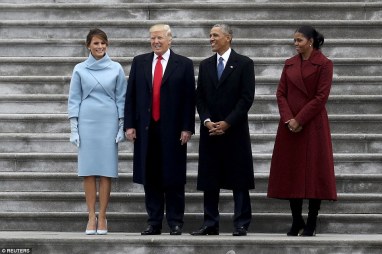
3c54e11f00000578-4140672-the_trumps_and_the_obamas_smile_as_they_talk_on_the_steps_of_the-a-83_1484945378910

Today, I watched what should always be — and thank God, was today — a celebration by all Americans of an event that for 240 years has occurred once every four years in this country. The focal point of the event itself is the inauguration of a newly-elected President, but the much more important part of the overall sequence of events is a celebration of the peaceful transition of power in this country.

In a way, this post might be considered an epilog to my recent post Illegitimate? Really?.  I’m publishing it because it became even clearer to me today that the thoughts I expressed in that post need expansion on one point: that all Americans, regardless of their personal ideology, and regardless of whether their personal ideology is the same as that of the President or the “party in power”, should consider it their privilege to share in this celebration.

Interestingly, an article in the USA Today section of the [Nashville] Tennessean this morning was a reminder of why we should celebrate this event regardless of whether we are happy or disappointed with the results of the election that gave rise to it.  I refer to this little “Briefs” item:

ETHIOPIA CELEBRATES TIMKAT

TROOPS ENTER GAMBIA TO FORCE OUT JAMMEH

A West African regional force charged into neighboring Gambia late Thursday to support the country’s newly inaugurated president, while longtime ruler Yahya Jammeh showed no sign of stepping down.

The troops moved in shortly after Adama Barrow was inaugurated at Gambia’s embassy in neighboring Senegal, after a final effort at diplomatic talks with Jammeh failed to secure his departure. His mandate expired at midnight. — The Associated Press

Think about that. Here, in America, despite some protests and voices of dissent, a peaceful transition of power has taken place today. No military was required to force the outgoing leader to relinquish that power. He did it voluntarily and graciously because that’s what we do in this great country.

About a third of the Democrats in the House of Representatives boycotted today’s inauguration event. I hope they realize how foolish they looked. To them, and to the Colin Kaepernicks and the property-destroying demonstrators [NOT the peaceful ones], a pox on all of them!

For whatever it’s worth, I would be writing these same thoughts if the shoe was on the other foot from my perspective — i.e., if Hillary Clinton had won the election [regardless, I might add, of whether by Electoral College only or by both it and the popular vote] and had been inaugurated today and a third of Republicans were boycotting this event [or any Republicans, for that matter].

When Democrats, and practically everybody in the media, were so clearly anticipating a Clinton victory last November, they were all with one voice in excoriating Donald Trump for not saying clearly that he would accept the results of the election “no matter what” — their mantra: “The peaceful transfer of power is a bedrock of our system of government”. Well, as Captain Picard [for those who are Star Trek fans will identify with] would say: “Make it so”!

Thanks!

img_7026 img_7043

Charles M. Jones

News [or NNTN?] Circa 2017

fake-news-cartoon

NNTN Then, “News” Now

I’m sure most people in their 40s or older today remember NNTN [Not Necessarily The News], their memories probably stemming more from off-shoot segments on shows such as NBC’s Laugh-In and Saturday Night Live than from the original [which was a satirical sketch comedy that first aired on HBO as a comedy special in 1982, and then ran as a series from 1983 to 1990; the 2004 movie Anchorman was similar in concept, but focused its satire more on the deliverer of the news than its content].

For this blog post, I’m going to start out positing that much of what is called “news” in the media today is remarkably similar to NNTN episodes of the 1980s, the main differences being a) that the talking heads and pundits do a better job of putting on serious faces throughout their shows than did their NNTN counterparts and b) audience laughter is not audible because it occurs in the homes of the viewers rather than in the studio airing the broadcast. As for “journalists” writing for “news”papers and magazines or posting their articles on social media, the serious face part is not as applicable, but content similarities are just as remarkable.

Let’s start with all the mention lately of “fake news” [re: my blog post An Alarming Development]. This term began to catch on recently as there has been more and more media coverage about whether “fake news” cost Hillary Clinton the presidency.  In the above-mentioned post, I got into the potential dangers I can see in continued proliferation of the use of that term — for the simple reason that each news broadcaster/publisher will have a different interpretation of what is “fake” and what is “real”.  In this context, we must keep some key facts in mind:

    • 90 percent of U.S. media is controlled by six corporations [see this link for source]. We can logically assume that they are driven by at least two factors that bring into question their objectivity: 1) their responsibility to their shareholders to maximize profits; and 2) the worldview of their top leadership [i.e., the context within which these leaders make decisions about what does and does not make it into their publications and broadcasts].
    • Information on the amount of material available on the internet is hard to pin down with assurance of accuracy, but these statistics are as accurate as any and serve to make a point: there are well over a billion websites in existence; hundreds of new sites start up every minute; 288 million monthly active Twitter users tweet a combined average of 347,222 times per minute; 1.44 billion monthly active FaceBook users send an average of 31.25 million messages and posts and view 2.77 million videos every minute.
    • Although the exact amount can be argued, scientists in medicine and psychology would agree that there is some finite limit to how much of the information to which the average person is exposed in a given day he/she will retain even at the end of that day, not to mention future days, weeks, months and years.

It is quite possible that the only place a person can go to find truly unbiased news is the uncensored internet; the key phrase being “to find“.  Unfortunately, applying some simple math to the above-mentioned facts clearly reveals that even if the average person spends an hour a day looking for news [which is far more than many sources indicate is the case], he/she decides [consciously or subconsciously] from among at least seven or eight TV channels and literally millions of internet-based sources where to spend that time [and in the latter case, the amount of available content being created per hour is far more than he/she could access by spending only one second on each page clicked on].

So Back To NNTN …

So from this perspective, consider a typical nightly news show on a broadcast or cable TV channel.  Whatever the talking head is reading from his/her teleprompter is the product of the company’s decision-making process for selecting what will and will not be included [after applying their own filter from the sea of possibilities — i.e., a decision has already been made as to what from that “sea” is real, what is fake, what will produce viewers and clicks, etc.].  The talking head has his/her own worldview and perspective, and through voice intonation, facial expressions and body language, affects how the actual content is perceived by many.  The same filtering process applies to print and posted media, the only difference in presentation being choice of words and phrases — and accompanying pictures and images — instead of voice intonation, facial expression and body language.

Comparing this scenario to an NNTN-type episode results in an obvious similarity [same description as above, the only differences being in bold italics]. … Whatever the talking head is reading from his/her teleprompter is the product of the company’s decision-making process for selecting what will and will not be included [after applying their own filter from the sea of possibilities — i.e., a decision has already been made as to what from that “sea” is funny and entertaining, what will produce viewers and clicks, etc.].  The talking head has his/her own worldview and perspective, and through voice intonation, facial expressions and body language, and perhaps some off-script content injections affects how the actual content is perceived by many.  The same filtering process applies to print and posted media, the only difference in presentation being choice of words and phrases — and accompanying pictures and images — instead of voice intonation, facial expression and body language.

Part Of Paradigm Shift

This fundamental change in “the media” — what it is structurally, how it is perceived, and how it can be used to influence public opinion — is simply one more piece of evidence confirming that a major paradigm shift is underway not only in America, but in the world [see A Major Paradigm Shift Well Underway; Election Aftermath – 1].  Evidence of this shift over the past two decades has been clearer and more visible in industry [manufacturing, mining, retailing, banking, etc. — and the entertainment component of the media].  Over the past two years, largely as a result of one of the most if not the most unusual presidential election campaigns in our history, evidence of it in politics and the news component of the media have moved to front and center.

So Where Can One Turn To Get Real News?

As I mentioned in my What I learned as a Boy Scout post, I believe all American citizens have an obligation to keep themselves informed about the issues of the day so they can vote intelligently in all elections at all levels of government. Only two things give a person the ability to develop truly well-informed positions on the issues: 1) personal choices of “channels” to access [“channels” here being much broader than the TV/YouTube connotation]; and 2) personal filters, based on his/her value system and Worldview, applied to the content flowing through those “channels”. Anyone who limits the first to just one or two channels and/or who essentially delegates the second to just one or two “trusted consolidators” runs a substantial risk of simply disappearing into the huge crowd of what one popular radio personality calls “low information voters”. Anyone who takes whatever time is required [whether he/she thinks he/she has that much time available or not] to control both of these things himself/herself will always be a part of making things better than they are. It’s a hard choice, but the greater the “flow” of people from the latter category to the former, the more rapid our drift toward authoritarianism will be.

Thanks!

img_7026 img_7043

Charles M. Jones

Illegitimate? Really?

On the eve of this day when we honor a man I believe was one of the greatest people of modern times, I was appalled when I saw news coverage of a sitting U.S. Representative saying “I don’t see this president-elect as a legitimate president”. This statement came from John Lewis, the Representative from Georgia’s 5th District [which includes the Atlanta area], on NBC’s Meet The Press program.

Note. … I am nearing completion of my regular weekly post, and will publish it on the usual mid-week schedule. I simply could not let this deplorable situation pass, however, without at least expressing my very negative view of it.

I know what a Civil Rights icon Congressman Lewis is, and I know that if I were a better-known commentator I’d be excoriated in the media as a racist for saying this, but this man has greatly reduced his own stature in my eyes. Clear proof that Lewis’ remark was pure politics is the fact that he took the opposite position last year when taking issue with people speaking disparagingly of President Obama — “Even if Obama’s critics don’t like him as a person, they should at least respect the position” [2016 interview on CNBC].

I grew up in the Deep South [Louisiana], and my preteen through high school years were in the late 1950s to early 1960s. That piece of information would cause many people who don’t know me to think that I’m just another white man putting down on a black man. Although the times, and to a considerable extent the region, of my upbringing exposed me to the racial divide that existed in those days, my upbringing was one that rose above all that and caused me to be just as appalled over racist activities as anybody from the North or the Midwest could possibly have been. My father was a school superintendent, and by his words, his demeanor and his actions, he was responsible for all schools in the parish, not just the white schools. In the excellent home environment that he and my mother provided, I developed an attitude of respect for people regardless of their race.

I say that simply to say that my repudiation of Congressman Lewis’ remark has absolutely nothing to do with his race. In fact, he and many other [certainly not all] black people in leadership roles these days are responsible for what, in many ways, is a worse racial divide than the one of my formative years. But maybe this scenario can end up being constructive. One way that outcome could come about would be for a considerable number of black leaders to take the high road and put their country above their politics and their sour grapes and let this inauguration be what it is supposed to be — a celebration of the peaceful transfer of power that is a bedrock of our country’s system of government [interestingly, that’s the way Democrats described this week when they were confident last November of a Clinton victory].

So in the spirit of what our country has been and hopefully has not completely lost, and in remembrance of the great man we honor today and the hope that those of his ilk will prevail over those of Representative Lewis’ ilk, let me close by saying that I hope everybody reading this has had a happy Martin Luther King Day.

Thanks!

img_7026 img_7043

Charles M. Jones

Revisiting “Hope and Change”

hope-and-change
How’s It Working Out?

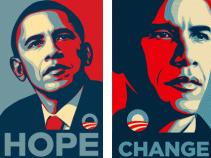
Hope and Change — Sound familiar?

Barack Obama’s theme in the campaign that resulted in his election in 2008 was “Hope and Change”. He repeated that theme over and over during the campaign, also saying “We are going to fundamentally change America”. Now, as he leaves office after an eight-year term, whether Americans have more Hope or less depends on which Americans you ask.  As for Change, few could argue that it has certainly come about on the ideological front and on the international stage [with many dissenters saying “OK, but not that kind of change”!] — but that on the political front, the establishment not only has not changed, it has gotten worse through even heavier polarization and entrenchment.

So is real change on the horizon now?

[and maybe I should add, “… And if so, will it be change for the better?”]

In a recent post in one of the blogs/sites I follow [www.FACTn.org], the author [a good friend of mine] pursued an interesting question: Will the Trump Revolution bring real change?. His post pursued the question from a Christian Worldview perspective, and as readers of my blog posts know if they have accessed applicable pages at this site, I share that perspective [see applicable links at this site: Who I AmWhy I’m Doing What I Do]. However, since I created this site to appeal to anybody who would listen to me regardless of whether or not they share my Christian Worldview, I’d like to take a shot at pursuing the same question from an “It is what it is” perspective, just applying simple logic to our Current Paradigm and [using what we have learned so far about it] the unfolding New Paradigm [for a refresher on the paradigm shift underway, see these pages at this site: A Major Paradigm Shift Well UnderwayElection Aftermath – 1].

When it became apparent in the final stretch leading up to the 2016 Republican convention that Donald Trump could actually become the nominee, I began to hear a lot more references to him [by Republicans] in which the term RINO [Republican In Name Only] was used. That term had been used early on in the primary campaigns to describe “mainstream” candidates like Jeb Bush, Rick Perry, John Kasich, et al [at that point, the prevalent thinking was that Trump was a flash in the pan and wouldn’t be in the “finals”; otherwise, those who used that term to describe Bush, Perry and Kasich [et al] would have called Trump a RINO, too, because although he didn’t fit into existing categories well, his positions on issues in the “core conservative mantra” were not strong enough to suit them].

I don’t think I’ve ever heard the term DINO used to refer to a person fitting the parallel profile in the Democrat party. My guess is that this avoidance [by Democrats] is intentional because of the potential attachment of the word DINOsaur to that acronym — which would create an imagery of obsolescence that Republicans could use as fodder in their campaign speeches. Be that as it may, the acronym is certainly applicable to “mainstream” Democrats [of which Hillary Clinton could be considered the poster child], and is no doubt thought of conceptually by far left Democrats [like Bernie Sanders and Elizabeth Warren] whether they articulate it or not.

RINOs, DINOs, SCHMINOs …

For reasons I have stated in one way or another in several previous posts, I firmly believe that the two-party system in the Current Paradigm is definitely on the demise as the New Paradigm continues to move into place. The only thing that remains to be seen is how long it will take for that demise to be complete. I doubt that it will be complete during Trump’s first term, but if his radical approach to things continues, I do believe it could be completed within a second term if he is re-elected.

Under the scenario that can begin unfolding after Trump’s inauguration [which I hope will unfold], terms like RINO and DINO would be meaningless. That scenario would result in passage of major legislation that can fundamentally change the entire outlook for this country while concomitantly putting in place a sustainable long-term fiscal path. That scenario is within reach because the two-party system has already been damaged enough to at least open the door for resolution very soon of the gridlock issues that have made our government dysfunctional [see Dysfunctional Government at this site] for at least the last four to six years. Four things favor the scenario I’m projecting:

  1. Lack of a closely-aligned philosophical mindset within the Republican majorities. A nearly monolithic alignment would be necessary to overcome what will clearly be a solid alignment among Democrats against at least some, maybe many, Republican initiatives.  Far-right Republicans seem to have been learning very quickly that a far-right, ultra-conservative agenda will do nothing but make the Republicans fail at every turn even though their party now “controls” the House, the Senate, and the White House — and drag their newly elected president down with them. The math that computes to this situation is simple: moderate Republicans [RINOs in the eyes of some] will not go along with far-right initiatives, and far-right Republicans will not go along with more moderate agendas [and in the Senate, in situations where Democrats are voting in lock step with each other, it only takes three Republicans to side with them and block a bill].
  2. A more closely-aligned [albeit not completely monolithic] philosophical mindset within the Democrat minorities. The far left wing of the Democrat party does not so far seem as able to exert as much influence on that side of “the center” as is the far right wing of the Republican Party to exert significant influence on that side of “the center” — the result being that Democrats seem more monolithic than they actually are. As 2020 approaches, I expect this will change, and the “Sanders” part of the “Trump/Sanders Phenomenon” [A Major Paradigm Shift Well UnderwayBack To The FutureCome, Let Us Reason Together …] will surface again through some other candidate [e.g., Elizabeth Warren, or more likely, somebody of her ilk but much younger — or,  maybe even Michelle Obama].
  3. A 2018 mid-term election cycle that favors Republicans unless Trump’s first term is viewed as a disaster at that point [i.e., more Democrats than Republicans will be up for re-election in 2018, many of them in Republican states]. Based on what’s been in the media recently, it appears that Democrats are gearing up to make Trump’s first term as unproductive as possible, setting the stage [in their view] for major shifts to Democrats [particularly the Senate] in 2018 and 2020 and a White House win in 2020. If Trump’s first term is viewed negatively by most Americans in 2018, and no better or even worse in 2020, that strategy might prove successful. Conversely, if Trump’s first term is viewed as at least “OK” in 2018, and at least as good or even better in 2020, that strategy will seriously backfire and paint Democrats as obstructionists, possibly resulting in even more power flowing to Republicans.
  4. A President who does not think like practically all his predecessors have, and who may actually: a) threaten vetoes of some legislation even when originated by and supported by a majority of Republicans in both Houses; or b) support some legislation even when originated by and supported by Democrats but opposed by significant numbers of Republicans [but not enough to block passage].

Unfortunately, there is at least one potentially major “fly in the ointment” that may present significant problems vis-a-vis #1 above. At least three Senators [possibly more] probably have their sights set on a Presidential run in 2024 for sure, possibly in 2020 — Paul, Rubio and Cruz.  To the extent they see contentious initiatives as opportunities to exert disproportionate influence and keep themselves in the media, they may “take a stand” on some bills on the Republican agenda [Senator Paul has already done this during the very first week of the new Congress in casting the only dissenting Republican vote on the first bill designed as part of repealing the ACA — on the grounds that it does not contribute toward addressing the national debt crisis].

The stage is set …

The bottom line is that the stage is set, probably better than it has been in recent history, for good negotiators to get a lot done — and remember, the ability to negotiate well was a major theme in Mr. Trump’s campaign; it is also evident that he has filled Cabinet and other top staff positions with people he believes possess this ability. For initiatives that Democrats will probably be unified in their efforts to block [like repealing the ACA], Republicans will have to negotiate intensely among themselves if there is no clear consensus at the outset on the details [because in these situations, almost monolithic Republican support would be required in the Senate].  Furthermore, they cannot assume that Trump will sign all bills that passed both houses without any support from Democrats [which means they must have regular dialog with him during development of those bills to ensure that the versions heading to the finish line address any concerns he may have with them].

It will be very interesting to see whether there is early evidence [say, in the “first 100 days” everybody seems to be focused on lately] that the scenario I’ve described in this post is unfolding.  I hope it is.

Thanks!

img_7026 img_7043

Charles M. Jones

What I learned as a Boy Scout

Over the past week, as my thoughts moved toward the new year before us, somehow they also seemed to pull from the past. At one point, a book that was popular in the 1980s came to mind: All I Really Need to Know I Learned in Kindergarten [Robert Fulghum, 1988]. That book was not about “knowledge learning”. It was about “things of life” learning that begins very early.  That moment of reminiscence, in turn, got me to thinking about a similar recollection in my own life.

I was fortunate to grow up in what most people today would call a “traditional” family, and in what many would call “Small-town America”. The value system this upbringing instilled in me is one that coincides very closely with the value system of our Founding Fathers — see Our Founders at this site.

It was this value system that generated my interest in the Boy Scouts of America. If you look at their Oath, their Law, their Motto, and their Slogan, it is easy to understand why an eleven-year-old boy with my upbringing would be attracted to this organization [my Boy Scout involvement was actually a natural progression from being a Cub Scout from age eight to age eleven].

I went on to earn the rank of Eagle Scout, that organization’s highest honor. I doubt that most people understand what is involved in achieving that rank as a Boy Scout, and what the mindset of a boy in his pre-teen and early teen years has to be to achieve that goal.  Nothing I could write here could produce that understanding, but let me say that a love for God and country is at the root of that mindset.

Although Scouting has in recent years yielded to the “Political Correctness” movement and deviated from what it was in my Scouting years, the basic tenets of Scouting offer much today that could help us become a better society than we are at this point in our history. 

Scout Oath.  On my honor, I will do my best to do my duty to God and my country, and to obey the Scout Law; to help other people at all times; to keep myself physically strong, mentally awake and morally straight [the connotation of “straight” in this context is not what “the LGBT community” might attach to it today — it is much broader in scope].

Scout Law.  A scout is Trustworthy, Loyal, Helpful, Friendly, Courteous, Kind, Obedient, Cheerful, Thrifty, Brave, Clean, and Reverent.

Scout Motto. Be Prepared.

Scout Slogan.  Do a good turn daily.

Can you imagine how many of our problems would just go away if everybody displayed the attitude described in these creeds?

So How Is All Of This Relevant To Anybody But Me? …

In what I’ve written in this post to this point, I’ve tried to articulate a backdrop to saying what I believe are my responsibilities as a U. S. citizen [which I believe are the responsibilities of all U. S. citizens].

The path to the Eagle Scout rank includes a number of specifically-listed requirements, one of which [probably the largest in terms of difficulty and time required to complete] is earning 21 merit badges, about two thirds of which are required [the rest being elective based on individual interests].  Merit badge requirements vary, but on average I’d say the overall load on the schedule of a boy meeting Eagle Scout requirements is about like adding at least one additional middle-/high-school class to a full academic year, maybe more.

Three of the required merit badges were Citizenship in the Home, Citizenship in the Community, and Citizenship in the Nation.  I was reminded of this recently when I read an article in the [Nashville] Tennessean about a bill currently under consideration by the Tennessee House of Representatives that would make passing a civics test a requirement for high school graduation.  And get this … the test would be the same civics test administered to immigrants looking to become U.S. citizens!  It seems unconscionable to me that we require immigrants seeking U. S. citizenship to know more of the basic rudiments of our government and how it works [ostensibly] than we do of a young citizen just entering the ranks of the voting population! If you’ve ever watched Watters’ World or [until he retired] Jay Leno’s Jaywalking segments on The Tonight Show, you can see that this lack of emphasis in our educational system has produced a generation of people who don’t have a clue about their government.

So, with the backdrop I’ve tried to present to this point, I believe every U. S. citizen has, at a minimum, the following responsibilities:

  • Learn, if they don’t know it already, at least the information on the civics test administered to immigrants looking to become U.S. citizens — preferably many times this very basic level of knowledge in civics.
  • Regularly pay attention to news [being careful to evaluate sources] and keep themselves informed on local, state, national and international matters.
  • Prepare for every election available to them — read candidate platforms and decide in advance which ones most closely align with their value system and their philosophy on government’s role [and ignore, to the extent possible, all negative mud-slinging ads].

{Note. … In this regard, it can be helpful for an individual to identify advocacy organizations which he/she trusts and which are aligned with his/her value system and philosophy on government’s role, and use the research data and recommendations provided by those organizations in his/her assessments of candidates for office. However, caveat civis [let the citizen beware] definitely applies here — an individual trusting an organization in this way should know it very well; many advocacy organizations purport to be one thing in order to gain appeal, but actually have much different philosophical views than their names and public profiles might portray.}

  • Vote in every election available to them — local/municipal, county, state and national.

To me, these are the basics that apply to every citizen. The propensity for more active, perhaps intense, involvement will vary greatly by individual. I’ll close with just a few examples of ways in which a person who is so inclined can act on that inclination: write opinion letters to his/her local newspaper; express his/her opinions on issues of the day in discussions with friends; be an advocate for candidates for office who share his/her values; encourage people he/she knows and respects to run for office; consider running for public office; join a political party; help with a campaign; join a civic group; join a community group; give an elected official your opinion on an issue; call senators and representatives; publicly support or oppose an issue or policy.

Thanks!

img_7026img_7043

Charles M. Jones

A Realistic View of the ACA – Part 4

In Part 1 of this series, I introduced the series and covered the first part, Repeal.  In Part 2, Transition, I focused on a relatively simple transition plan for people currently covered under the ACA, including some of the financial math that would be associated with such a plan. In this Part 3, Replace, I focused on essential elements that would need to be included in a system to permanently replace the ACA.  In this Part 4, Looking Forward, I’ll get into 1) how repeal and replacement of the ACA could potentially be the main determinant of the outcome of the 2018 mid-term elections and/or the 2020 presidential election, and 2) what the future will probably look like under the replacement law if it is successful.

2018 and 2020 Elections Could Swing On Success Or Failure of the ACA Repeal/Replace Scenario

If repeal and replacement of the ACA is viewed as highly successful, that will favor continued and potentially even heavier Republican dominance. If is viewed as a total flop, that will favor at least some swing of the pendulum back toward Democrats.  Whether the outcomes of those elections are “sweeps” in either direction will depend on the perceived success or failure in other areas [immigration, terrorism, etc., but probably mostly the economy].

Note. Although the preceding paragraph assumes that the Current Paradigm will not fully “die” in another 2, maybe even 4 years, we must keep that factor in our thinking. A major acceleration in the paradigm shift underway, which I think is likely because of Mr Trump’s leadership style, would essentially erase the Republican/Democrat domination and change future elections dramatically [see the page A Major Paradigm Shift Well Underway at this site for a more in-depth description of this paradigm shift, and my blog post Election Aftermath – 1 for a confirmation that such a shift is underway].

It will be very interesting to see how the media characterizes both repeal and replacement. The extreme liberal bias in the media will no doubt result in second-guessing Trump and his administration at every point. The media’s strong supportive tone in reporting on Obama for the past eight years will turn into resistance and skepticism in its reporting on Trump. This will make Trump’s task in repeal and replacement much more difficult than Obama’s task in getting the ACA pushed through [i.e., Trump will have to not only produce a successful transition, but also counter negative press about it — much more challenging than having a press that is essentially a cheer-leading squad].

The Unfolding Of Healthcare From Here

There are two trends that I believe are imminent and will consume an increasing share of both financial and “mainstream” media coverage about Healthcare over the next few years.  Both would no doubt have occurred regardless of the presence or absence of the ACA or its replacement, for one simple reason: in 1960, Healthcare costs were 6% of the GDP; at the end of 2015 [most recent finalized data available], they were 17.8% and still rising. You don’t have to be a mathematician to understand that this is an exponential trend that not only will not, but cannot continue. Any component of the economy exhibiting that kind of exponential increase in the percentage of the GDP is headed for massive change, because continuation of that trend would ultimately result in that component completely dominating the economy and, over time, literally shutting down all other components.

Home Health And Other Alternate [Non-Hospital] Service Delivery Venues

One of these trends has to do with a major shift in how Healthcare services are delivered — specifically, a shift toward a substantially higher percentage of care that is delivered in venues other than hospitals. I believe hospital care will become more and more associated with very complex surgeries and other conditions that require intensive care and highly expensive equipment, that smaller hospitals will ultimately become more like networks of “remote emergency rooms” associated with large tertiary care hospitals, and that home-based care will become much more prevalent than it is today.

The trend toward alternate-venue delivery of healthcare services has actually been underway for well upwards of a decade [one evidence being the proliferation during that time of Urgent Care Centers, often staffed by Physician Assistants and Nurse Practitioners], but it is accelerating much more rapidly now. Also, more in-home service [Home Health] agencies are starting up, and existing ones are experiencing exponential growth.

The reason for this trend is no more complicated than cost containment. Hospitals have extremely high fixed costs when compared with those of alternate venues [particularly patients’ homes], and per-service costs in the alternate venues do not include allocations to cover those high fixed costs. Variable [labor and materials] costs are also higher in tertiary hospitals because of specialty staff and materials that have to always be available in them [this staff and those materials are not actually needed for many, many procedures].  Even when transportation costs [e.g., of medical professionals to patient homes] are accounted for, overall costs are still lower. As icing on the cake, it is quite possible that the quality of some alternate-venue services, all things considered, could actually be higher than the quality of services delivered in hospitals.

Massive Re-Engineering of the Healthcare Industry

The other trend I see on the horizon might actually be several different trends that could be viewed separately. I am grouping them into one because they will all be fueled by one main driver — the huge and rapidly growing need for improved overall effectiveness, a term I like to use to describe the ratio of quality divided by cost. Since there is no single number that reflects quality, this ratio does not exist, but referring to it conceptually is a concise way to define overall effectiveness — i.e.: if quality improves and cost remains constant, overall effectiveness [OE] increases; if quality remains constant and cost is reduced, OE increases; and [the ideal scenario] if quality improves and cost is reduced, OE increases dramatically.  This trend, then, can be thought of as a massive re-engineering of the Healthcare industry, not unlike what we have seen over the past few decades in other industries — notably manufacturing and mining.

Although considerable progress has been made in the past decade or so, Healthcare, in comparison to other industries, is still extremely inefficient. With all that technology has done to increase the OE of other industries, Healthcare is still a very “manual”, labor-intensive industry.  Granted, barriers to progress in Healthcare are probably more intense than in other industries [information security, for example], and risks of failure are more severe [loss of life from system failures rather than just recovery costs and/or lost revenue from outages in other industries], but the biggest barrier is burdensome regulation.  Getting into the details of that is beyond the scope of this blog post, but believe me, I wrestled with the Healthcare regulatory environment for decades. It’s like putting a boxer in the ring with one arm tied behind his back.

On the positive side, I believe the stage is now set for huge leaps in OE in Healthcare. Technology [telemedicine, more sophisticated yet less expensive testing methods, smartphones and smart watches and other “wearables”, smart homes and the “Internet of Things”, emerging standards for information interchange, more non-invasive “surgical” procedures …] is poised to facilitate massive functional changes, and the current leadership mindset of reducing government regulations, although mostly articulated in terms of environmental and financial regulations, will hopefully extend to Healthcare.

And Finally … Actually Dealing With Fraud and Abuse

Another factor that would contribute substantially to OE is virtual elimination of — not just reduction in — fraud and abuse [one notable example being providers who obtain reimbursements from Medicare and Medicaid based on fraudulently reported diagnoses and/or procedures]. This has become a standard claim of both Republican and Democrat candidates for at least the last six presidential election campaigns, and it has even been quantified by DHHS at $60 billion [that’s BILLION, with a “b”] in 2015. In my years as a senior executive in large regional healthcare systems, if I had told my Board that I had become aware of $16 million in unnecessary and avoidable expenses [about the same percent of annual budgets in those organizations as $60 billion is of the $3.8 trillion federal budget], particularly if they were related to fraud, it would have been OK if I had simultaneously articulated my plan for eliminating them in the current quarter. If I had said I just wanted them to be aware, and that I had formed a task force to look into the matter and fully quantify the problem and give me recommendations by the end of the current quarter to completely eliminate that waste in the next quarter, that might have been OK, too.  Had I then said in the next quarter that we were still researching the matter without simultaneously reporting at least some progress toward fixing the problem, I would have been fired on the spot. Only in government can a $60 billion [that we know of] problem be allowed to exist for decades and still be talked about by politicians as something that “we need to look into”.

Series Conclusion / Upcoming Plans For This Website

This post concludes this 4-part series that I entitled A Realistic View of the ACA.  Since this topic is so critical to the success of the Trump administration, I have decided to include the main content of Parts 2 [Transition] and 3 [Replace] in a new section of pages at this website that will focus on the future [Healthcare being only one of those areas of focus]. When that section’s content is ready for publication [which I’m currently targeting for sometime in January 2017], I will announce it in a blog post.  I have already drafted quite a few additions to the page that was originally the content of the Replace plan in Part 3 [some of those additions stemmed from reader comments].  Stay tuned!

Thanks!

img_7026 img_7043

Charles M. Jones
A Realistic View of the ACA – Part 3

In Part 1 of this series, I introduced the series and covered the first part, Repeal.  In Part 2, Transition, I focused on a relatively simple transition plan for people currently covered under the ACA, including some of the financial math that would be associated with such a plan. In this Part 3, Replace, I’ll focus on essential elements that would need to be included in a system to permanently replace the ACA [trying to provide decent coverage of such a broad topic in an average-length post was impossible, so this one is a little longer].  In Part 4, Looking Forward, I’ll get into 1) how repeal and replacement of the ACA could potentially be the main determinant of the outcome of the 2018 mid-term elections and/or the 2020 presidential election, and 2) what the future will probably look like under the replacement law if it is successful.

Replace

Keep This In Mind …

To be meaningful and useful, outlining the essential elements that would need to be included in a system to permanently replace the ACA must be done in context with the Some Basics First section at the beginning of Part 2 of this series [A Realistic View of the ACA – Part 2]. If you review that section and overlay its conceptual framework on what I’ll be writing here, you’ll see that this post reflects my philosophy on the guiding principles I mentioned in that section. In a nutshell, I don’t believe that all Americans are entitled to some kind of “standard” level of health insurance [any more than I believe that all Americans are entitled to own a home, or to have a job they want, or to have an automobile, a telephone, …]. I do believe, however, that some government-mandated elements of a national healthcare system need to be in place, the main purposes of which would be: a) to ensure that all citizens are protected from financial ruin brought about by health problems; and b) to minimize the overall cost of providing all healthcare services, whether through government facilities and employees or through private sector providers. Under that basic philosophy, I will now list what I believe are the essential elements of an effective system that will not be the financial train wreck that the ACA is.

Essential Elements

NOTE. I am not asserting here that this simple outline fully defines the entire replacement system that would be needed. However, I do believe that it summarizes a conceptual approach that will work.

  • (1) All insurance policies must cover the same time period [January 1 to December 31, or some other twelve-month period — calendar year will be assumed here], and all deadlines for signup must be the same.
  • (2) By the same date each year, all insurance companies must submit electronically to DHHS a database of policies they will offer in the upcoming year, and those lists must contain a small amount of key information such as monthly premium, deductibles that must be met before any reimbursement begins, average co-pay ratio (e.g., 80% / 20%) for all situations where such ratios apply, primary physician visit co-pay, specialist visit co-pay, drug co-pays by “tier”, etc. [all of this would be very easy for any company to provide].
  • (3) No insurance company can refuse to issue a policy to anyone based on their health status [e.g., pre-existing conditions].  This would clearly result in most insurance companies attaching astronomically high premiums to some of their policies, putting them out of financial reach for the vast majority of people who would need them. This issue will be addressed in subsequent items in this list. NOTE. Even Medicare is denied to people with end-stage renal failure at the time of their initial qualification for coverage. Allowing that criterion for this ACA replacement system should be investigated if elimination of those cases would have a material impact on overall costs.
  • (4) If there are to be any mandated coverages [maternity, children under 26 can remain as dependents under their parents’ policies, abortion, gender change, etc.], all insurers who offer those kinds of benefits to any policyholders must offer optional riders in all policies they offer to anyone. One mandated coverage I believe would solve many problems and simplify this [or any] program greatly would be policies that provide catastrophic coverage only. For example: a much-lower-than-average premium; no coverage for anything up to $X, 80% insurance coverage / 20% patient copay from there to $Y, and 100% insurance coverage above $Y [the values of X and Y would have to be worked out, but I expect that values like $2,000 to $3,000 for X and somewhere between $10,000 and $20,000 for Y would result in premiums substantially lower than average and “maximum out of pocket” amounts at least as low as any current ACA-enabled policies, maybe lower].
  • (5) Using statistical techniques [simple “bell curve” logic, standard deviations, etc. — far less sophisticated than techniques many government agencies use every day], DHHS will identify two groups of “outliers” in the policy database [i.e., policies that fall outside affordability limits set in the preceding year — see Ongoing Refinement section below].  One group of outliers will be called the Mandated Coverage Special Handling Pool [MCSHP], and will consist of people who are cost outliers and have applied for mandated coverage. The other group of outliers will be called the Cost Outlier Special Handling Pool [COSHP], and will consist of all other people classified as outliers.  For all of these outlier applicants [both groups], the following steps would be taken:
    1. The applicable insurance companies would be issued letters of authorization to approve those policies at the average rate of all policies to be issued by that company in that year, with DHHS’ guarantee that it will reimburse them for all costs for those policies that are over and above their average costs for all other claims paid during that year.
    2. All SHP applicants will be issued letters from DHHS [or from the companies to which they applied if that is more practical] outlining their options: 1) proceed with enrollment [which would put them in the same status as anyone else who was not put in the SHP, including determination of their qualification for any other governmental financial assistance that may apply to them]; or 2) refuse this offer of government assistance over and above any other assistance for which they may otherwise qualify.
    3. Through dialog with each SHP policyholder who elected to go ahead and enroll, DHHS would: 1) determine whether or not they qualify for any other governmental financial assistance that may apply to them; 2) attempt to identify other coverage options that would provide equivalent or better benefits while lowering the government’s projected costs to support their policy; and 3) implement any decisions resulting from this interaction.
  • (6) A determination will be made as to income levels [and/or other criteria] at which government assistance should be offered, and what that assistance will be.  If such an assistance program is included, it will be implemented through income tax credits [not just deductions from income] and a mechanism for providing those credits through payroll withholding credits for employed people or through additions to any unemployment or other [disability, etc.] payments for others. NOTE. The details of this would have to be worked out in conjunction with changes in the Tax Code that will likely be underway at the same time.
  • (7) All insurers will submit an annual report to DHHS to include total revenues from policyholders, total reimbursements from government, other revenues, total cost of claims paid [and maybe expenses “incurred but not reported”, or IBNR, depending on how long after year-end the report is due], etc. Data for these reports would be readily-available within these organizations, so the reporting [which should be common-format electronic data, not paper] would not be burdensome. A similar reporting requirement for providers might also be advisable if that information would enhance the usefulness of the information obtained from insurers.
  • (8) At some point in the future, when more viable measures of quality are available and more effective ways to incorporate them into insurance policy comparisons have been developed, quality parameters should be integrated into this entire process [attempting to do this now could actually be detrimental without better measures than we have at this time].
  • (9) The above items are operational in nature. Other possibilities for reducing overall healthcare costs that should be investigated would include but not be limited to the following [some of these are controversial; to the extent those controversies are simply driven by “wars among lobbyists”, that more fundamental issue will need to be dealt with before meaningful progress can be made]:
    1. Imposition of maximum increases or mandated reductions in a given year.  This would have to be purely data-driven, not fully controlled by politicians, and some “appeal” process would be necessary.
    2. Removal of state-level boundaries for insurers. Allow the sale of national policies, regional multi-state policies, etc.
    3. Promulgation of Tort Reform. Curb sometimes ridiculous jury awards, but in a way that does not adversely affect accountability. This is much more costly than the awards themselves — the bigger cost is in “defensive medicine” [tests ordered and procedures performed by providers to avoid potential lawsuits even when they would not, absent the threat of litigation, consider those tests and procedures medically necessary].
    4. Identification of ways to curb “blockbuster” drug costs without thwarting innovation within companies that develop them.
    5. Improvement of capabilities to curb fraud and abuse in all entitlement programs as well as in this new ACA replacement system.

Program Administration

On the administrative side, the massive organization put in place under the ACA would be dismantled as soon as possible, leaving a much-reduced, very streamlined management structure and a much smaller staff consisting of current employees having skills most applicable to administration of the new law, plus any new hires required to ensure an appropriately skilled workforce.

Ongoing Refinement

Certain elements of this program would require an ongoing effort to adjust various parameters each year to ensure that they remain current. One example would be computation of the “outlier” definition mentioned in #5 in the Essential Elements section above.  In the first year, the information in the ACA database for the 2017 enrollment period would be used to establish a baseline database for the new law [see #2 in the Essential Elements section above for a description of the kinds of information that database would contain].

Another area that needs more focused research right now as well as ongoing refinement over time is identification of more viable measures of quality and development of ways to incorporate use of these measures into insurance policy comparisons. Despite much time and effort along these lines over many years, the truth is that current measures simply do not adequately account for variations in patient conditions and other factors that can grossly skew current measures like mortality rates, unexpected returns to surgery, patient satisfaction scores, etc.

Potential Roadblocks

To repeal, and to replace, the ACA will require “lock-step” solidarity among almost all Republicans in the House and at least 50 of the 52 in the Senate [just as initial passage of the ACA required that of all Democrats at that time]. Assuming that all Democrats will be in solidarity with their opposition, this may be tougher than some legislators think at this time.  Also, there may be certain provisions that may raise the specter of a presidential veto even though a Republican will be in the White House. This may turn out to be a textbook example of Mr. Trump’s deal-making ability — or an example of lack thereof as it could potentially apply to this situation.

On the prospect of filibusters as a blocking mechanism … Minority-party threats of filibusters have become so commonplace over the past two years that many people probably think that a less-than-60-seat majority in the Senate enables the minority party to block forever [by threatening filibusters] any bill they oppose, rendering the majority party completely powerless to drive its agenda. That is not the case, however, and the first two years of the Trump administration could produce a major breakthrough in the gridlock of recent years if Republicans are as unified in their agenda as Democrats have been in blocking it. The decision by a majority leader to bow to the threat of a minority-party filibuster is a simple practical matter — avoiding an actual filibuster, which can consume many days, perhaps longer, before the majority leader can bring “cloture” about [the last step that results in the bill being brought before the full Senate for a vote], frees up time for passage of other more bipartisan bills which have greater prospects of being passed.  With a minority-party President who would likely veto narrowly-passed controversial bills, that decision is probably a wise one.   If there has ever been a time when the majority needs to stand up to filibuster threats and do whatever it takes to drive key pieces of its agenda through, this is it!  If a bill is particularly important to the Senate majority and its legislative agenda [and/or the president’s agenda], then going through a filibuster would be worth it and would expose very publicly that it’s the minority that’s causing the logjam.

Note. For anyone interested in gaining a more in-depth understanding of Senate rules and operations as they relate to filibusters and cloture, the document at this link would be a good start: Senate Filabuster & Cloture Rules.

Why This Replacement Approach?

The main advantages in taking this general approach are not that difficult to figure out:

  • Rather than micromanaging every citizen’s healthcare coverage, it focuses the government’s attention [and expenditures] on problem situations [a) all citizens who cannot obtain any coverage, and b) all citizens whose coverage options are financially out of their reach and who qualify — based on all applicable criteria, not just those associated with healthcare — for government assistance].
  • It allows for mandated coverage items that will probably be required to get the law passed in both houses of the Legislature, particularly the Senate, and it keeps the direct costs of those mandates visible every year.
  • It keeps cost outlier criteria current every year, providing a) a more efficient and more expeditious method of adjusting them to changing conditions and b) better information for identifying the actual cost to the program of egregious pricing for certain items like “blockbuster” drugs, “exotic” prostheses, etc. [currently, these situations become visible through media coverage of specific situations, and the resulting politicization (politicians continuously engaged in “issue-hunting”)].
  • The overall cost, the administrative complexity, and the size of the bureaucracy required to administer the program, would be dramatically lower [largely because of the previous items in this list].

There are probably other advantages, but those listed above are enough to warrant taking this approach.

In Part 4 …

In Part 4, Looking Forward, I’ll get into 1) how repeal and replacement of the ACA could potentially be the main determinant of the outcome of the 2018 mid-term elections and/or the 2020 presidential election, and 2) what the future will probably look like under the replacement law if it is successful.

Thanks!

img_7026 img_7043

Charles M. Jones