Election Aftermath – 2

poster227x227-2Note. … After purposely consuming a bit more than my usual amount of media coverage over the past 36 hours or so since the election outcome was known, I decided to take a different approach in this seven-day “Election Aftermath” series than I outlined in yesterday’s first post of the series. Although I will probably incorporate into remaining posts some results of the “number-crunching” I mentioned in that first post, the overall purpose of this series will now be to assess and comment on the unfolding post-election climate.

In a way, I guess it’s encouraging to me that the only negative I got from the victory and concession speeches of 11/9/16 was the “glass ceiling” reference Hillary Clinton made in her concession speech. I call that a negative because the outcome of this election had absolutely nothing to do with the fact that the defeated candidate was a woman, but everything to do with the fact that she is a “standard politician”. Running against a person like Trump, she [or he] would have been defeated whether she/he was a woman, an African American, a Latina/Latino, an Asian American, or whatever. By the same token, had the Republican candidate been a “standard politician”, too [which would have been the case if one of at least 14 of the other 16 initial contestants had won the nomination], a Clinton win might have been more likely. Although ideological drivers were clearly at work, too, this election was mostly about fixing Washington. People are simply fed up with the current dysfunctional government in this country. They want something that will work, and things like which major party our leaders are in, or what their race or their sex is, simply don’t matter any more.

So what else about the post-election climate stands out so far? Without hesitation, I can say it’s all the demonstrations going on. Democrats [and of course, the media] were the ones that pounced on Trump’s hesitation to say up front that he would accept the election outcome. In that debate, Clinton quickly gave the “standard politician” response: “Yes”. For the rest of the campaign, she touted that “peaceful transition of power” was a “hallmark of our democracy”, and that Trump’s refusal to say he would accept the outcome “no matter what” was deplorable.

Fast forward to now. Demonstrations that cause traffic blockages, “keying” cars, breaking store windows, starting fires … the very people whose leaders [yes, both Obama and Clinton!] have graciously expressed their own support for an orderly transition are doing exactly what those same leaders have denounced and called deplorable. In fact, what they are doing is much worse — damaging property, and putting lives in danger. The vitriol and the hateful remarks are at least as bad if not worse than anything Trump has said, even including his disgusting remarks in the now-infamous 2005 video released by NBC. It appears to me that if these people are a valid sample of Clinton’s supporters, she was referring to the wrong people when she called Trump’s supporters a “basket of deplorables”.

In order to make one last important point in this post, let me mention one other remark Trump made that many people considered inappropriate and was picked up and amplified in the media and in the campaign … Lately, he has referred to the election process as being “rigged”. I believe his opponent, and the media, failed to grasp the scope of what he meant. Everybody denouncing that remark referred to dead people voting, multiple votes being cast by the same person, etc. — i.e., actual fraudulent activity — and gave the “standard politician” response that there is no hard evidence that any of this is actually going on.

Back to the “issue” of Trump’s refusal to say up front that he would accept the outcome of the election, and relating it to his “the system is rigged” remarks, what everybody who pounced on him about both of these “issues” failed to take into account was that Trump might have had a broader-scope view of them than any of them had. I believe the scope of his “rigged” remark extended to how the Electoral College system works [not whether or not it’s a valid system — just how both parties have learned to manipulate it], the presence of Super Delegates in the Democrat Party nomination process [and outwardly different but conceptually similar components of the Republican Party nomination process], and how liberally biased the media is [which results in grossly disproportionate “free air time” that supports the liberal candidate].

In the same way, his refusal to just answer up front with a simple “Yes” to the question “Will you say now that you will accept the outcome of the election?” was less about selfishness and narcissism than it was about a shrewd businessmen simply giving an answer that harmed nobody and wouldn’t affect his electability — and doing so after calculating very quickly in his mind potential conditions under which that could come back to haunt him [like the 2000 “hanging chad” issue, particularly if there was solid evidence of fraudulent activity].

The truth is that what won Donald Trump the presidency was not just his own brilliance, but his ability to surround himself with people who could find out what it would take in this election to win, put together a plan [i.e., a campaign strategy] that would capitalize on that knowledge, and effectively and efficiently implement that plan — and his part was to continuously assess how it was going and make personnel or other adjustments as necessary to drive the process to a successful outcome. As just one example of why that outcome was successful, the “Blue Wall” was toppled by Trump’s wins in midwestern and other states the Clinton campaign literally quit campaigning in because they viewed them as being behind the “Blue Wall”.

Barack Obama is a brilliant man, but he has been one of the worst if not the worst President in my lifetime. Donald Trump is a brilliant man. Whether he will be an even worse President, a good President, or a great President remains to be seen. On this, I can truly say “I’m with her” [to use a phrase from the Clinton campaign, coined by Elizabeth Warren, I think]: We must accept this result and then look to the future. Donald Trump is going to be our president. We owe him an open mind and a chance to lead. Our constitutional democracy enshrines the peaceful transfer of power. And we don’t just respect that, we cherish it”.

Stay tuned. We’re in uncharted territory, and until some trends and patterns begin to take shape between now and 1/20/17 [inauguration of Donald Trump as POTUS], there is literally no reliable basis on which to predict what each post-election day/week/month will look like.

Thanks!
img_7026 img_7043

Charles M. Jones


It’s not about the candidates — it’s about the parties (Part 1)

Does the title I gave this blog post sound crazy? I’ll attempt in this post (Part 1) and my next post (Part 2) to make it sound not only NOT crazy but perfectly sensible in the context of making an informed decision about “who” [or more importantly, “what”] to vote for in this election [or whether to vote at all].

Does the title I gave this blog post sound crazy? I’ll attempt in this post (Part 1) and my next post (Part 2) to make it sound not only NOT crazy but perfectly sensible in the context of making an informed decision about “who” [or more importantly, “what”] to vote for in this election [or whether to vote at all].

First, if you think it’s possible that on November 8 [election day] any candidate other than Donald Trump or Hillary Clinton will get the 270 electoral votes required to make him/her our next president, all I can do is ask you to study the matter further. If you do that, you will find that you are wrong [almost any credible source of information on election history and the current mechanism in place to elect a president will help you get to that point, including my past blog posts and several of the pages on this web site].

Part 1

I often hear remarks like “I can’t bring myself to vote for ‘that man’ / ‘that woman’ “, and there is frequent reference in the media to Never Trump and Never Hillary constituencies and the historically record-setting unpopularity of both of these candidates.  I’ve mentioned in previous posts that people in these camps need to realize that this election is not about them and how they feel — it’s about the future of America.

Let’s look at all situations that could even theoretically exist on November 9 [or a few days / weeks later if there is a 2000-like situation, but in any event, fairly soon after November 9], and what the ultimate outcome would be in each situation.  The possible situations are the following:

  1. Hillary Clinton won 270 or more electoral votes, regardless of whether or not she won the popular vote. She will be sworn in as POTUS at noon on January 20.
  2. Donald Trump won 270 or more electoral votes, regardless of whether or not he won the popular vote. He will be sworn in as POTUS at noon on January 20.
  3. Neither Clinton nor Trump won 270 or more electoral votes.  This is extremely unlikely, but not impossible. It has not occurred in the last 192 years, and has occurred only twice in our entire 240 year history [1800 and 1824]. There was controversy around the electoral vote counts the 1876 election, too, but the process for resolving that controversy was not the same. In this situation #3, the responsibility of selecting our next POTUS falls on the House of Representatives, and the responsibility of selecting our next VPOTUS falls on the Senate. The details of this outcome will be covered in Part 2 under the heading A Closer Look At Outcome #3.

If either #1 or #2 is the outcome, we will have made a choice between two diametrically opposed ideologies, the tenets of which are expressed in the platforms of the Democrat and Republican parties.  As I said above, it is extremely unlikely that situation #3 will be the outcome — but since it’s not impossible, I’ll take a closer look at it in Part 2.  I’ll proceed at this point, however, under the assumption that the outcome is either #1 or #2, because the ultimate result of outcome #3 will not be appreciably different from either outcome #1 or #2 — i.e., people who vote for anyone other than Donald Trump or Hillary Clinton — or who don’t vote — will have unwittingly voted for one of these two candidates.  So when the polls close on November 8, we still will have made a choice between two ideological extremes, the tenets of which are expressed in the platforms of the Democrat and Republican parties.

In Part 2 of this post, I will include a simple table that boils the “planks” from the platforms of the two parties down to their positions on about ten issues that I think most people would agree highlight the extremes of the two ideologies. Every citizen of this country should become familiar with these party platforms, because in this election, we will be deciding which of these two platforms we align with as a country, and therefore what direction we want to take going forward.

If the candidate you voted for is elected on November 8, you can be happy that our chosen path aligns with his/her [and one would think, your] party’s platform.  If you unwittingly [see A Closer Look At Outcome #3 in Part 2] voted for the candidate that was elected but do not align with his/her party’s platform, you were among those who caused that candidate’s party to prevail, so you bear part of the responsibility for that outcome and will need to live with it even though it was not your preference.

If the candidate you voted for is not elected, you will need to live with movement in the direction of the winning candidate’s party’s platform even though you [one would think] disagree with it.  If this is the outcome, it would behoove all who fit in this category to do everything they can to make the next president a one-term president.  In at least one respect [composition of the Supreme Court], the potential impact of the 2020 election outcome will be much less significant than the outcome on 11/8/16.  By 2020, composition of the Court will definitely have shifted considerably in the direction that is in alignment with the 2016 winning party’s ideology, and it’s quite possible that it could already be set in that direction for a generation [thereby making the 2020 election ineffective from this perspective].  Nonetheless, at least you could say that limiting his/her term to one would be better than acquiescing to eight more years [from now] of current policies and direction.

So the question I would ask is “Why would any citizen of this country take an action [or refrain from taking an action available to them] that they know in advance might actually throw their support toward an election outcome they don’t want?”. I’ll get into that in more depth in Part 2, and I’ll also get to the expanded description of Situation #3 I promised above.  For now, I’ll close this post with what mathematicians write when they have demonstrated a hypothesis to be correct — Q.E.D. [an abbreviation for the Latin phrase quod erat demonstrandum, which means “That which was to be proven”].

img_7026

Charles M. Jones

Binary Party Affiliation Choices — We Need Something Better

democraticlogoquestion-markrepublicanlogo-svg

Why are you a [Democrat, Republican, Libertarian, Independent, … pick your poison]?

Version 2One of the ten long term trends John Naisbitt identified in his 1982 book Megatrends that is being heralded now as being “right on” was “[a] society [
that] is changing from a narrow ‘either/or’ perspective with a limited range of personal choices to one of ‘free-wheeling’ multiple options”. One realm in which this prediction has not moved as rapidly to reality as it has in many areas is the political arena.

Although third party options were available at the time Naisbitt’s book was written, the fact is that no third-party candidate has ever won a U.S. presidential election. The strongest showing for a third-party candidate came in 1912, when former President Teddy Roosevelt left the Republican Party. He ended up coming in second, with 27.4 percent of the popular vote and 88 electoral votes. It’s generally agreed that Roosevelt’s 1912 candidacy took votes away from the Republican candidate, incumbent President William Howard Taft, allowing Democrat Woodrow Wilson to win with just 41.8 percent of the popular vote. Many say third-party candidate Ralph Nader played a “spoiler” role in the 2000 election. Running to the left of Democrat Al Gore, Nader received 97,488 popular votes in Florida, a state Republican George W. Bush won by just 537 votes. If most of the Nader supporters had voted for Gore instead, Gore would have won Florida’s 25 electoral votes, and he would have been elected president instead of Bush [1].

So the bottom line is that a vote for a third-party [or write-in] candidate has historically been a vote for the incumbent-party candidate. However, if a major paradigm shift is in fact underway now, as I believe it is, the current polls can be misleading. I believe that trying to apply past statistics to this election is a useless process.

At this writing, the Republican and Democrat candidates are virtually tied — polls show that either party’s candidate’s lead is within the statistical margin of error. Support for all alternative candidates, collectively, accounts for about 10% of the people polled [2]. If the alternative-candidate support is pulling from both major-party candidates equally, the race is still a toss-up; if it is pulling more from one than the other [particularly if prevalently so in the so-called “swing states”], that segment alone can determine the outcome of this election. The interesting thing about a paradigm shift is that nobody, even “experts”, can accurately predict where within this range actual election-day votes will fall.

A major problem at this time is that the campaigns of the organized political parties, all of which are largely tied to the Current [I would say, Old] Paradigm, are not equipped to operate under the New Paradigm that is rapidly [exponentially] unfolding. In polls, people are asked whether they are Liberal or Conservative, Democrat or Republican, for or against a particular issue, etc. — binary, either/or, current/old paradigm choices. It would be great if people could indicate where they are on a far left to far right scale on each of, say, ten specific issues, with their answers resulting in mapping to a specific point on a left-to-right spectrum. Such a system would be even better if each person could then form his/her own “custom-tailored party”, or CTP — i.e., connect [through emails and/or texts and/or web/app interaction designed by that “custom-tailored party”, or probably more efficiently through existing social media like FaceBook, Twitter, etc.] with everybody who is within some plus or minus “band” around his/her position on the left-to-right spectrum.

In this CTP system, it might also be advisable to allow each person to place a weight on each issue. This weight could be 1, 2 or 3, with 2 meaning average weight for that person, 1 meaning less important / critical than his/her average and 3 meaning more important / critical than his/her average.

As an example of how this would work, I designed a prototype model to do the computations for ten issues [3], and I entered my selections for each issue. On a 5-left to 5-right scale, and using a weight of 2 on all issues, my point on the left-right spectrum is 2.4 right. For perspective, the most enthusiastic Bernie Sanders supporters in this election would probably find themselves at least between 4 and 5 left, maybe all the way to 5 left. Most people who identify very closely with the Tea Party wing of the Republican Party would probably find themselves at least between 4 and 5 right, maybe all the way to 5 right.

So to use Naisbitt’s terminology, how would this new multiple-option system be better than the current either-or system? Our current government has become dysfunctional because of party polarization [see the Dysfunctional Government page in the The Situation Today section of this web site]. Lawmakers in both of the major parties tend to flock together and vote along party lines. This is why Republicans can’t move legislation that can easily pass the House through the Senate and on to the President — the Senate minority can, in effect, ensure that bills the Democratic party opposes never even get voted on in the Senate. In the rare cases where a bill is opposed by most Democrats but manages to get through the Senate, the President can veto it — and the odds are heavily against a veto override because whatever bipartisan support it had would not likely have included the number of Democrats that would be needed for an override.

This new CTP system would have both short term and long term advantages over the current dysfunctional system. Under this system, elected officials’ “bases” [died-in-the-wool, no-matter-what supporters] would no longer be as easily identifiable, making it much more difficult for them to pander to these “bases”. Also, “blocks” [groups that tend to vote heavily in favor of one party or the other] like Blacks, Whites, Hispanics, LGBTs, Labor Unions, Evangelical Christians, Rural, Urban, etc., would probably not be as monolithic in their voting patterns, because the people in these “blocks” would feel less need to formally affiliate with organizations that ostensibly represent their interests and concerns.

In the short term, this system would require elected officials to pay closer attention to a wide range of CTPs rather than assuming that their traditional party “bases” and the “blocks” that traditionally vote for their parties are securely in their camps.

Longer term, this CTP system would greatly diminish the power and influence of traditional parties, possibly even ultimately rendering them completely obsolete. Perhaps even more importantly, it would set the stage for ensuring that better slates of candidates make it into races in the first place — because money and “connections” would play a much smaller role in a person’s decision to run for office. This, in turn, would result in a dramatic increase in the ability of elected officials to find common ground on which compromises could be negotiated.

I am actually trying to find ways to develop and implement an app / web site that can provide exactly this capability, with the goal of ultimately using existing social media as at least part of if not the main communication mechanism within CTPs. If this effort is successful, readers of this blog will be among the people given the opportunity to participate in the development process. Meanwhile, I would welcome any feedback anyone would like to offer on the concept.

If the app / web site then gains some traction and becomes widely used, it could become a key component of the New Paradigm developing at this time. If I am unable to actually bring this about, it is my sincere hope that by introducing the concept, I am making a meaningful contribution to the development of a better future system than the current dysfunctional one.

Footnotes

  1. Source for the historical summary in this paragraph: http://www.cnn.com.
  2. Source: http://www.RealClearPolitics.com.
  3. The 10 issues were: Abortion, Marriage, Defense, Education, Social Security, Medicare, the ACA, Budget, Law Enforcement, and Capital Punishment. An example of far-left / far-right extremes [using Abortion]: 5 left, “Abortions should be available on demand for any reason and at any point in a pregnancy, and government funding should be available to any woman who wants one but cannot afford it”; 5 right, “Abortions should be illegal with one exception: when a choice must be made between the life of the unborn child and the life of the mother”.

[Note … If you haven’t read my Introduction To USAparadigm.com blog post and the Home Page of USAparadigm.com, I strongly urge you to do so. This and all subsequent posts will make more sense to readers familiar with that introductory information.]

img_7026

Charles M. Jones

Accountability

I am confident that a major paradigm shift [as described in one of the pages on this site] is underway in this country. There are many factors driving this shift [described throughout this site], a major one of which is that a growing number of Americans of all political persuasions and party affiliations are simply fed up with the current paradigm [how things currently work]. One of the main things they are fed up with is the lack of accountability in government. This post is on that topic.

IMG_7043.jpgI am confident that a major paradigm shift [as described in one of the pages on this site] is underway in this country.  There are many factors driving this shift [described throughout this site], a major one of which is that a growing number of Americans of all political persuasions and party affiliations are simply fed up with the current paradigm [how things currently work].  One of the main things they are fed up with is the lack of accountability in government.  This post is on that topic.

To illustrate the point, I’ll use a brief tidbit of history that is in stark contrast with what we see routinely nowadays in news stories. …

On June 6, 1944, nearly 3 million Allied troops readied themselves for one of the greatest military operations in world history — D-Day, and the ensuing push that led to Hitler’s defeat.  At least 160,000 of those troops landed on the shores of Normandy, France. As they stormed the beaches, General Dwight D. Eisenhower’s confident words summed up the incredible significance of their mission:

“You are about to embark upon a great crusade, toward which we have striven these many months. The eyes of the world are upon you,” he wrote in a famous letter sent to troops before the assault. “We will accept nothing less than full victory! Good Luck!”

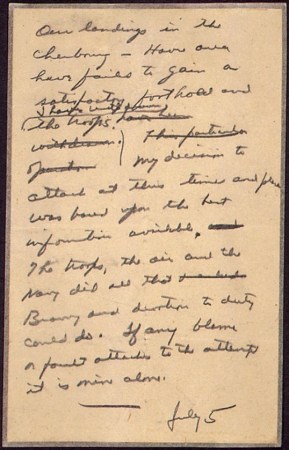
But there’s another letter that he set aside in case of failure. What if we lost? General Eisenhower had doubts in the face of a “well trained, well equipped and battle-hardened” enemy. If the invasion of Normandy had failed, this is the message he would have relayed to the public [the image displayed in this post is from his actual handwritten note]:img_7069

“Our landings in the Cherbourg-Havre area have failed to gain a satisfactory foothold and I have withdrawn the troops. My decision to attack at this time and place was based upon the best information available. The troops, the air and the Navy did all that Bravery and devotion to duty could do. If any blame or fault attaches to the attempt it is mine alone” [emphasis mine]. [He accidentally dated the letter July 5; it was, of course, June 5 when he scratched out this draft.]

Of course, we know that this “defeat speech” was not needed, and the success of that mission might very well have changed the course of human history for the better because it is viewed by most military experts as the turning point in the Allies’ efforts to keep Adolf Hitler from achieving his evil dreams of world domination.

I introduced this blog post with that bit of history for one reason — to use Eisenhower’s “defeat speech” as a standard against which to measure accountability nowadays, clearly showing that the very concept of accountability has practically disappeared from our leadership since Eisenhower’s time.  I’m not touting Eisenhower or trying to say that he was perfect, but I do believe he was part of a generation that understood what accountability means, how it should be expected to play out in a particular situation, and why that view of it is important.

General Eisenhower knew very well the magnitude of the “go/no-go” decision he needed to make on June 5, 1944. A major storm was headed in the direction of the beaches where the invasion would occur. If he delayed for a day or two, the element of surprise would be compromised.  If the brunt of the storm hit at just the wrong time during the invasion, numerous logistical elements of the attack could go wrong, increasing the number of casualties and decreasing the chances of success.  He no doubt had detailed estimates of the huge number of casualties there would be even if everything went well. All of this was a tremendous weight to bear.

He knew that if the invasion was successful, he would share in the fruits of that success — and that if it failed, he would have to absorb the blame and perhaps become a scapegoat. Two important points deserve emphasis here: 1) he made a decision, rather than waffling, saying he couldn’t get the information he needed [thereby subtly shifting the blame to others], etc.; and 2) he decided up front that he would step up and be accountable for failure if that was the result of his decision.

In today’s environment, many generals, and practically all elected officials, would probably have drafted a statement something like this:

“Our landings in the Cherbourg-Havre area have failed to gain a satisfactory foothold, and our troops have been withdrawn. The decision to attack at this time and place was based upon the best information our resources could provide. Our brave troops performed as was expected of them in all respects. We regret that lives were lost in the process, and we are determined to continue our fight to … blah blah blah”.

Lois Lerner, the IRS official who was behind the targeting of certain organizations for IRS scrutiny, said “I did nothing wrong” and then invoked her 5th Amendment rights in all the rest of her “testimony” — and then retired with full pension.  No high-level [or even lower-level, it appears] Veterans Administration officials to date have been fired as a result of clearly gross mismanagement over many years.  These are just two examples that are representative of items in a seemingly endless list of situations demonstrating that nobody in government is being held accountable for their performance.

Perhaps the saddest part of this story is that millions of Americans [more than the number by which most presidential elections are won] don’t seem to care about this.  They will make their voting decisions based on little if anything more than their perception of which candidate will dispense the most “goodies” described as “free”.

I honestly hope that the new paradigm unfolding in America will fully “flesh itself out” in this election.  If we end up electing the candidate who will stay our current course, the developing paradigm may be short-lived, and another may take its place — but unfortunately, I fear, even if that new paradigm is better than the currently-unfolding one, not until the damage done to our country has passed the point of no return.

IMG_7026.jpg

Charles M. Jones

Sources: in this blog post, most of the factual information, as well as a few text excerpts in the opening paragraphs, are from past posts at http://www.CNN.com and http://www.BusinessInsider.com

[Note … If you haven’t read my Introduction To USAparadigm.com blog post and the Home Page of USAparadigm.com, I strongly urge you to do so. This and all subsequent posts will make more sense to readers familiar with that introductory information.]

An Introduction To USAparadigm.com

According to experts on blogs, if I’m going to capture your attention with this, my introductory blog post at this site, I must do so in the next few sentences. I sincerely hope I can do that, … read more

According to experts on blogs, if I’m going to capture your attention with this, my introductory blog post at this site, I must do so in the next few sentences.  I sincerely hope I can do that, because I honestly believe I have a perspective on “goings on” in America that makes me more than just another blogger in the [insert your own adjective: Liberal; Conservative; Republican; Democrat; White; African-American; Asian; Gay; Straight; Religious; Non-Religious; Wall Street; Main Street …] Camp. This country is on a path to a future that the vast majority of its citizens will find very undesirable — from many perspectives, but although I see the country [just as anyone else does] through the lens of my ideological worldview, the financial situation will ultimately make all ideological considerations moot if we don’t develop the political will in our leadership to get ourselves onto a more sustainable fiscal path.  If you don’t agree with me at this point and your interest in what I have to say is waning, PLEASE consider the possibility that there may actually be something to my claim of potentially bringing a broader — perhaps even unique — perspective to the endless stream of opinions from bloggers in the various camps mentioned parenthetically above, and at least read the rest of this introductory blog post before making a decision to move on to something else.  If you agree with me to this point, I’d like to assume that you will at least read the rest of this introductory blog post [if that assumption is incorrect, all I can do is ask you to PLEASE reconsider — for the same reason]. Continue reading “An Introduction To USAparadigm.com”