Blog

And The Winner Is …

budget-battle-f096959b0cd9682b

In a year and a half of writing weekly posts to this blog, I have usually been able to zero in on a topic fairly easily and just go straight to writing a day or two before my usual Wednesday post day. This week, though, there was such a tsunami of ripe pickings I had difficulty coming up with the “winner.” And the winner is … [drum roll, brass fanfare]: The Complete Demise Of Fiscally Responsible Thinking In America.

At least once or twice in earlier posts I’ve alluded to what has always seemed to me to be a clear difference in philosophy between Republicans and Democrats on fiscal matters. Generally, the mindset of Democrats has always seemed to be that if initiating or continuing a particular government program seems to be a good thing to do, then we should just make the decision to do it for that reason alone and let the cost considerations work themselves out in some separate process. Conversely, the mindset of Republicans has always seemed to be that the decision to initiate or continue any government program must necessarily be made in context with consideration of its cost and whether or not we can fund it under a fiscally responsible financing plan. This dichotomy has been at the root of many government “shutdowns” [see The Senate Shutdown for debunking of that term] when increases in the debt ceiling are required.

All Made Out Of Ticky Tacky; All Look Just The Same

One of my favorite songs of all time is Little Boxes, made popular by Pete Seeger in 1963. Although the song was a political satire about that era’s development of suburbia and associated conformist middle-class attitudes, only slight changes in the lyrics would make it describe the situation I’m writing about here. The “budget” [to use the term lightly] bill signed into law by President Trump in the wee hours of the morning of February 9 ended the latest [only hours-old] “shutdown” and was heralded by the leadership of both parties as a bipartisan compromise [“leadership” emphasized here because there was considerable disgruntlement in the Republican party’s “rank and file”]. Since even “leadership” wasn’t totally on board on the Democrat side, I would be remiss if I didn’t at least mention Nancy Pelosi’s huge public tantrum over a DACA fix being left out of the negotiations [which has been nothing but a political ruse all along since trying to use a spending “crisis” to drive action on a totally unrelated ideological issue is a silly idea at the get-go].  I think Senator Jeff Flake [R-Arizona] expressed it best: “I love bipartisanship, as you know, but the problem is the only time we discover bipartisanship is when we spend more money.”

So here we are. This “budget” adds $300 billion to current recurring spending levels plus another $89 billion in one-time disaster relief for areas hit by hurricanes and fires. After meager improvements in our fiscal performance over the past few years, this will send our annual deficit once again over a trillion dollars — at a time when our national debt is already over $20 trillion! And the final nail in the coffin of fiscally responsible thinking in either party was refusal to include an amendment offered by Senator Rand Paul that would have kept Congress under strict budget caps and retained the debt limit in the package.

So trying to figure out which if either party is the more fiscally prudent is now almost impossible — because, to quote lyrics from Little Boxes, they’re all made out of Ticky Tacky, and they all look just the same.

A Glimmer Of Hope?

Although Senator Rand Paul’s continued aspirations to the Presidency are always at least a part of the motivation behind his periodic theatrics that keep his visibility high, I think he made some very insightful comments in his opposition to this latest “budget” bill. Here’s how it went down:

The Senate vote came only after Sen. Rand Paul (R-Ky.) refused to allow any action on the measure before the midnight funding deadline, triggering the second government shutdown in three weeks and an embarrassing outcome for the GOP-controlled Congress. … Paul blocked consideration of the measure because he didn’t get a vote on an amendment to keep Congress under strict budget caps, as well as stripping the debt limit from the package. GOP and Democratic leaders in the Senate feared if they let Paul proceed with his proposal, other senators would seek to amend the underlying deal as well. So they refused to allow a vote on Paul’s proposal. Paul countered by delaying Senate consideration of the bill as long as possible, a move that angered McConnell and other top Republicans. Paul didn’t seem to care. “There’s only so much I can do. This is a silly thing about it. I can keep them here until 3 a.m. I will make them listen to me,” Paul said on Fox News. With a shutdown only hours away, McConnell tried to set up a vote on the budget deal beginning at 6 p.m. But Paul objected. McConnell then pleaded with senators to accept a procedural vote and allow the Senate to move a deal that Trump backs. “The president of the United States supports the bill and is waiting to sign it into law. I understand my friend and colleague from Kentucky does not join the president in supporting the bill,” McConnell said. “It’s his right, of course, to vote against the bill. But I would argue that it’s time to vote.” Paul told POLITICO on Thursday evening that he would not consent to congressional leaders’ plan without a vote on his amendment. He ended up never getting that vote. Asked if he’s worried about singlehandedly inheriting the blame for a shutdown, Paul replied: “No. I think it’s an important enough thing that we should have a discussion over.” [Source: POLITICO Article]

I’m not a big fan of Rand Paul, but I think what he did and said during debate over this bill was “right on”. Maybe he and some of the Freedom Caucus / Tea Party types haven’t totally lost the battle for fiscal responsibility in America. Otherwise, we will stay on the current Unsustainable Fiscal Path.

Thanks for reading this post, and if you regularly follow my Blog, for that, too. Please consider sharing this or other posts with your friends, colleagues and associates.

img_7026 Charles M Jones

Charles M. Jones

SOTU And A Story Of Two Boys

Somewhere in the distant “backroads by the rivers of my memory” is a speech I heard several decades ago in which the speaker told a story about a little boy put in a room a foot deep in horse manure in a psychological experiment about people’s mindsets and motivations. They came back after two hours and found the boy jumping around delightedly throwing horse manure everywhere. Confused, they asked him how on earth he could be having so much fun in a room full of horse manure. He said, “With all this horse manure around, there’s got to be a pony in here somewhere!”

Before I move on to the point of this post, I need to share the story of the other room used in the experiment, so bear with me. … In the other room, they put another boy, and the room was absolutely packed with toys — toy trucks and cars, soldiers, games, electronic gadgets, anything you’d think a boy his age could possibly want for Christmas. They came back after two hours and found the boy in the middle of the room throwing a temper tantrum and shouting “Let me out of this place!”  Confused again, they asked him how on earth he could be having such a terrible time in a room filled with toys most boys his age would want. He said, “This is a dull red fire truck; I want a bright red one. And I don’t like board games, and …” Well, you get the picture.

So This Story Is An Allegory For What?

Well, the attitude of the “pony boy” reflects fairly accurately the atmosphere displayed by Republicans at the 1/30/18 State of the Union address [the room full of horse manure, of course, being the Swamp 😊 ]. And you guessed it, the apparent attitude of Democrats [all of them, to a person] was very much akin to the “fire truck boy” [the room full of toys, of course, being numerous opportunities to be a part of some really great initiatives]. The poster-children of the latter attitude were folks like House Minority Leader Nancy Pelosi and Senator Heidi Heitkamp [D-ND] …

  • “In terms of the bonus that corporate America receives versus the crumbs they are giving to workers to put the schmooze on is … pathetic. … I think it’s insignificant.” [Pelosi]
  • “If [corporations giving bonuses] were that comfortable, why don’t [sic.] they give them a thousand-dollar boost in their salary, which would continue over the next years?” [Heitkamp]

Add to this list of poster-children the eleven representatives who chose to boycott the address altogether [i.e., didn’t even attend]: Bobby Rush (D-Illinois); Jan Schakowsky (D-Illinois); Danny Davis (D-Illinois); John Lewis (D-Ga.); Maxine Waters (D-Calif.); Primila Jayapal (D-Wash.); Gregory Meeks (D-N.Y.); Barbara Lee (D-Calif.); Albio Sires (D-N.J.); Earl Blumenauer (D-Ore.); and Frederica S. Wilson (D-Fla.).

And, of those who did dutifully [but many no doubt reluctantly] attend. … Congressional women wore black in support of the MeToo movement. Congressional Black Caucus members, dressed in West African kente cloth to protest Trump after reports he called some African nations shithole countries, sat “stone-faced and unmoved” [description used by one of the many media reports].

And the prize for the lead poster-child goes to Rep. Luis Gutierrez [D-Illinois], who stormed out of the chamber when Republicans started chanting “USA, USA.” Instead of listing something he later said sarcastically with other quotes above, I saved it for this honorary paragraph: “Whoever translated [the speech] for him from Russian did a good job.”

So Buckle Up

So forget the President’s attempts to speak in cooperative terms. We’re in for more gridlock at least until the elections this November. Democrats, absolutely convinced by traditional thinking and how they “read” the situation that they will win a majority in at least one if not both houses of Congress, will block all attempts by the Administration to accomplish anything beyond the major accomplishments so far.

Sure, President Trump did some bragging, but so have all previous presidents in both parties in their SOTU addresses. Maybe he even exaggerated some of his claims or put a positive spin on some essentially neutral statistics, but so have all previous presidents in both parties in their SOTU addresses. What’s different here is the level of vitriol exhibited by the minority toward the president who put them in their current situation. I thought the Republican attempts to block President Obama’s agenda were “typical Current Paradigm politics” — the same attempts to block everything, and maybe even some similar barbs directed at Democrats and at him, personally. Comparatively, though, those years were nothing even close to today’s environment.

According to “traditional thinking” in November 2016 [what most polls indicated, the fact that Trump seemed to have “shot himself in the foot” numerous times, etc.], Clinton was going to win the Presidency by a landslide. Well, “traditional thinking” turned out to be “erroneous thinking” — it was Trump who won by a landslide. It will be very interesting to see how the midterm elections this November turn out. If the Democrat strategy, which is essentially to block everything they can and push the Russian interference / collusion / obstruction / whatever narrative as far as it will go, is successful, the Current Paradigm will still have some legs and the Swamp will continue to sputter along. If the elements of the New Paradigm are even stronger than they clearly were in 2016 and Republicans keep their comfortable majority in the House and increase their majority in the Senate, however, get ready for a major acceleration in dominance of the New Paradigm and great things happening in 2019-2020 — maybe even 2019-2024.

Unfortunately, …

Unfortunately, the next nine months will be a constant barrage of negative ads in the media, particularly in states where Democrats “smell blood in the water” [e.g., where incumbent Republicans are not seeking re-election to House or Senate seats, or where Republicans are running for re-election in states Trump either lost or won by lower margins]. So make sure your Netflix and Amazon Prime accounts are current. There will probably be a lot of times when watching a movie will be a good way to escape from the media outlets where all these ads are running ad nauseam.

Thanks for reading this post, and if you regularly follow my Blog, for that, too. Please consider  sharing this or other posts with your friends, colleagues and associates.

img_7026 img_3358

Charles M. Jones

The Senate Shutdown

In the blame game leading up to, during, and after the three-day government “shutdown” last weekend, all you saw in media coverage was The Schumer Shutdown versus The Trump Shutdown.  The way I see it, it was The Senate Shutdown, and about as conclusive proof as can be found that a) we have a Dysfunctional Government, and b) there is a Major Paradigm Shift Well Underway in this country.

Why Enclose “Shutdown” In Quote Marks?

Why enclose “shutdown” in quote marks? The government does not actually “shut down”.  There are many ways to fund operations during these manufactured crises. Neither party would allow the funding wind-down to last long enough to actually cause the government to begin shutting down. Once the brinksmanship is over, both parties are eager to get past the “shutdown” and shift into “spin mode,” each posturing itself as the champion of the people and the winner of the brinksmanship trophy. The Continuing Resolution [CR] that ended the “shutdown” on January 22 was the nineteenth since 2009 and the sixty-first since 2000! Unfortunately, CRs have become the norm because we have not had a Legislature since 2009 that has been able to produce an actual budget and get it signed by the President!

Political Grandstanding

If you think the showdown leading up to this “shutdown” was anything but political grandstanding, think again. All the hype is nothing more than political theatrics, with various legislators and their parties attempting to capitalize on expiration of a CR as an opportunity to further their narratives [which have nothing to do with any of the “issues” ostensibly driving the threat of a shutdown — the underlying motivations are simply gaining or maintaining political power].

Only five Democrats voted for the January 19 CR [the one that failed, causing the “shutdown”], and five Republicans voted against it [one of those five, however, was McConnell, who only voted “No” because as Majority Leader, he could technically leave the vote open only if he voted with the prevailing result, which in this case was “No”]. All five Democrats who voted “Yes” are from states that Trump won handily, and all five are up for reelection this year! Their leadership allowed them to break ranks and vote “Yes” for one and only one reason: their votes were not enough to bring the “Yes” total to sixty anyway [even if all Republicans had voted “Yes”], so putting this slack in their leashes gave them some talking points for their upcoming reelection campaigns.

An Insightful Observation By One Representative

The best example I saw in media coverage of just how foolish all of this looks to most Americans is this comment to a Rolling Stone reporter by Representative John Kennedy [from my home state of Louisiana] as the Legislature was finalizing the details of resolution of the “shutdown”: “It’s like a circus without a tent. I think most Americans are wondering how some folks up here made it through the birth canal.”  My, my, I can think of quite a few names to put on that “some folks up here” list!

A Reasonable Way To End These Shenanigans

Unfortunately, there’s no “silver bullet” that will end all these shenanigans in one fell swoop. At least not one that is realistic — perhaps this would work, though, if it were possible: a) a fire in the Capitol that would destroy all documentation of formal adoption of House and Senate rules [which are not in the Constitution]; and b) mandatory participation of all legislators who have been in office for more than their current term in a clinical trial test to determine the effectiveness of a new device for selective memory erasure in humans [for the latter, with anything having to do with knowledge of current Senate and House rules being the target memory area, the outcome would be good either way — success, meaning nobody remembers all those rules; or the subject ends up in a vegetative state, essentially no effect for those fitting into Senator Kennedy’s “some folks up here” group].

One thing that is doable is to get rid of the filibuster altogether. I referred to this in depth in a previous post to this Blog [Going Nuclear On Gorsuch – And? …]. That would be a major step toward getting our government back to a functional status. If you didn’t read or don’t recall that post, I’d strongly encourage looking at it now. I think I built a pretty good case for getting rid of this roadblock [and in reality in this day and time, good intentions in its origins notwithstanding, that’s what it is regardless of which party is in the majority — a roadblock].

Thanks for reading this post, and if you regularly follow my Blog, for that, too. Please consider sharing this or other posts with your friends, colleagues and associates.

img_7026 img_3358

Charles M. Jones

Clever? … Or Clueless?

Senators and representatives who have been elected in the last few cycles as “tea party” [or more recently Freedom Caucus] candidates have received a lot of negative press because of their supposedly over-the-top conservatism. They generally oppose any legislative action that would increase the national debt — and in the eyes of many, that makes them appear as obstructionists to “progress”.

On the opposite end of that spectrum are Legislators whose philosophy seems to be that if a program they envision is good “for the people”, it should be implemented no matter what, considerations about affordability being secondary details. I wonder if maybe one side is clever and the other is clueless — but if so, the logical question that follows is which description fits which side?

Hint: Listen To Characterizations Of The New Tax Law

A clue to the answer lies in how lawmakers of these two leanings express their support of or opposition to the recently-passed tax law. One side tends to use phrases like “unleashing our economic potential”, “getting the economy moving again”, “producing jobs”, and “allowing the average working person to keep more of his/her money”. The other side tends to use phrases like “big corporations and rich people get a windfall, but middle-class Americans get crumbs”.

A Legislator who thinks in terms of who gets what from any particular action by government has the mindset that government has the capacity to give things to people. Government has no such capacity. Government takes money from its citizens [taxes, at least in theory with their approval] to provide “products” and services [e.g., infrastructure, law enforcement …] to them. If people are generally satisfied with the services provided and the taxes associated with them, everything is fine. If not, their recourse is to replace enough of their elected officials to change the price/performance ratio, a process which unfortunately takes a considerable amount of “collective resolve” and [assuming that collective resolve is achievable and that the “pipeline “ of potential candidates has desirable choices] anywhere from at least two to four years to possibly eight years or even more. In case you missed it, this paragraph has explained about as succinctly as possible why it seems to take forever to significantly change the status quo in our government.

Wanted: Sensible Leaders; Sensible Voters

I have pointed out in the pages of this web site and several times in posts to this blog that this country is on an Unsustainable Fiscal Path. With our national debt now over $20 trillion, we nonetheless continue every year to spend more than we take in — meaning, of course, that our national debt is still rising. Not surprisingly, interest on our debt is rising faster than any other single expenditure.

At the risk of sounding like I’m making self-contradictory points [i.e., by now saying that deficit spending is OK], I believe pursuing the current economic direction has a much greater probability of ultimately getting us back on a sustainable fiscal path than continuation of the past direction [which would have no doubt been the case had the 2016 election gone the other way]. Whether I’m right in this assessment remains to be seen, but despite the rhetoric from those who complain about who is getting what under the new tax law, drastic action is needed to get our fiscal house in order. When that is the case, seemingly counterintuitive actions undertaken by innovative thinkers [i.e., doing what status-quo logic says will reduce revenue and increase expenses when just the opposite is needed] makes more sense than “doing the same thing over and over again and expecting different results” [a definition of insanity often attributed to Albert Einstein — an unverifiable attribution but nonetheless a sensible definition].

So Who Is Clever And Who Is Clueless?

So who is clever and who is clueless? It depends. … If “political cleverness” alone prevails and positive results have not become visible in late October / early November this year, or if “economic cleverness” prevails and positive results are visible in late October / early November, we should have a pretty good idea in ten months [this year’s mid-term election]. If “political cleverness” alone wins, I don’t see better times five to ten years out [and beyond]. If “economic cleverness” alone prevails, the future looks much brighter to me.

Thanks for reading this post, and if you regularly follow my Blog, for that, too. Please consider sharing this or other posts with your friends, colleagues and associates.

img_7026 Charles M Jones

Charles M. Jones

The Politics Of DACA

Personally, although I understand and appreciate arguments against a favored path to citizenship for people in America who qualify for the Deferred Action for Childhood Arrivals program [DACA], I believe this is one segment of our population that we have an obligation to consider separately from other issues labeled as “amnesty” in debates about finding solutions to the extremely complicated issue of illegal immigration. These are people brought here illegally as children. They were too young to know that what their parents were doing was illegal, and they have grown up here and know of no other previous life elsewhere. Many [most, as I understand it] have become productive residents, have jobs, and pay taxes. Many have gotten an education, some at advanced levels. The problem is our fault, not theirs — i.e., our lack of resolve in dealing with the issue of border control and illegal immigration over many decades has resulted in numerous problems, the plight of these people being only one relatively small part of a bigger whole.

The Right Thing To Do [But Don’t Kid Yourself About Supporters’ Motivations]

Whenever politicians even within their own party have differing opinions on an issue, there is at least a modicum of rationale for assuming that the differences of opinion are not party-line focused. However, any time you hear all politicians of one party expressing themselves at every opportunity in a party-line monolithic mode, giving impassioned speeches about the plight of a certain segment of our population and pushing for legislation to “ease their pain”, you can bet that their motivation is not altogether altruistic. This is true regardless of which party is trying to capture the “high-road” [ostensibly the more altruistic] image.

In the case of DACA, it’s the Democrats that are trying [and so far, in my opinion, succeeding] to portray themselves as their advocates. Because of their monolithic solidarity, though, my suspicion got the best of me, so I decided to do a little research. My findings revealed some interesting correlations between their ostensible passion for DACA beneficiaries and just plain run-of-the-mill politics.

Looking Deeper

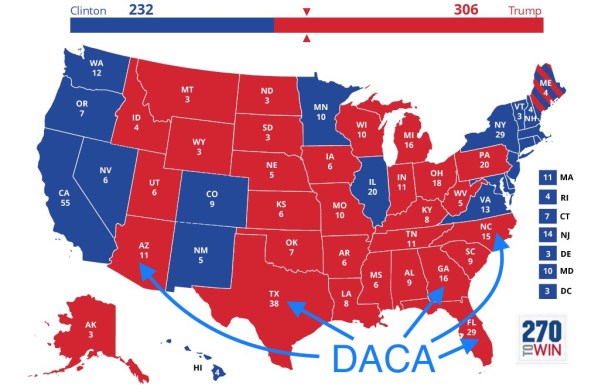
Let’s just look at the numbers. In the 2016 presidential election, all the hype about Hillary Clinton winning the popular vote by 2.9 million votes is meaningless [that’s only a 48.1% to 46.1% victory — neither Clinton nor Trump got a majority of the popular vote]. Clinton lost the Electoral College vote 306 to 232, and that 70% to 30% trouncing was achieved by a margin of only a few hundred thousand votes. Which states? Five states that supplied 109 Electoral votes for Trump [more than enough to have swung the election to Clinton] were in the top ten states in terms of DACA applications — Arizona, Florida, North Carolina, Texas and Georgia. In each of those states, the number of DACA-eligible people not currently in the DACA program averages 30% of the votes that would be required to swing the state from Republican to Democrat in terms of Electoral College votes [the range is 17% in Georgia to 45% in Arizona].

The bottom line is that, under two assumptions, current and future DACA participants would be a major component of the votes that could swing these Trump states to a Democrat challenger if Democrats are able to solidify the perception that they are the true DACA advocates. The two assumptions are 1) that all current DACA participants [who would supposedly ultimately become voters] vote Democrat and 2) all newly-approved DACA participants [i.e., those eligible to vote under a new law] vote Democrat. That would enable Democrats to focus their advertising dollars on other segments of those states’ populations, dramatically improving their chances of turning those states from red to blue on the Electoral map.

It Would Be Great …

It would be great if motivations to support current and potential future DACA participants were pure, and driven by people in our elected leadership who have true concerns for the people in the program — but the truth is, it’s just politics as usual.

Thanks for reading this post, and if you regularly follow my Blog, for that, too. Please consider sharing this or other posts with your friends, colleagues and associates.

Charles M Jones

Charles M. Jones
The Runaway Trolley Problem

The Runaway Trolley Problem is one of those classic hypothetical situations that can be useful in helping us understand difficult trade-off decisions that often arise in dealing with complex issues.  The problem can be summarized as follows. …

There is a runaway trolley barreling down the railway tracks. Ahead, on the tracks, there are five people tied up and unable to move. The trolley is headed straight for them. You are standing some distance off in the train yard, next to a lever. If you pull this lever, the trolley will switch to a different set of tracks. However, you notice that there is one person tied up on the side track. You have two options:

      1. Do nothing, and the trolley kills the five people on the main track.
      2. Pull the lever, diverting the trolley onto the side track where it will kill one person.

Which is the most ethical choice?

This is a pretty good analogy of the current situation with the entitlement programs [Medicare, Medicaid, and if not completely replaced with something that can even theoretically work, the “Affordable” Healthcare Act  (aka Obamacare)] which, if left to themselves with no action very soon, will drive America into bankruptcy in fewer years than most politicians want to think possible.

I have written extensively in posts to this Blog and on the pages of this website [e.g., Unsustainable Fiscal Path] about the fact that if we don’t get our fiscal situation in order pretty soon, our ideological differences will become almost insignificant in comparison to our economic situation.

The “Entitlement Programs Problem” — A Version Of The “Runaway Trolley Problem”

Very few people, even in our leadership, are willing to unequivocally call our entitlement problem what it is  — a train wreck in the making. You don’t need to be a mathematician, an economist, or a financial expert to look at simple trend graphs and conclude that our current fiscal path is not sustainable in the long term, and that entitlement programs are the principal drivers of the problem. We have before us the same kind of choice presented by the Runaway Trolley Problem:

      1. Do nothing and just allow these programs to eventually drive us into bankruptcy [because continuing on our current path is not mathematically possible] — i.e., allow all the millions of current and future beneficiaries to ultimately receive reduced levels of (or potentially lose altogether) whatever benefits they currently receive or would otherwise be eligible to receive in the future. … Analogous to “Don’t pull the lever, and allow five people to die”. After the comma, however, a more accurate analogy would be “and cause 49,244,195 people to lose or receive reductions in benefits and/or be unable to begin receiving expected benefits” [49,244,195 is the 65+ population].
      2. Modify these programs now as required to make them financially sustainable — i.e., reduce the benefits to which future beneficiaries will be entitled, increase the age at which future beneficiaries will begin receiving benefits, reduce benefits being paid now to current beneficiaries, and/or increase taxes to fund the amounts required to pay current and future benefits. … Analogous to “Pull the lever, saving the lives of five people but allowing one person to die”. After the comma, however, a more accurate analogy would be “and increase the payroll taxes 200,241,033 people are paying” [200,241,033 is the 18-to-64 population].

So the ““Entitlement Programs Problem” is a tradeoff decision that is kind of reversed from the “Runaway Trolley Problem“: more like “adversely impact 49 million people later with no action now or four times that many people now by taking corrective action now”.

Would’a … Could’a … Should’a’ / What Now?

The truth of the matter is that this problem, had choice 2 been a decision made decades ago, would not exist today — and the number of people negatively impacted from then to now would have been far smaller than will be the case going forward from now. Chalk that up to the simple fact that politicians make their decisions not based on what is best for the country, but based on [in this order] 1) what maximizes their personal chances of being re-elected and 2) what maximizes their party’s chances of obtaining or maintaining majorities in the Legislature and having a member of their party in the White House. Unfortunately, that mentality results in a propensity to “ kick the can down the road” — i.e., to put off controversial decisions until after the next election [and of course, there’s always a “next election”].

House Speaker Paul Ryan has said that Entitlement Reform is a major 2018 agenda item. Senate Majority Leader Mitch McConnell seems less enthusiastic about that, and it’s hard to read at this time whether President Trump considers it a priority or not. As a current beneficiary of two of these four programs, I hope Speaker Ryan is able to drive toward action now.

Thanks for reading this post, and if you regularly follow my Blog, for that, too. Please consider sharing this or other posts with your friends, colleagues and associates.

img_7026 Charles M Jones

Charles M. Jones

Budgeting 101

For anyone who wonders why Swamp politicians, be they Democrat or Republican, can’t seem to get a grip on America’s finances and put us on a fiscally sustainable path, this Blog post is a must-read. Let’s start with some fundamental facts:

    1. No entity — an individual person, a family, a corporation, or a government — can continuously expend more funds than it takes in for an indefinite number of years. The result of such a scenario is a continuously-increasing debt — and inevitably, at some point in time, the creditor(s) who have granted the bulk of that credit will lose confidence in the debtor’s ability to repay what is owed, or even the interest on it. That, in turn, will result in the creditor(s) taking such actions as refusal to extend additional credit, requiring pay-down of some existing debt before any new loans of smaller amounts will be made [i.e., creating a scenario in which the debtor’s overall debt level is reducing each year], and/or increasing interest rates on new debt.
    2. No government can make all of the people over whom it has authority happy all of the time [it can, however, keep some of the people happy all of the time, and all [or at least most] of the people happy some of the time].
    3. In recent decades and currently, attributes in a person running for office that are most likely to result in his/her being elected to that office have very little if anything to do with his/her knowledge of fiscal or other domestic [or foreign policy] issues. Factors determining electability are more in the realm of name recognition [vis-a-vis that of his/her opponent], speech-making ability, and “charisma”.

The “drain the Swamp” mantra these days, at its core, is a recognition on the part of many that these fundamental facts, which I might add form the basis of the ground rules of the Current Paradigm, must change if anything other than the status quo will prevail until a financial meltdown forces acceleration to a New Paradigm.

For anyone doubting the accuracy of the preceding paragraph, one of the original pages of this site [Unsustainable Fiscal Path] gets into the weeds of why #1 above is a fact and not just a collection of assumptions on my part. The purpose of this blog post is not to attempt to debate #1 [or any of the items] in my fundamental facts list above, but to clarify why Swamp politicians, absent a “wake up call,” will never move the needle on this issue — ergo, “draining the Swamp” may be the only way to get us off the fence voluntarily before we fall off of it.

Demonstrations And Protests Won’t Do It

Demonstrations and protests seem to me to be more prevalent nowadays than they’ve ever been in my lifetime. I realize that it’s possible they just appear to be more prevalent because of our climate of 24-hour, 365-day instantaneous “news” coverage — and in recent years, Social Media posts that can “go viral” within hours if not minutes. I do think it’s accurate to say, though, that they are organized and promulgated much more quickly, and that their usefulness has been outlived. While distant-past versions have played a major role in producing very meaningful and lasting change [e.g., the Civil Rights era], today we have such a plethora of issues simultaneously in the media that they tend to drown each other out and just become general evidence that there are segments of our society who are not happy — and therefore nothing more than evidence of the truth of assumption #2.

Current Swamp Occupants Won’t Change

In retrospect, President John Adams was certainly speaking prophetically over 200 years ago when he said this: “There is nothing which I dread so much as a division of the republic into two great parties, each arranged under its leader, and concerting measures in opposition to each other. This, in my humble apprehension, is to be dreaded as the greatest political evil under our Constitution.” That’s a pretty accurate description of our current situation, which has no doubt evolved [or devolved might be more descriptive] to a much worse state than he must have been imagining when he said that. If Swamp occupants haven’t changed in over 200 years, we would be foolish to think they will change now.

So What Are We Left With?

I think Pogo [Walt Kelly], in summing up his attitude towards the foibles of mankind and the nature of the human condition, had the answer in 1970 — “We have met the enemy, and he is us” [a parody of a message sent in 1813 from U. S. Navy Commodore Oliver Hazard Perry to Army General William Henry Harrison after his War-Of-1812 victory in the Battle of Lake Erie, stating, “We have met the enemy, and they are ours.”].

Interestingly, this 1970 edition of that famous comic strip was a timely confirmation of something President James Garfield had said almost 100 years earlier — “The people are responsible for the character of their Congress. If that body be ignorant, reckless, and corrupt, it is because the people tolerate ignorance, recklessness, and corruption.  If it be intelligent, brave, and pure, it is because the people demand these high qualities to represent them in the national legislature. … If the next centennial does not find us a great nation . . . it will be because those who represent the enterprise, the culture, and the morality of the nation do not aid in controlling the political force.” [Garfield focused these remarks on legislators, but I would broaden them to apply to all elected officials — national, state, and local.]

So what we are left with is us!  And the question before us is “What can we do?”

Our Challenge

Albert Einstein is often quoted as defining insanity as “doing the same thing over and over again and expecting different results.” [he later disputed having said that]. Nonetheless, a quote accurately attributed to him is “We cannot solve our problems with the same thinking we used when we created them.”

Almost 129 million votes were cast in the 2017 presidential election. However, because of our Electoral College system [which I believe is a good thing], only a few hundred thousand votes could have changed the 306-227 outcome. I believe that at least a third, maybe closer to half, of the 129 million people who voted fall into a category one popular radio talk show host calls “low information voters” — basically, people who are easily swayed by the most petty of factors [how the candidate looks, how good a speaker he/she is, liking or disliking one thing he/she said or did in the final weeks or even days of the campaign, etc.]

I’d like to think that the 2016 election was the last one that will have been dominated by the Current Paradigm, and that the Major Paradigm Shift Well Underway in this country is, at least for our elections, complete. If that is the case, those of us who have the will to do so can surely find ways to swing a few hundred thousand low-information voters in our direction. Then, the remaining issue will be to ensure that there is a steady stream of candidates for elected offices who have something in their qualification profiles other than “looks nice on camera”, “speaks eloquently”, and “has charisma”: for starters, maybe one such item could be “has a rudimentary understanding of economics and finance”. Sorry, no capacity to deal with that issue in this post — I’ve already run a little over my self-imposed length for individual posts. I’ll save that for another day.

Thanks for reading this post, and if you regularly follow my Blog, for that, too. Please consider sharing this or other posts with your friends, colleagues and associates.

img_7026 img_3358

Charles M. Jones

Observations Regarding The New Tax Law

Tax Law Cartoon

The media coverage, both in the weeks leading up to the December 20 passage of the new Tax Reform Law now awaiting the President’s signature and in the hours since its passage, has been the starkest example you could find of three things I’ve written extensively about in posts to this blog and in the overall content in the pages of this web site: 1) the extreme [and still worsening] ideological/philosophical polarization within our elected leadership; 2) the heavy bias to the Left in most “mainstream” media outlets; and 3) the alarming number of people in this country who qualify as what one popular radio talk show host calls low information voters.

Intensifying Ideological Polarization

It certainly doesn’t take much research to make this point — consider these remarks by Democrats and Republicans about the new law:

Democrats: “A monumental, brazen theft of the middle class”, showing “moral obscenity and unrepentant greed. … It is a vote to instill a permanent plutocracy in our nation.” … “Armageddon.”

Republicans: “We are about to achieve some really big things, things that the cynics have scoffed at for years, for decades even. This really is a generational defining moment.”

One legislator [a Democrat, of course] recently said “Millionaires will get an average annual tax break of $35,000 a year,” while “millions of middle class taxpayers will see their taxes go up.” This got aired and re-aired multiple times in the “mainstream” media. So my question to that legislator [and to the media pundits who aired this] is “What’s your point? The percentage savings of the millionaires is less than the percentage savings that many more millions of middle class taxpayers will save under this law.”

More Evidence Of Left-Biased Media

In most “mainstream” media coverage of the bill, the general drift is how it “robs Peter to pay Paul” — Peter in this case being the “Middle Class”, and Paul being the very wealthy [the “top 1%”, as Bernie Sanders says] and huge corporations. In the “mainstream” media’s more conservative minority, the general drift is on the potential for economic growth fueling a more prosperous outlook if the Republican logic is correct, but tempered with “What if …” caveats on how the law could hurt Republicans in the 2018 and 2020 elections absent appreciable evidence to the average voter in those years of substantial improvements in the economy.

“Repeat a lie often enough and it becomes the truth.” Although not all of what the “mainstream” media is pushing is actual lies [more accurately, it could often be labeled “partial truths”], this quote by Joseph Goebbels [Adolf Hitler’s Propaganda Minister] has  a great deal of applicability here. An excellent case in point is all the flack in the past few days about the so-called Corker “bribe”. Based on “undisclosed sources,” a component of the law regarding special treatment of real estate companies [which were the source of Corker’s considerable wealth] was characterized as a “last minute change” to get his vote. That has been debunked repeatedly [that provision was at least a month old, going back to the House version of the bill], but it is still being reported on and commented on.

Alarming Number Of “Low Information Voters”

Let me begin expanding on #3 in my introductory paragraph with this quote often attributed to P. T. Barnum: “There’s a sucker born every minute.” [there is no clear evidence that the attribution to Barnum is valid; early examples of its use among gamblers and confidence men can be found]. Now, let me just report some facts, not opinions or “spin” on somebody else’s “spin.”  The new tax law is not skewed toward the rich [I actually did the research with a spreadsheet — figure it out for yourself if you think I’m biased]:

    • First, under the current tax law, a couple whose Adjusted Gross Income is $20,800 or less pays no income tax. Under the new plan, that zero-tax threshold increases to $24,000.
    • For a married couple with Adjusted Gross Income of $59,039 [U. S. median as of 2016 returns], filing jointly and taking the Standard Deduction and [under current law] $8,100 [2 x $4,050] in personal exemptions, tax: under current law, is $4,783; under the new law, is $3,824 [reduction: $960, or 20.1%].
    • For a married couple filing jointly, at the income levels below and with a 5% mortgage five times their income, giving 5% of their income to charity, their taxes are affected as follows:
      • Income $59,039, tax: under current law, is $4,032; under the new law, is $3,824 [reduction: $208, or 5.2%].
      • Income $500,000, tax: under current law, is $83,435; under the new law, is $75,379 [reduction: $8,056, or 9.7%]. Note: a little higher percentage reduction here only because of my choice of income levels — the $750,000 limitation on the mortgage interest deduction in the new law did not “kick in” for this particular couple with a $500,000 income [it did “kick in” at the $5,000,000 level below, shifting those “rich people” to tax increases instead of reductions].
      • Income $1,000,000, tax: under current law, is $209,000; under the new law, is $198,379 [reduction: $10,621, or 5.1%].
      • Income $5,000,000, tax: under current law, is $1,323,635; under the new law, is $1,419,379 [INCREASE: $95,744, or 7.2%].

I put these facts in this section about low information voters because there are literally millions of people who have absorbed negative media spinning of the content of this law. My guess is that when its intended results begin to manifest themselves — and I believe they will — the opinion polls will change dramatically, and in a year the current polls will be looked back upon the same way we now look back upon the polls leading up to the 2017 election [worthless].

So Who’s Right?

The short answer is “Nobody actually knows whether Ms. Pelosi’s “Armageddon” characterization of the law or Speaker Ryan’s “generational defining moment” characterization will prove to be more accurate when viewed in our rear-view mirror a decade or two from now [all ten-year projections, whether optimistic or pessimistic, are based on too many assumptions to be reasonably accurate]. This is particularly true of projections about what net impact, if any, this law will have on our national debt [which as I’ve often said is probably the single most significant number that will define our future — see the Unsustainable Fiscal Path page at this site].

Which “side” is right will determine the degree to which our currently unsustainable path continues its recent turn toward a more sustainable direction. I sincerely hope the Republicans are right — not because I’m a Republican, but because I believe that our current leadership is at least trying to move us toward financial sustainability and moral clarity, and that our leadership under the alternative outcome of the 2017 election would have already made significant progress toward sealing our ultimate doom.

Thanks for reading this post, and if you regularly follow my Blog, for that, too. Please consider sharing this or other posts with your friends, colleagues and associates.

img_7026 img_3358

Charles M. Jones

I’m With Eliza Doolittle …

Audrey-Hepburn-as-Eliza-Doolittle

An interesting thing came to my mind as I watched the December 12 special election in Alabama for former Senator Jeff Sessions’ [now Attorney General] seat go to a Democrat — Eliza Doolittle’s [Audrey Hepburn’s] wistful song Wouldn’t It Be Lovely in the 1964 musical My Fair Lady. In that song, “Eloyza” [as she pronounced her name before her metamorphosis under the direction of Professor Henry Higgins (Rex Harrison)] expressed how “lov-e-ly” it would be if [in so many words] she could live a more affluent lifestyle.

This election presented me with numerous sub-themes to write about, mostly around the general theme of the Major Paradigm Shift Well Underway not only in this country but in the world [i.e., more evidence of the shift, and what we can glean from this particular component of it]. I chose my “Eliza Doolittle epiphany” because it looks forward to what could be rather than backward-to-now to confirm what has been and is taking place.

Back To The Alabama Election …

That imagery in my mind caused me to think “Oh, wouldn’t it be lovely if Doug Jones, the newly-elected Democrat, would realize how much of a change agent he could become in the three years he has until he will surely be unseated by a Republican if he does not become that change agent?”.

Think about it. … Jones, who if he simply plays by the Current Paradigm rules and falls in line behind the Democrat leadership is a “lame duck” Senator from the get-go, has the potential to almost immediately become one of the most powerful people in our elected leadership. And if he rises to that challenge and “plays his cards right”, he could have a bright future ahead of him.

Unfortunately, Doug Jones doesn’t appear to be one of the sharper knives in the drawer, but heck, there are many examples in both parties of people about whom that could be said. So for a moment, let’s forget the fact that Jones is beholden to the Democrat Party because they poured millions into his campaign and brought in party “big guns” to voice their support of him in ads and rallies [which means the Current Paradigm will no doubt prevail, and he will just fall in line and play by the rules]. Let’s just indulge ourselves and fantasize a bit here on what could be if Jones wakes up and smells the coffee. …

What Could Jones Do If He “Sees The Light”?

Overnight, Doug Jones has removed 33% of the Republican margin for any action that requires only a simple majority in the Senate. That margin has dropped from three to two, meaning that before Jones’ January 2018 swearing in, three Republicans can defeat an action promoted by the their leadership, whereas beginning in January only two can kill it — assuming, of course, no yea votes from Democrats and a tie-breaking yea from the Vice President.

If Jones realizes that the money and support he got from Democrats this month is history, and that it is likely that no amount of money or support from them in 2020 [when Sessions’ seat is up for regular re-election] will propel him to victory in that election if he is “just another Democrat” between now and then, he will benefit greatly from voting the way all legislators from both parties should vote — as he believes most of the people in his state [whether they voted for him or not] would want him to vote.

Think about what that could accomplish. … Envision an atmosphere in which he is “in play” [as the media pundits say] in every piece of legislation coming to the Senate over the next three years — i.e., an atmosphere in which he is never a shoo-in nay vote like all the monolithic automatons under Chuck Schumer. Legislation that a Jones yea vote helped pass could no longer be branded by Democrats as purely partisan in 2018 and 2020 election campaigns. Better yet, a yea from a single member of one party can often embolden others to vote with that “renegade”, breaking the “nobody wants to be the first to step out of line” mold.  Building on the momentum of that latter thought, what if that one “ice breaking” action by Jones ended up getting the Senate back into truly bipartisan discussion, with nine or more Democrats potentially opening up the possibility of multiple bills passing with 60 or more votes?

Back To Reality

Sorry, I got carried away there. I won’t hold my breath until I see this scenario unfolding. My guess is that it’ll be business as usual after Jones is sworn in — business as usual meaning that regardless of which party has a majority as thin as 51-49, the majority brings its bills to the floor and the vote is [at best from the majority’s view] 51 yea, 49 nay [or 51 yea, 50 nay if the Vice President’s tie-breaking vote is required]. This brief moment of fantasizing was uplifting, though!

Thanks for reading this post, and if you regularly follow my Blog, for that, too. Please consider sharing this or other posts with your friends, colleagues and associates.

img_7026  Charles M Jones

Charles M. Jones

The Rorschach Test?

Rorschach_blot_01I’ve always been fascinated with the logic behind the Rorschach Test, which ostensibly contributes to the ability of Psychologists to develop a person’s psychological profile. As I read, hear and watch samples of news coverage of events from day to day, it becomes apparent to me that the application of similar logic to the news coverage can allow any objective person to see more clearly that there is indeed A Major Paradigm Shift Well Underway in this country.

The lead image for this post is the first of ten ink blot images used in the test. The most common responses are “bat”, “butterfly” and “moth”. These responses can supposedly provide clues about how subjects tackle a new and stressful task. Other ink blot images provide [to the Psychologist, at least] indications about how a person is likely to manage feelings of anger or physical harm, how he/she relates with other people, his/her perception of self-worth, his/her view of authority, etc.

Applying That Logic To News Coverage Today …

Everybody tends to view news coverage through the “lens” of their Value System [links to USAparadigm page(s)]. A news reporter also [of necessity] factors into his/her coverage the Value System of his/her media outlet’s ownership/management, which drives the editorial screening process [Six Corporations Control …]. So content [the actual objective “story”] that is “filtered” by the Value System of a particular media outlet and its reporters and anchors is viewed by a person whose perception of that “filtered” content is “filtered” by his/her Value System. The result? Just like the impression formed in the mind of a person looking at one of the Rorschach Test ink blot images, the person reading/hearing/watching the news forms an impression of the situation.

If you back away from the detail and look at multiple news stories in multiple media outlets about multiple events on a given day, evidence of the paradigm shift going on abound.  Let’s look at just two examples — the Alabama special election to replace former Senator [now Attorney General] Jeff Sessions [the voters will make the selection on December 13]; and President Trump’s announcement that the U. S. will move its embassy in Israel from Tel Aviv to Jerusalem.

Alabama Senate Race

Alabama’s Senate seats are about as solidly in the Republican camp as any state’s, and everybody assumed that a Republican would easily win the election to replace Senator Sessions. In the Republican primary, the two front-runners were Luther Strange, the appointed temporary replacement and “traditional Republican politician”, and Roy Moore, a known “fly” in the “ointment” of Establishment government. Moore won the primary and will face Doug Jones, an Establishment Democrat, in the General Election on December 13.

U. S. Embassy In Israel

Last June, President Trump signed [as his three predecessors had] a waiver of The Jerusalem Embassy Act of 1995, a law that dictated and funded the relocation of our embassy in Israel from Tel Aviv to Jerusalem no later than May 31, 1999. He simply said that other items on his agenda were taking priority at the time an extension decision was needed, and that he needed more time to consider the matter so that he could make an informed decision and act in an appropriate manner.  Everybody was happy, and seemed to assume that at least on this issue, Trump would simply renege on his campaign promise [as his three predecessors had done] in order to avoid “rocking the boat”. Now, after considering the matter further, he is simply doing what he said he’d do and there seems to be a world-wide uproar complete with predictions of doom.

Paradigm Shift Evidence

These two examples reveal some very clear evidence of the Major Paradigm Shift Well Underway not only in this country, but in the world.

How the Alabama Senate race is playing out is just another of many examples that collectively are clear evidence that we have a two-party system that is working less and less well every day. In one of the links referenced above, Joel Arthur Barker defined a Paradigm Shift as a decline in the current paradigm’s capacity to solve problems and create new things, and a concomitant rise in the ability of a new paradigm to do so. Practically everybody in Senate leadership dissed themselves from Moore when the sexual misconduct allegations first arose, but then Republican leaders began to soften their criticisms when polls showed Moore’s drop in the polls to be temporary. What’s still in the Current Paradigm is that our elected leaders make their decisions based purely on politics and not on what is right or what is best for our country. The “shift” part is that there is clearly a growing anti-Establishment mindset in this country — the voters in Alabama, whether they’re “right” from a broader perspective or not, seem to be saying [at least as indicated by current polls] “If the Establishment is against a candidate, we’re for him” [in fact, that’s how Moore won the Republican Primary — the Establishment pushed hard for his opponent, the incumbent appointee].

Reaction to the President’s announcement about the U. S. Embassy in Israel clearly shows two things about the paradigm shift. The first is simply more — among much — evidence that this President is focused on doing what he said he would do [contrary to his three immediate predecessors, two Democrats and one Republican, all of whom said in their election campaigns that they would do this]. The second is clear evidence that the paradigm shift is worldwide [world leaders tend to assume that one American President will be more or less like his/her predecessors on these kinds of issues, choosing not to “rock the boat” too much, so the “shift” part of this announcement is that a world leader — particularly a U. S. President — did exactly what he said he would do rather than softening his resolve after his election and just “going with the flow”].

It’ll be most interesting to see what the voters in Alabama actually say on December 13, and whether the predictions of doom about the U. S. Embassy announcement amount to anything [that won’t be known for months at least, probably years — any demonstrations going on, denouncements by other world leaders, etc., provide a view far too short-sided to be of any value].

Thanks for reading this post, and if you regularly follow my Blog, for that, too. Please consider sharing this or other posts with your friends, colleagues and associates.

img_7026 img_3358

Charles M. Jones