Down The Stretch – 5

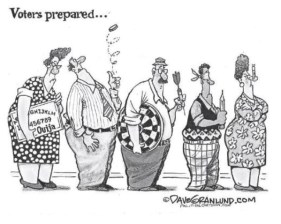
For anybody who is disgusted with the options they have for voting on November 8, I’d offer this cartoon from today’s Tennessean:

prepared-voters-cartoon

Pick who in this line you can identify with, but PLEASE vote!

[This post is an excerpt from an earlier blog post I entitled Mirror, Mirror, On The Wall, Who’s The Most Despicable Of Them All.]

Let me re-emphasize at this point how important it is that voters in this country focus on what is at stake in this election — at this critical juncture in our history, we have an opportunity before us to choose between two diametrically opposed ideologies, the tenets of which are expressed in the platforms of the Democrat and Republican parties [Democrat Party PlatformRepublican Party Platform]. We cannot afford to let ourselves get focused on the shortcomings of either candidate, because both of them are equally undesirable. It’s not about how we as individuals “feel”, regardless of how validly-based we believe our disdain for either or both candidates may be; it’s about the future we will be building for our children and grandchildren.

In previous posts to this blog [which can be read by simply scrolling down from here — they are in reverse chronological order (most recent to oldest)], I have spelled out in considerable detail the rationale for the fact that all possible scenarios that could exist on November 9 [the day after Election Day] will ultimately result in the ideological choice I’ve described here — and people who vote for anyone other than Donald Trump or Hillary Clinton [or who don’t vote] will have unwittingly voted for one of these two candidates — and it’s impossible for them to predict in advance which of the two they will have unwittingly voted for!

⇒ Think about that.  People who, in protest because of their disgust for the candidate on the ticket of the party with which they are most closely aligned ideologically, vote for anyone other than Clinton or Trump — or don’t vote at all — may be unwittingly actually voting FOR the candidate that is the source of their disgust!

So let’s step away from all the media hype and just look at what we actually know about each candidate’s shortcomings [i.e., not at how these shortcomings are characterized in the media — as Sgt. Friday of the 1950s Dragnet TV series would say, “Just the facts, Ma’am”].  I decided to list out in tabular form several issues [lying, corruption, derogatory remarks about entire segments of the U. S. population, etc.], and just put “yes” or “no” in each candidate’s column as to whether that issue or accusation applies to him or her [based on verifiable facts, not media characterizations].  You can look at the table at this link: Clinton-Trump Comparison Note: this table was developed weeks before the FBI announced that it is investigating new evidence about Hillary Clinton’s emails, Clinton Foundation “pay for play”, etc.].  What does this tell us? Nothing we couldn’t have figured out for ourselves by just ignoring media characterizations and filtering out “just the facts”: a) both of these candidates have serious personal character flaws; b) there is suspicion about the business dealings of both of them; and c) neither is the profile of person most of us would like to see occupying the Oval Office. That is exactly why we must put our personal likes and dislikes of the candidates [the people at the top of the two tickets] aside and vote for the party whose platform most closely meshes with our own worldview.

img_7026 img_7043

Charles M. Jones

Down The Stretch – 6

It’s six days to Election Day.  That means that seven days from today, the results of this presidential race, absent a 2000-like situation or the extremely unikely chance that neither Donald Trump nor Hillary Clinton won 270 Electoral College votes on November 8, will be known, and we will know who will take office on January 20.

For reasons I have described in detail in previous posts to this blog, the person heading for the White House will be one of the following:

… and will  NOT be any of these [the one on the right represents ALL write-ins]:

All registered voters need to know now that if they don’t want the above outcome on November 9, and if their vote has been, or will be on November 8, cast for any of the above “alternative choices”, or if they don’t vote, they will actually have voted unwittingly for either Trump or Clinton.  I beg anybody who is considering one of these “alternatives” [including the alternative of not voting], to reconsider now.  A week from today, it will be too late.

Thanks.

img_7026 img_7043

Charles M. Jones


Down The Stretch – 7

I’ve always been keenly interested in horse racing. Some of the most spine-tingling moments in media coverage of sports are in horse racing. Anybody who’s ever watched a race will probably remember when the announcer said “And they’re off!” as the starting gates swing open. Another thrilling moment is when the horses make the final turn and head down what’s known as “the stretch”, the final straight stretch of track in which clearly dominant leaders have often kept and perhaps lengthened their lead — or in which “middle of the pack” or even “dark horse” contestants establish leads and win the race “at the wire”. Different announcers articulate this latter moment different ways, but it’s always something like “and now it’s down the stretch!”

I decided to pick up on this terminology as a name for my final seven posts from now to November 8 because this race for the presidency started with a total slate of candidates [“the field” in horse racing] in the same range as the field in major horse races, and because it has been [and is, and I believe, will be right into Election Day] about as unpredictable as a horse race.  Each of these posts will be named Down The Stretch, followed by a declining number indicating the number of days left to Election Day.

In each of these posts, I will pick one major point of emphasis, one major theme, from either the posts I’ve made since starting this web site and blog a couple of months ago or the pages of the web site. If there is news unfolding during this time that warrants additional content, I will include commentary about that as well.

So here goes … the major point of emphasis for today is “It’s not about the people who are at the top of the tickets of their respective parties — it’s about the platforms [ideologies] of the parties they represent”.

It’s Not About The Candidates — It’s About The Party Platforms

This election is a clear choice between two ideological extremes, the tenets of which are expressed in the platforms of the Democrat and Republican parties.  If votes for candidates other than Trump or Clinton are insufficient to result in a Twelfth Amendment process for selecting the President and Vice President, those casting them [or refraining from voting] will have essentially voted for either Clinton or Trump, and there is no way they can predict in advance which one they will have unwittingly voted for.

Even if the Twelfth Amendment process is the outcome on November 8, the ultimate outcome will be the same — either a Republican or a Democrat will be the next President, so the ideological choice will still have been made.

The rationale behind all of this is contained in previous blogs.  If you haven’t read them, please do so.

Thanks.

img_7026 img_7043

Charles M. Jones

Back To The Future

In over a decade running my own businesses, and in over two decades as a senior executive in larger corporations, I developed and learned to use a technique for making decisions [particularly when they involved choosing from among several options] that I knew would have a significant impact on the company’s overall performance. That technique served me very well during the course of my career, not only in my business and employment situations, but in other areas of my life.  Using available supporting facts and incorporating whatever assumptions I had to make to fill in the gaps [which there always are], I would do the best I could to come up with the decision I thought was probably best. All decision-makers do that part, whether they describe it the same way I just did or with different words. The technique I would then apply would be to project, under the assumption that my chosen option had been the decision, what things would probably be like in six months, in a year, in three years, and in five years. In business, the accuracy of such projections reduces exponentially beyond three years, making projections beyond five years a somewhat useless endeavor.

However, much longer-range [decades into the future] impacts of this election can be projected with considerable accuracy because of the huge differences between Democrat and Republican philosophies in at least three areas: 1) long-range financial stability [how to overcome our debt situation and move in that direction]; 2) the ideological balance of the Supreme Court [what it should be]; and 3) world reputation and influence [again, what it should be].  We can predict now  before we vote — the very long-range impact of decisions the next President [and the Legislature and Supreme Court he/she will be working with] will make in these three areas — and frankly, if we don’t make the right decisions in these three areas, the accuracy of our decisions in other areas probably won’t matter much.

So let’s do some “back to the future” thinking here, using the title and logic of the famous 1985 movie in which the characters went back to the past, found a situation that clearly caused a problem that existed in their time, changed the circumstances [and therefore the outcome] at that point in the past, and then went “back to the future” to find the better result. Of course, we know that we can’t actually do that, so I will use my technique as described above in an attempt to depict the same overall scenario — i.e., we look forward a few decades into the future under the assumption that Clinton [any Democrat] won the 11/8/16 election, and then do the same thing under the assumption that Trump [any Republican] won.

Note: If you think there is some chance that a person who is not either a Democrat or a Republican can win, please see my previous blogs — even under the scenario in which neither Clinton nor Trump gets the required 270 Electoral votes on November 8, the end result will still be that the new president will be a Democrat or a Republican.  Nothing is ever absolutely certain, but for all practical purposes, the probability that any of the other candidates [or anyone else who is not a Democrat or a Republican] will ultimately be inaugurated as president on January 20 is zero.

Assumption A: A Democrat Became President on January 20, 2017

Long-Range Financial Stability

Probably at some point during the President’s first term, and most definitely within his/her second term if applicable, a true crisis will cause very drastic cost-cutting measures to necessarily be taken.  The window of opportunity for “kicking the can down the road” has almost closed already, but by then it will have long since passed.  The exact nature and form of the crisis is difficult to predict, but at least two of the outcomes are not — there will definitely be cuts to the Social Security benefits of current retirees, and for current Medicare beneficiaries, diminished benefit levels more than likely in addition to higher premiums.

Supreme Court

It is quite possible that Justice Ginsberg [who is 80] would retire in this situation, which along with the already-vacant seat of Justice Scalia, will create an immediate situation in which two liberal justices will be replacing one liberal [Ginsberg] and one conservative [Scalia].

If Justice Ginsberg doesn’t retire, the odds are substantial that she will die during the President’s first term, and they are even higher that she will die during his/her second term, if applicable.  In either event, the court will have shifted to the left even with one appointment by this President [Scalia’s replacement], and even farther left with two.

Justice Kennedy [generally left of center, but not always siding with liberals] is 80, and Justice Breyer [liberal] is 78. A Breyer replacement under this President would not affect the left-right mix [i.e., he would be replaced by another liberal], but a Kennedy replacement would shift the court clearly at least liberal-leaning, and it would remain that way for a generation.

Another key factor to consider regarding the Supreme Court is how President Obama has used Executive Orders to drive his policy positions. Although the number of his Executive Orders isn’t alarming vis-a-vis that of his predecessors, the scope of them is alarming.  If another Democrat is in the White House and Republicans are able to hang on to their majorities in both the House and the Senate, or if they retain House control but lose their Senate majority, the new president will face the same challenges as the current one.  Since Senate Republicans even in a minority could exercise the same “blocking by the minority” ability the Democrats have now, the Supreme Court could become the way the President could drive a liberal agenda.

World Reputation And Influence

Our reputation and stature on the world stage will continue to decline.  We will have clearly ceased to be considered a major power, maybe even a major influence.  This will be brought about both by continuation of the Obama foreign policies and by the huge financial problems that will literally be consuming our attention. It is almost a certainty that North Korea will be a nuclear power, and it is highly likely that Iran will be.

Assumption B: A Republican Became President on January 20, 2017

Long-Range Financial Stability

Although some painful financial decisions will have to be made during the President’s first term, they will be made [i.e., the “can” won’t continue to be “kicked down the road”].  If these decisions are made wisely, cuts to the Social Security benefits of current retirees will probably not be required, but cuts to benefits of future retirees will probably still be required [we’ve been “kicking this can down the road” for too many years already].  For current Medicare beneficiaries, diminished benefit levels may not be required, but it is likely that higher premiums, and probably a means-adjusted premium scale, will be necessary.

Supreme Court

Justice Scalia’s replacement will probably be considerably more conservative than any Democrat-appointed Justice would have been — at a minimum, he/she would be a strict constitutionalist.  Justice Ginsberg [who is 80] would not likely retire in this situation. If she doesn’t retire, the odds are substantial that she will die during the President’s first term, and they are even higher that she will die during his/her second term, if applicable, which along with the already-vacant seat of Justice Scalia, will create an immediate situation in which two conservative justices will be replacing one liberal [Ginsberg] and one conservative [Scalia].

In either event, the court will have shifted very slightly to the right even with one appointment by this President [Scalia’s replacement], and even farther right with two.

Justice Kennedy [general left of center, but not always siding with liberals] is 80, and Justice Breyer [liberal] is 78. A Breyer replacement under this President would not affect the left-right mix [i.e., he would be replaced by another liberal], but a Kennedy replacement would shift the court clearly conservative, and it would remain that way for a generation.

Many, probably most, of the Executive Orders Barack Obama used to drive his policy positions will be cancelled. The Supreme Court will then have to become the adjudicating mechanism in any reversals of direction those cancelations will require. It is unlikely that a Republican president will subsequently engage in as many congressional by-pass maneuvers as did Obama.

World Reputation And Influence

Our reputation and stature on the world stage will improve, but by how much remains to be seen.  We will definitely get back to being considered a major power, maybe even more of a major influence.  This will be brought about by a clear reversal of the Obama foreign policies and a more decisive leader in the White House, but what will remain unclear [until it becomes more evident] is the degree to which domestic financial problems can be averted fairly quickly [i.e., by getting us onto a more sustainable fiscal path], thereby giving us more capacity to deal with our international status.  Whether renewed American strength and more decisive leadership internationally can prevent or at least substantially delay North Korea and Iran becoming nuclear powers is not certain, but our level of influence in both of these situations will certainly be higher.

And In Either Case ..,

The two-dominant-party system, if not completely dead with their control over the election process totally gone, at a minimum will have lost even more of its influence. The far left wing of the Democrat Party [Sanders, Warren et al] will be even stronger if still within the party at all.  The far right wing of the Republican Party [Cruz et al] will be even stronger if still within the party at all.  The moderate / centrist segments of both parties will be much weaker if they are still in their current parties.  Even if they have merged to form another party, their influence will be lower than it is now if they are essentially all “Old Guard” politicians [McConnell, Pelosi et al] — perhaps not as much lower if their ranks include a significant element of younger, more visionary members.

To try and predict more specifically how all of this will infold would be pure conjecture at this point.  One thing is certain, though: what I have labeled in previous posts as the Trump/Sanders Phenomenon is not going away.  It is here to stay, and it will “evolve” and mature into whatever it is going to become — but in any event, it will have a dramatic impact on American Politics.

So we’re back to an underlying theme in all of my previous posts, and in the pages at this web site — it’s not about the people who are the candidates; it’s about the platforms [ideologies] of the parties of which they are a part.

Depending on how this week’s news unfolds, I may offer in my next post [which will be this week] a perspective on the 10/27 decision by FBI Director Comey to revisit the Clinton email scandal.
img_7026 img_7043

Charles M. Jones

A Closer Look At Who’s Dis’ing Trump [And Who’s Not]

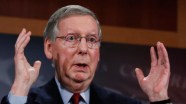
Paul RyanMItch McConnell

In my last post, I said that in this one I’d explore what I think is an interesting — perhaps unique since I haven’t observed any expression of it in the media — perspective on all the hype about how “devastating” recent revelations about Trump have been to his presidential campaign.

I don’t hear anybody saying Trump’s remarks about women in the 2005 tape NBC exposed are OK [and that’s the way it should be — they were terrible].  Interestingly, though, when I look at who seemed to be the quickest to openly denounce Trump [the candidate, not just the remarks themselves, which everybody is denouncing (and rightfully so)], it’s politicians who are pulling away from Trump — interestingly, not the most prominent among religious leaders who have been either openly backing him or at least referring to him as a better option than Clinton.

unknown-3unknown-1unknown-4unknown-2unknown

Think about that … Many people, including many Christians, might argue that religious leaders, particularly those who most Christians probably consider the best known and most influential ones, should all pull away from Trump because he is so “immoral” and isn’t a good role model for Americans and their children. So why would almost all of these key religious leaders maintain their previously-held positions on Trump [e.g., James Dobson, Franklin Graham, Tony Perkins, Jerry Falwell, Jr., Ralph Reed, Robert Jeffress, …]?  And what additional light might be shed on this by looking at which politicians are “running” from Trump and which aren’t?

unknown-5As I’ve reunknown-6ad and heard statements by two Tennessee Republican U. S. Representatives [Marsha Blackburn and Diane Black, both of whom are women, I should emphasize, and one of whom was a victim of physical assault by men as a young adult], neither of them is dis’ing herself totally from Trump. Both of these women seem to me to be principled people with sound value systems.  In what they’ve said and written, they’ve stated that they are standing with their party because their country is more important than “how they feel personally”.

It would be great if we had a personal profile and belief system description for each of the politicians who came out formally against Trump, withdrawing their endorsements, etc. — i.e., it would be interesting to see if most of them are principled people like Representatives Marsha Blackburn and Diane Black, or simply “say/do whatever is needed to get elected/re-elected” politicians.

As for the best-known, most influential religious leaders, we do have belief system descriptions for them — it’s the Bible.  Their statements after the Trump video exposure indicate their continued belief that the Republican platform and ideology are much more closely aligned with Christian values than is the Democrat platform and ideology, and that Christians need to view this election from that perspective regardless of their feelings about the candidates at the top of the tickets of the parties.

I believe the basic reason for this dichotomy between how Christians might expect these key religious leaders to react to Trump’s overall profile and how they actually do react to it is explainable in one word: perspective.  They realize what is at stake in this election, and as leaders they feel a responsibility to lead. In their view, leading in this context means communicating to people who have a level of respect for them and listen to what they have to say that Christians have the capacity numerically to be the deciding factor in the outcome of this election, and that this is a time when all Christians need to rise above their personal feelings and vote for the party most likely to at least begin to “right the American ship”.

It is important to note that these religious leaders are not saying that the solutions to America’s problems will stem from this election. Trying very hard to avoid any terminology that could be construed as formal endorsements, they are simply saying that the country’s moral decline will most certainly continue and even accelerate if we align ourselves with the Democratic platform [by voting in a way that essentially is a vote for the Democrats, or even by not voting — see previous posts to this blog as to why a vote for anybody other than Trump, or not voting, may actually be an unwitting vote for Clinton], and that the decline will at least have a chance of decelerating — and maybe even beginning to stop — if we align ourselves with the Republican platform.

A recent FaceBook post that got to my Newsfeed through indirect Friend connections expressed this very well. The person said “I am not defending Trump, I’m voting for him. I’m defending America against Hillary Clinton, who will fundamentally do much more damage to our beloved country than Trump will” [emphasis mine].

If Democrats win this election, it will be because of five factors: 1) they came together and supported their candidate whether they “liked” her or not, and in spite of her many shortcomings [while the Republicans scattered themselves in all directions and openly denounced their candidate rather than finding tactful ways to coalesce around him]; 2) they used their vastly superior [to the Republicans’] campaign and election process management “machine” to figure out precisely where to spend their campaign energy to maximize their probability of getting 270 or more Electoral College votes; 3) the heavily liberally-biased media was essentially another forceful arm of their campaign; 4) the same percentage of Christians who voted Democrat in 2008 and 2012 [something that is very difficult for me to understand in view of the Democrat platform] did so again this year; and 5) other Christians [Republicans, Independents, Democrats, or whatever] who align more closely with the Republican platform and ideology than they do with the Democrat platform and ideology either stayed home or voted for anyone other than Trump.

So we’re back to an underlying theme in all of my previous posts, and in the pages at this web site — it’s not about the people who are the candidates; it’s about the platforms [ideologies] of the parties of which they are a part.

The bottom line of all this is that the “he said / she said, he did / she did” battle is a toss-up from this perspective [see my last post, Mirror, Mirror On The Wall] — all the more reason to make November 8 ballot decisions based on party platforms [and maybe even factoring in the profiles of the vice presidential candidates], not the attributes of, or the personal issues associated with, the presidential candidates.

I’ve entitled my next post Back To The Future.  In it, I’ll describe a decision-making technique I found very useful during my career, and apply it to the decision before us at this time.

img_7026img_7043

Charles M. Jones

Mirror, Mirror, On The Wall, …

Mirror, Mirror, on the wall, who’s the least despicable of them all? …

Well, the campaign is in its final stretch. We can be sure that probably well over 90% of what we will see, hear and read in the media between now and November 8, whether in news and commentary or in paid advertisements, will be four things:


2016-dem-platform-2160302005451-trump-and-hillary-large-169platform-blog-header_1468871768_content_consumption_large

Mirror, Mirror, on the wall, who’s the least despicable of them all? …

Well, the campaign is in its final stretch.  We can be sure that probably well over 90% of what we will see, hear and read in the media between now and November 8, whether in news and commentary or in paid advertisements, will be four things: 1) each candidate trying to convince us that the other candidate is more despicable than he/she is [thereby making him/her the least despicable, and therefore the better choice]; 2) poll results showing who is “ahead” [with heavy focus on “swing states”]; 3) fact-checking and “interpretation” stemming from statements the candidates make and/or newly uncovered evidence of their shortcomings; and 4) talking head pundits, from their vast pool of knowledge and wisdom, telling us, the ordinary people who need their wise counsel, what all of this means.

Wouldn’t it be great if the technology existed to weed out all the “voting for Trump [or his party] no matter what” and “voting for Clinton [or her party] no matter what” voters and just do targeted advertising [through social media, snail mail, email, blogs, etc.] to people who are likely to vote but are still trying to figure out how they should vote. That would spare the 2/3 of us who are more decisive from being “road kill” in the wake of billions of dollars being spent on negative broadcast ads and force the pain of those ads onto the 1/3 of voters who can actually be swayed by them — but who, I’m sorry to say, will probably determine whether our next president is Hillary Clinton or Donald Trump [or more importantly, whether the Democrat Party ideology (platform) or the Republican Party ideology (platform) will guide the direction of our country].

There is an important “undercurrent” in all of the media buzz going on this week since NBC’s release just prior to the October 9 debate of the vulgar and disgusting 1995 videotape of a Trump discussion with one of its show hosts. It should be obvious to anybody watching or listening to almost any news/commentary show, or reading almost any newspaper or magazine, that most of the entire media world is heavily liberal-leaning at best, or completely in the tank for Hillary Clinton at worst. Rapidly-growing and equally damaging and derogatory information about Clinton during that exact same time period [scandal after scandal, newly released emails, etc.] gets little coverage [if any mention at all], but every detail any reporter can muster about that one thing about Trump is plastered across front pages of newspapers and scrolled across TV screens as “breaking news”.

A Special Note To Women

Before I move on to my continuing emphasis on why this is a critical election and why our votes in it need to be for parties, not necessarily for the people at the top of their tickets, there’s something I’d like to say to people — particularly women — who are so disgusted with Trump’s remarks in the 1995 video that they are really struggling with voting for him even though they are more closely aligned with his party’s platform than they are with Clinton’s party’s platform.  I do not in any way want to seem insensitive to those people [again, particularly those among them who are women] in the remarks I will make here or in future posts to this blog.  I fully understand how deeply some people, particularly women — and even more particularly women who have personally experienced that kind of interaction with men — may feel about the remarks Trump made. But this is a time when all of us need to make our thoughts about our country more important than our thoughts about ourselves and our personal feelings.

Let’s Keep Focused On What’s At Stake

Let me re-emphasize at this point how important it is that voters in this country focus on what is at stake in this election — at this critical juncture in our history, we have an opportunity before us to choose between two diametrically opposed ideologies, the tenets of which are expressed in the platforms of the Democrat and Republican parties [Democrat Party PlatformRepublican Party Platform]. We cannot afford to let ourselves get focused on the shortcomings of either candidate, because both of them are equally undesirable. It’s not about how we as individuals “feel”, regardless of how validly-based we believe our disdain for either or both candidates may be; it’s about the future we will be building for our children and grandchildren.

In previous posts to this blog [which can be read by simply scrolling down from here — they are in reverse chronological order (most recent to oldest)], I have spelled out in considerable detail the rationale for the fact that all possible scenarios that could exist on November 9 [the day after Election Day] will ultimately result in the ideological choice I’ve described here — and people who vote for anyone other than Donald Trump or Hillary Clinton [or who don’t vote] will have unwittingly voted for one of these two candidates — and it’s impossible for them to predict in advance which of the two they will have unwittingly voted for!

⇒ Think about that.  People who, in protest because of their disgust for the candidate on the ticket of the party with which they are most closely aligned ideologically, vote for anyone other than Clinton or Trump — or don’t vote at all — may be unwittingly actually voting FOR the candidate that is the source of their disgust!

So let’s step away from all the media hype and just look at what we actually know about each candidate’s shortcomings [i.e., not at how these shortcomings are characterized in the media — as Sgt. Friday of the 1950s Dragnet TV series would say, “Just the facts, Ma’am”].  I decided to list out in tabular form several issues [lying, corruption, derogatory remarks about entire segments of the U. S. population, etc.], and just put “yes” or “no” in each candidate’s column as to whether that issue or accusation applies to him or her [based on verifiable facts, not media characterizations].  You can look at the table at this link: Clinton-Trump Comparison.  What does this tell us? Nothing we couldn’t have figured out for ourselves by just ignoring media characterizations and filtering out “just the facts”: a) both of these candidates have serious personal character flaws; b) there is suspicion about the business dealings of both of them; and c) neither is the profile of person most of us would like to see occupying the Oval Office. That is exactly why we must put our personal likes and dislikes of the candidates [the people at the top of the two tickets] aside and vote for the party whose platform most closely meshes with our own worldview.

So if you’re considering a “protest vote” for somebody other than Trump or Clinton, or just not voting, consider this: check the “party ticket” item in the voting booth to vote for the entire slate of candidates in races in your precinct for the party with whose platform/ideology you most closely identify.  Maybe that will mitigate whatever stigma you may attach to casting your vote for the person at the top of that party’s ticket — and you will have 1) done your country a service and 2) made yourself feel better by not specifically checking the box by a candidate you can’t bring yourself to vote for as a person.

In my next post, I’ll explore what I think is an interesting — perhaps unique since I haven’t observed any expression of it in the media — perspective on all the hype about how “devastating” recent revelations about Trump have been to his presidential campaign.

img_7026

Charles M. Jones

It’s not about the candidates — it’s about the parties (Part 2)

People who vote for anyone other than Donald Trump or Hillary Clinton — or who don’t vote — will have unwittingly voted for one of these two candidates. So when the polls close on November 8, we still will have made a choice between two ideological extremes, the tenets of which are expressed in the platforms of the Democrat and Republican parties.

In Part 1, I outlined the only three possible situations that could even theoretically exist on 11/9/16: 1) Hillary Clinton won 270 or more electoral votes and is President Elect, 2) Donald Trump won 270 or more electoral votes and is President Elect, or 3) neither Clinton nor Trump won 270 or more electoral votes, which according to the Twelfth Amendment, has moved responsibility for selecting our next President and Vice President to the House of Representatives and Senate, respectively.  I also pointed out why regardless of which of these is the outcome, the ultimate result will be the same — i.e., we will have made a choice between two ideological extremes, the tenets of which are expressed in the platforms of the Democrat and Republican parties. Furthermore, I outlined why people who vote for anyone other than Donald Trump or Hillary Clinton — or who don’t vote — will have unwittingly voted for one of these two candidates.

Also in Part 1 of this post, I said I would include in this Part 2 a simple table that boils the “planks” from the platforms of the two parties down to their ideological/philosophical positions on ten issues that I think most people would agree highlight the extremes of their two ideologies. Click on this link to display that table:  Party Philosophy Comparison.  To access the full party platforms themselves [which I suggest in the table that you also read], follow these links: Democrat Party Platform; Republican Party Platform.

In this Part 2, I will provide more detail on Situation #3, which is unlikely but not impossible, and also consider in more depth the question I posed at the end of Part 1: “Why would any citizen of this country take an action [or refrain from taking an action available to them] that they know in advance might actually throw their support toward an election outcome they don’t want?”.

Situation #3 is described in more depth in the section A Closer Look At Outcome #3 below. The significance of this scenario, however, in this election, is simply that the ultimate result of outcome #3 will not be appreciably different from either outcome #1 or #2 — i.e., people who vote for anyone other than Donald Trump or Hillary Clinton — or who don’t vote — will have unwittingly voted for one of these two candidates.  So when the polls close on November 8, we still will have made a choice between two ideological extremes, the tenets of which are expressed in the platforms of the Democrat and Republican parties [see links referenced above].

So What Influence Can Non-Trump / Non-Clinton Votes, or Not Voting, Have?

The only possible influence either voting for anybody other than Clinton or Trump, or not voting, could have is to throw the election to the House of Representatives [Situation #3 above].  If these votes are insufficient to produce that outcome, those casting them [or refraining from voting] will have essentially voted for either Clinton or Trump, and there is no way they can predict in advance which one they will have unwittingly voted for.

So back to the question “Why would any citizen of this country take an action [or refrain from taking an action available to them] that they know in advance might actually throw their support toward an election outcome they don’t want?”.  I can think of no other reasons than these: 1) not understanding the current process for electing a president [what we would like that process to be is irrelevant for this election]; or 2) allowing how he/she “feels” about voting for Clinton or voting for Trump to govern his/her voting decision, rather than choosing between ideologies that will determine what kind of country we will be a generation from now. Before moving on to an expanded description of situation #3 [see opening paragraph of this post], I would like to suggest consideration of the following facts I gleaned from a recent article in USA Today [original sources, which I consider credible, were quoted within the article]:

  • More than 92 million Americans who were eligible to vote four years ago didn’t vote. This is more than eighteen times Barack Obama’s margin of victory over Mitt Romney. The highest rate of voter turnout since World War II was 63.8% in 1960. It spiked again to 61.6% in 2008.
  • More than eight in ten say they are following news about the candidates closely [the highest level of interest in a quarter century]. Eight in ten say they have thought “quite a lot” about the election. Three of four say it “really matters” who wins.
  • Two-thirds call the tone of the campaign too negative, and only four in ten are satisfied with their choices [the lowest level in two decades]. Just one in ten say either candidate would make a good president. Four in ten say neither would. “It’s not: ‘How much do I like these people?'” says Jan Leighley, an American University professor and co-author of Who Votes Now? Demographics, Issues, Inequality and Turnout in the United States. “It’s: ‘Does it make a difference between this person I do not like as opposed to that person I do not like?'”

And by the way, for anybody who thinks there are no dishonest practices involved in our elections, consider at least these two recent revelations: 1) a recent Washington Post article revealed that a World War II veteran who died in Virginia in 2014 registered to vote in September 2016; and 2) there is a huge drive underway in Arizona to get masses of Latinos registered to vote.

A Closer Look At Outcome #3

I said above that I would get into a little more depth as to why the ultimate result of outcome #3 would not be appreciably different from either outcome #1 or #2 — i.e., we still will have made a choice between two diametrically opposed ideologies, the tenets of which are expressed in the platforms of the Democrat and Republican parties.  First, let’s look at the process itself.

As outlined in the Twelfth Amendment, if no candidate receives a majority of Electoral votes, the House of Representatives elects the President from the 3 Presidential candidates who received the most Electoral votes. Each state delegation has one vote. The Senate would elect the Vice President from the 2 Vice Presidential candidates with the most Electoral votes. Each Senator would cast one vote for Vice President. If the House of Representatives fails to elect a President by Inauguration Day, the Vice-President Elect serves as acting President until the deadlock is resolved in the House [Source: Archives.gov].

So back to what outcome #3 actually means in the context of the decision that we will have made after the above process has been followed. … If the outcome on November 8 is #3, it will be because of one or more unusual factors in this election.  Those factors are numerous, and are reasons for doubting “tradtional” ways of predicting election outcomes, but the bottom line is that either a Democrat or a Republican will be POTUS, more than likely a Republican.

If this situation occurs, a very interesting choice will have to be made by each of our Representatives and Senators — to cast their vote for either: 1) the person scores of millions of people in their party voted for; or 2) another person a majority of the politicians in the Legislature feel they can align with.

Unless this election also results in a huge shift in the percentage of Democrats in the House [which even Democrats aren’t predicting], the next POTUS, under situation #3, will be Donald Trump unless Democrats can convince 30 Republicans to join with them to elect Hillary Clinton. Despite the rhetoric among some Republicans and the number of them who are distancing themselves from Trump, it is highly unlikely that they would go so far under these circumstances as to actually cast this vote for Hillary Clinton. I suppose it is also remotely possible that the POTUS elected under this scenario could be Gary Johnson — assuming he receives at least one more electoral vote than Jill Stein — but it is difficult for me to imagine a House majority going in that direction.

In the highly politicized and polarized environment that exists today, there is some possibility that “back-office, smoke-filled room” bargaining among Representatives and Senators [e.g., in “gaming” quorum rules applicable to this process] could produce some other outcome. The probability of that scenario unfolding is extremely remote in my opinion — almost nil — so I’m not “fleshing it out” as I did situation #3.

Overall Conclusion for Parts 1 and 2

Bottom line: 1) this election is a clear choice between two ideological extremes, the tenets of which are expressed in the platforms of the Democrat and Republican parties; and 2) if votes for candidates other than Trump or Clinton are insufficient to result in a Twelfth Amendment process for selecting the President and Vice President, those casting them [or refraining from voting] will have essentially voted for either Clinton or Trump, and there is no way they can predict in advance which one they will have unwittingly voted for.  Never in my lifetime has an election had this much weight in determining what America will be a generation into the future.

Version 2img_7026

Charles M. Jones

It’s not about the candidates — it’s about the parties (Part 1)

Does the title I gave this blog post sound crazy? I’ll attempt in this post (Part 1) and my next post (Part 2) to make it sound not only NOT crazy but perfectly sensible in the context of making an informed decision about “who” [or more importantly, “what”] to vote for in this election [or whether to vote at all].

Does the title I gave this blog post sound crazy? I’ll attempt in this post (Part 1) and my next post (Part 2) to make it sound not only NOT crazy but perfectly sensible in the context of making an informed decision about “who” [or more importantly, “what”] to vote for in this election [or whether to vote at all].

First, if you think it’s possible that on November 8 [election day] any candidate other than Donald Trump or Hillary Clinton will get the 270 electoral votes required to make him/her our next president, all I can do is ask you to study the matter further. If you do that, you will find that you are wrong [almost any credible source of information on election history and the current mechanism in place to elect a president will help you get to that point, including my past blog posts and several of the pages on this web site].

Part 1

I often hear remarks like “I can’t bring myself to vote for ‘that man’ / ‘that woman’ “, and there is frequent reference in the media to Never Trump and Never Hillary constituencies and the historically record-setting unpopularity of both of these candidates.  I’ve mentioned in previous posts that people in these camps need to realize that this election is not about them and how they feel — it’s about the future of America.

Let’s look at all situations that could even theoretically exist on November 9 [or a few days / weeks later if there is a 2000-like situation, but in any event, fairly soon after November 9], and what the ultimate outcome would be in each situation.  The possible situations are the following:

  1. Hillary Clinton won 270 or more electoral votes, regardless of whether or not she won the popular vote. She will be sworn in as POTUS at noon on January 20.
  2. Donald Trump won 270 or more electoral votes, regardless of whether or not he won the popular vote. He will be sworn in as POTUS at noon on January 20.
  3. Neither Clinton nor Trump won 270 or more electoral votes.  This is extremely unlikely, but not impossible. It has not occurred in the last 192 years, and has occurred only twice in our entire 240 year history [1800 and 1824]. There was controversy around the electoral vote counts the 1876 election, too, but the process for resolving that controversy was not the same. In this situation #3, the responsibility of selecting our next POTUS falls on the House of Representatives, and the responsibility of selecting our next VPOTUS falls on the Senate. The details of this outcome will be covered in Part 2 under the heading A Closer Look At Outcome #3.

If either #1 or #2 is the outcome, we will have made a choice between two diametrically opposed ideologies, the tenets of which are expressed in the platforms of the Democrat and Republican parties.  As I said above, it is extremely unlikely that situation #3 will be the outcome — but since it’s not impossible, I’ll take a closer look at it in Part 2.  I’ll proceed at this point, however, under the assumption that the outcome is either #1 or #2, because the ultimate result of outcome #3 will not be appreciably different from either outcome #1 or #2 — i.e., people who vote for anyone other than Donald Trump or Hillary Clinton — or who don’t vote — will have unwittingly voted for one of these two candidates.  So when the polls close on November 8, we still will have made a choice between two ideological extremes, the tenets of which are expressed in the platforms of the Democrat and Republican parties.

In Part 2 of this post, I will include a simple table that boils the “planks” from the platforms of the two parties down to their positions on about ten issues that I think most people would agree highlight the extremes of the two ideologies. Every citizen of this country should become familiar with these party platforms, because in this election, we will be deciding which of these two platforms we align with as a country, and therefore what direction we want to take going forward.

If the candidate you voted for is elected on November 8, you can be happy that our chosen path aligns with his/her [and one would think, your] party’s platform.  If you unwittingly [see A Closer Look At Outcome #3 in Part 2] voted for the candidate that was elected but do not align with his/her party’s platform, you were among those who caused that candidate’s party to prevail, so you bear part of the responsibility for that outcome and will need to live with it even though it was not your preference.

If the candidate you voted for is not elected, you will need to live with movement in the direction of the winning candidate’s party’s platform even though you [one would think] disagree with it.  If this is the outcome, it would behoove all who fit in this category to do everything they can to make the next president a one-term president.  In at least one respect [composition of the Supreme Court], the potential impact of the 2020 election outcome will be much less significant than the outcome on 11/8/16.  By 2020, composition of the Court will definitely have shifted considerably in the direction that is in alignment with the 2016 winning party’s ideology, and it’s quite possible that it could already be set in that direction for a generation [thereby making the 2020 election ineffective from this perspective].  Nonetheless, at least you could say that limiting his/her term to one would be better than acquiescing to eight more years [from now] of current policies and direction.

So the question I would ask is “Why would any citizen of this country take an action [or refrain from taking an action available to them] that they know in advance might actually throw their support toward an election outcome they don’t want?”. I’ll get into that in more depth in Part 2, and I’ll also get to the expanded description of Situation #3 I promised above.  For now, I’ll close this post with what mathematicians write when they have demonstrated a hypothesis to be correct — Q.E.D. [an abbreviation for the Latin phrase quod erat demonstrandum, which means “That which was to be proven”].

img_7026

Charles M. Jones

Binary Party Affiliation Choices — We Need Something Better

democraticlogoquestion-markrepublicanlogo-svg

Why are you a [Democrat, Republican, Libertarian, Independent, … pick your poison]?

Version 2One of the ten long term trends John Naisbitt identified in his 1982 book Megatrends that is being heralded now as being “right on” was “[a] society [
that] is changing from a narrow ‘either/or’ perspective with a limited range of personal choices to one of ‘free-wheeling’ multiple options”. One realm in which this prediction has not moved as rapidly to reality as it has in many areas is the political arena.

Although third party options were available at the time Naisbitt’s book was written, the fact is that no third-party candidate has ever won a U.S. presidential election. The strongest showing for a third-party candidate came in 1912, when former President Teddy Roosevelt left the Republican Party. He ended up coming in second, with 27.4 percent of the popular vote and 88 electoral votes. It’s generally agreed that Roosevelt’s 1912 candidacy took votes away from the Republican candidate, incumbent President William Howard Taft, allowing Democrat Woodrow Wilson to win with just 41.8 percent of the popular vote. Many say third-party candidate Ralph Nader played a “spoiler” role in the 2000 election. Running to the left of Democrat Al Gore, Nader received 97,488 popular votes in Florida, a state Republican George W. Bush won by just 537 votes. If most of the Nader supporters had voted for Gore instead, Gore would have won Florida’s 25 electoral votes, and he would have been elected president instead of Bush [1].

So the bottom line is that a vote for a third-party [or write-in] candidate has historically been a vote for the incumbent-party candidate. However, if a major paradigm shift is in fact underway now, as I believe it is, the current polls can be misleading. I believe that trying to apply past statistics to this election is a useless process.

At this writing, the Republican and Democrat candidates are virtually tied — polls show that either party’s candidate’s lead is within the statistical margin of error. Support for all alternative candidates, collectively, accounts for about 10% of the people polled [2]. If the alternative-candidate support is pulling from both major-party candidates equally, the race is still a toss-up; if it is pulling more from one than the other [particularly if prevalently so in the so-called “swing states”], that segment alone can determine the outcome of this election. The interesting thing about a paradigm shift is that nobody, even “experts”, can accurately predict where within this range actual election-day votes will fall.

A major problem at this time is that the campaigns of the organized political parties, all of which are largely tied to the Current [I would say, Old] Paradigm, are not equipped to operate under the New Paradigm that is rapidly [exponentially] unfolding. In polls, people are asked whether they are Liberal or Conservative, Democrat or Republican, for or against a particular issue, etc. — binary, either/or, current/old paradigm choices. It would be great if people could indicate where they are on a far left to far right scale on each of, say, ten specific issues, with their answers resulting in mapping to a specific point on a left-to-right spectrum. Such a system would be even better if each person could then form his/her own “custom-tailored party”, or CTP — i.e., connect [through emails and/or texts and/or web/app interaction designed by that “custom-tailored party”, or probably more efficiently through existing social media like FaceBook, Twitter, etc.] with everybody who is within some plus or minus “band” around his/her position on the left-to-right spectrum.

In this CTP system, it might also be advisable to allow each person to place a weight on each issue. This weight could be 1, 2 or 3, with 2 meaning average weight for that person, 1 meaning less important / critical than his/her average and 3 meaning more important / critical than his/her average.

As an example of how this would work, I designed a prototype model to do the computations for ten issues [3], and I entered my selections for each issue. On a 5-left to 5-right scale, and using a weight of 2 on all issues, my point on the left-right spectrum is 2.4 right. For perspective, the most enthusiastic Bernie Sanders supporters in this election would probably find themselves at least between 4 and 5 left, maybe all the way to 5 left. Most people who identify very closely with the Tea Party wing of the Republican Party would probably find themselves at least between 4 and 5 right, maybe all the way to 5 right.

So to use Naisbitt’s terminology, how would this new multiple-option system be better than the current either-or system? Our current government has become dysfunctional because of party polarization [see the Dysfunctional Government page in the The Situation Today section of this web site]. Lawmakers in both of the major parties tend to flock together and vote along party lines. This is why Republicans can’t move legislation that can easily pass the House through the Senate and on to the President — the Senate minority can, in effect, ensure that bills the Democratic party opposes never even get voted on in the Senate. In the rare cases where a bill is opposed by most Democrats but manages to get through the Senate, the President can veto it — and the odds are heavily against a veto override because whatever bipartisan support it had would not likely have included the number of Democrats that would be needed for an override.

This new CTP system would have both short term and long term advantages over the current dysfunctional system. Under this system, elected officials’ “bases” [died-in-the-wool, no-matter-what supporters] would no longer be as easily identifiable, making it much more difficult for them to pander to these “bases”. Also, “blocks” [groups that tend to vote heavily in favor of one party or the other] like Blacks, Whites, Hispanics, LGBTs, Labor Unions, Evangelical Christians, Rural, Urban, etc., would probably not be as monolithic in their voting patterns, because the people in these “blocks” would feel less need to formally affiliate with organizations that ostensibly represent their interests and concerns.

In the short term, this system would require elected officials to pay closer attention to a wide range of CTPs rather than assuming that their traditional party “bases” and the “blocks” that traditionally vote for their parties are securely in their camps.

Longer term, this CTP system would greatly diminish the power and influence of traditional parties, possibly even ultimately rendering them completely obsolete. Perhaps even more importantly, it would set the stage for ensuring that better slates of candidates make it into races in the first place — because money and “connections” would play a much smaller role in a person’s decision to run for office. This, in turn, would result in a dramatic increase in the ability of elected officials to find common ground on which compromises could be negotiated.

I am actually trying to find ways to develop and implement an app / web site that can provide exactly this capability, with the goal of ultimately using existing social media as at least part of if not the main communication mechanism within CTPs. If this effort is successful, readers of this blog will be among the people given the opportunity to participate in the development process. Meanwhile, I would welcome any feedback anyone would like to offer on the concept.

If the app / web site then gains some traction and becomes widely used, it could become a key component of the New Paradigm developing at this time. If I am unable to actually bring this about, it is my sincere hope that by introducing the concept, I am making a meaningful contribution to the development of a better future system than the current dysfunctional one.

Footnotes

  1. Source for the historical summary in this paragraph: http://www.cnn.com.
  2. Source: http://www.RealClearPolitics.com.
  3. The 10 issues were: Abortion, Marriage, Defense, Education, Social Security, Medicare, the ACA, Budget, Law Enforcement, and Capital Punishment. An example of far-left / far-right extremes [using Abortion]: 5 left, “Abortions should be available on demand for any reason and at any point in a pregnancy, and government funding should be available to any woman who wants one but cannot afford it”; 5 right, “Abortions should be illegal with one exception: when a choice must be made between the life of the unborn child and the life of the mother”.

[Note … If you haven’t read my Introduction To USAparadigm.com blog post and the Home Page of USAparadigm.com, I strongly urge you to do so. This and all subsequent posts will make more sense to readers familiar with that introductory information.]

img_7026

Charles M. Jones

Accountability

I am confident that a major paradigm shift [as described in one of the pages on this site] is underway in this country. There are many factors driving this shift [described throughout this site], a major one of which is that a growing number of Americans of all political persuasions and party affiliations are simply fed up with the current paradigm [how things currently work]. One of the main things they are fed up with is the lack of accountability in government. This post is on that topic.

IMG_7043.jpgI am confident that a major paradigm shift [as described in one of the pages on this site] is underway in this country.  There are many factors driving this shift [described throughout this site], a major one of which is that a growing number of Americans of all political persuasions and party affiliations are simply fed up with the current paradigm [how things currently work].  One of the main things they are fed up with is the lack of accountability in government.  This post is on that topic.

To illustrate the point, I’ll use a brief tidbit of history that is in stark contrast with what we see routinely nowadays in news stories. …

On June 6, 1944, nearly 3 million Allied troops readied themselves for one of the greatest military operations in world history — D-Day, and the ensuing push that led to Hitler’s defeat.  At least 160,000 of those troops landed on the shores of Normandy, France. As they stormed the beaches, General Dwight D. Eisenhower’s confident words summed up the incredible significance of their mission:

“You are about to embark upon a great crusade, toward which we have striven these many months. The eyes of the world are upon you,” he wrote in a famous letter sent to troops before the assault. “We will accept nothing less than full victory! Good Luck!”

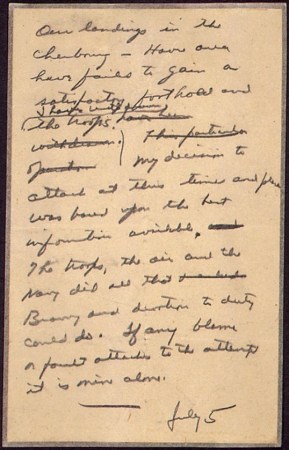
But there’s another letter that he set aside in case of failure. What if we lost? General Eisenhower had doubts in the face of a “well trained, well equipped and battle-hardened” enemy. If the invasion of Normandy had failed, this is the message he would have relayed to the public [the image displayed in this post is from his actual handwritten note]:img_7069

“Our landings in the Cherbourg-Havre area have failed to gain a satisfactory foothold and I have withdrawn the troops. My decision to attack at this time and place was based upon the best information available. The troops, the air and the Navy did all that Bravery and devotion to duty could do. If any blame or fault attaches to the attempt it is mine alone” [emphasis mine]. [He accidentally dated the letter July 5; it was, of course, June 5 when he scratched out this draft.]

Of course, we know that this “defeat speech” was not needed, and the success of that mission might very well have changed the course of human history for the better because it is viewed by most military experts as the turning point in the Allies’ efforts to keep Adolf Hitler from achieving his evil dreams of world domination.

I introduced this blog post with that bit of history for one reason — to use Eisenhower’s “defeat speech” as a standard against which to measure accountability nowadays, clearly showing that the very concept of accountability has practically disappeared from our leadership since Eisenhower’s time.  I’m not touting Eisenhower or trying to say that he was perfect, but I do believe he was part of a generation that understood what accountability means, how it should be expected to play out in a particular situation, and why that view of it is important.

General Eisenhower knew very well the magnitude of the “go/no-go” decision he needed to make on June 5, 1944. A major storm was headed in the direction of the beaches where the invasion would occur. If he delayed for a day or two, the element of surprise would be compromised.  If the brunt of the storm hit at just the wrong time during the invasion, numerous logistical elements of the attack could go wrong, increasing the number of casualties and decreasing the chances of success.  He no doubt had detailed estimates of the huge number of casualties there would be even if everything went well. All of this was a tremendous weight to bear.

He knew that if the invasion was successful, he would share in the fruits of that success — and that if it failed, he would have to absorb the blame and perhaps become a scapegoat. Two important points deserve emphasis here: 1) he made a decision, rather than waffling, saying he couldn’t get the information he needed [thereby subtly shifting the blame to others], etc.; and 2) he decided up front that he would step up and be accountable for failure if that was the result of his decision.

In today’s environment, many generals, and practically all elected officials, would probably have drafted a statement something like this:

“Our landings in the Cherbourg-Havre area have failed to gain a satisfactory foothold, and our troops have been withdrawn. The decision to attack at this time and place was based upon the best information our resources could provide. Our brave troops performed as was expected of them in all respects. We regret that lives were lost in the process, and we are determined to continue our fight to … blah blah blah”.

Lois Lerner, the IRS official who was behind the targeting of certain organizations for IRS scrutiny, said “I did nothing wrong” and then invoked her 5th Amendment rights in all the rest of her “testimony” — and then retired with full pension.  No high-level [or even lower-level, it appears] Veterans Administration officials to date have been fired as a result of clearly gross mismanagement over many years.  These are just two examples that are representative of items in a seemingly endless list of situations demonstrating that nobody in government is being held accountable for their performance.

Perhaps the saddest part of this story is that millions of Americans [more than the number by which most presidential elections are won] don’t seem to care about this.  They will make their voting decisions based on little if anything more than their perception of which candidate will dispense the most “goodies” described as “free”.

I honestly hope that the new paradigm unfolding in America will fully “flesh itself out” in this election.  If we end up electing the candidate who will stay our current course, the developing paradigm may be short-lived, and another may take its place — but unfortunately, I fear, even if that new paradigm is better than the currently-unfolding one, not until the damage done to our country has passed the point of no return.

IMG_7026.jpg

Charles M. Jones

Sources: in this blog post, most of the factual information, as well as a few text excerpts in the opening paragraphs, are from past posts at http://www.CNN.com and http://www.BusinessInsider.com

[Note … If you haven’t read my Introduction To USAparadigm.com blog post and the Home Page of USAparadigm.com, I strongly urge you to do so. This and all subsequent posts will make more sense to readers familiar with that introductory information.]